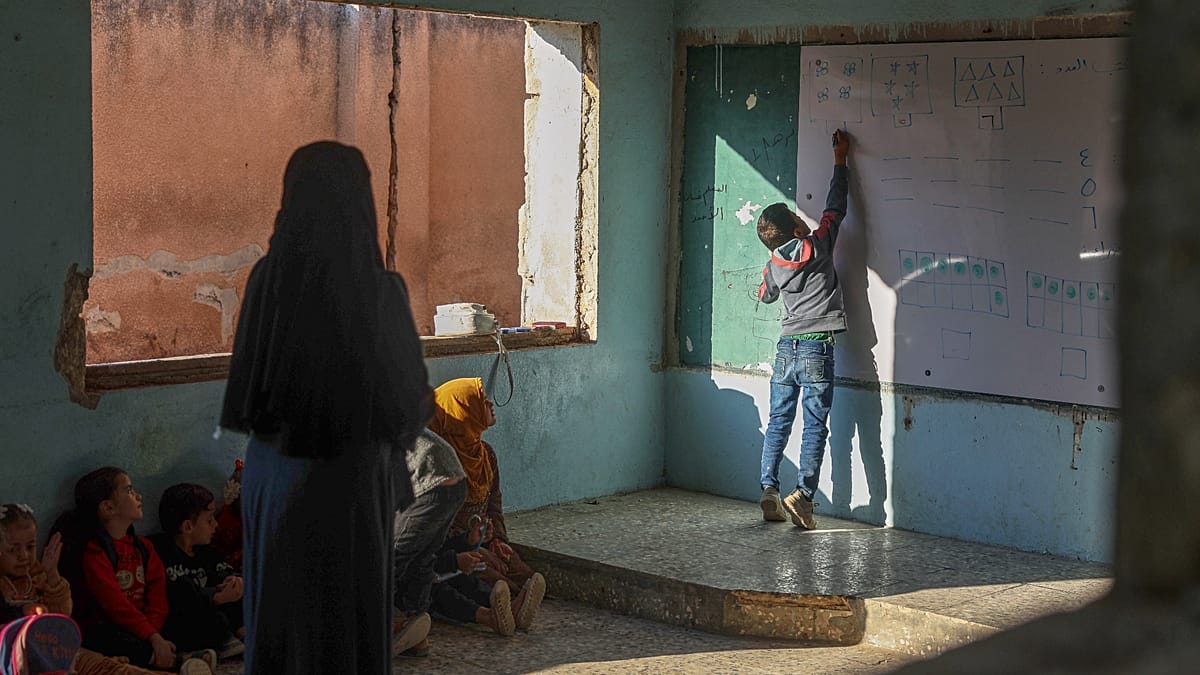
When Syrian pupils opened their new textbooks this autumn, few may have noticed the subtle edits: a hijab added to a female doctor on one page, a pharaonic statue dressed in a striped shirt, the Mona Lisa gone entirely. But on social media, a wave of comparisons between old and new editions has ignited a fierce debate over what the Ministry of Education's revisions really mean for how a generation learns about its past and its society.
The changes go far beyond cosmetic tweaks. Textbooks for several grades, including the sixth-grade "Social Studies" book first issued in 2012–2013, have been reissued with lessons on local administration, political life, citizenship, the media and democratic participation removed or rewritten. Images have been digitally altered using Photoshop: female figures have been given hijabs or long robes, some photographs of women have been deleted entirely, and statues and artworks have been covered or replaced.
Rewriting history, one image at a time
The most contentious edits involve historical figures. The Phoenician princess Elissar, legendary founder of Carthage, has been replaced in one textbook by a digitally modified portrait that covers her chin and neck—a move critics see as imposing contemporary ideological standards on an ancient era. A pharaonic statue now wears a striped shirt that many users likened to a prison uniform, prompting ridicule and disbelief.
More seriously, the new history books have removed prominent national and pan-Arab figures. Sultan Pasha al-Atrash, a leader of the Great Syrian Revolt against French rule, has been replaced by Sheikh Saleh al-Ali, a figure associated with a different region and sect. The photograph of Egyptian president Gamal Abdel Nasser has also been dropped. Activists have pointed to passages that now describe the "martyrs" executed on 6 May 1916 by Ottoman governor Jamal Pasha—known as the Butcher—as "agents of Britain and France," a stark reversal of their traditional portrayal as heroes of the national movement.
Even maps have been altered: the district of Iskenderun and the occupied Syrian Golan have been omitted from one map, and a paragraph on the role of Syrian women in resisting the French Mandate has been deleted. These changes have raised questions about whether the Ministry of Education is merely purging content linked to the former regime of Bashar al-Assad, or whether it is going further, reshaping the historical narrative along narrower ideological and sectarian lines.
Inconsistencies and parental concerns
The execution of the edits has also drawn criticism for its lack of consistency. In a first-grade book, a female doctor appears wearing a hijab on one page and without it on another. Such inconsistencies have fueled satire online, with users mocking the apparent randomness of the decisions.
Parents, too, have voiced concerns. Alia, a mother of a lower-secondary pupil in Damascus, told European Pulse that she initially missed the changes because of poor print quality and dense academic content. She questioned the logic of editing historical images rather than replacing them outright. "Imposing a single pattern in the way women are depicted could shape how social diversity is presented to children," she said, "instead of promoting values of harmony and coexistence."
The debate comes at a time when education systems across Europe are grappling with similar questions about how to present history and identity. In Greece, for example, thousands recently rallied in Athens over school funding, while the EU has been debating how to handle membership rules as countries like Montenegro seek to join. But in Syria, the stakes are higher: the country is emerging from a devastating civil war, and the curriculum is a battleground for defining the nation's future.
The Ministry of Education has not yet responded publicly to the criticism. But the controversy shows no signs of abating. As one activist put it, "These are not just pictures. They are statements about who we are and who we are allowed to remember."