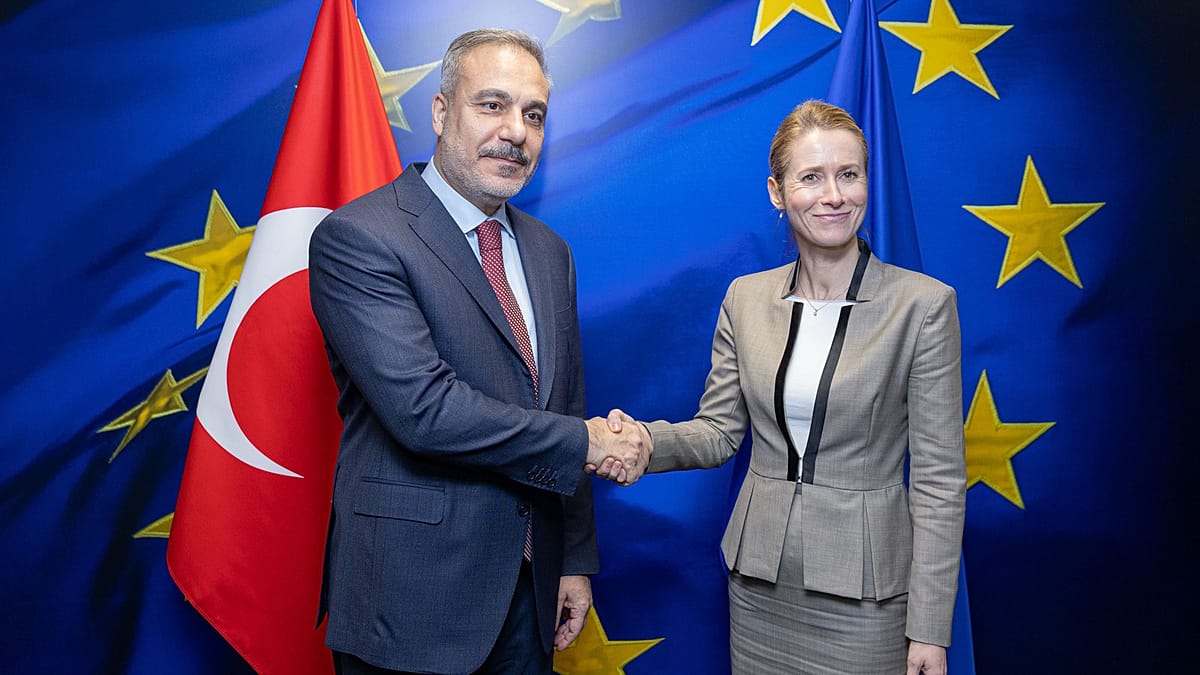
Three senior European Commissioners are in Ankara today for talks with Turkish officials, marking a renewed push by Brussels to deepen cooperation with a key NATO ally ahead of the alliance's annual summit next week. Enlargement Commissioner Marta Kos, Migration Commissioner Magnus Brunner, and Foreign Policy Chief Kaja Kallas will meet Foreign Minister Hakan Fidan to discuss EU-Turkey relations, regional security, and potential areas for collaboration.
A European Commission spokesperson described the visit as “an opportunity to review EU-Turkey relations, discuss the common challenges in an increasingly volatile geopolitical environment and also look for additional avenues for cooperation.” The trip underscores the EU's recognition of Turkey's strategic importance, particularly as the country prepares to host the NATO summit in Ankara on 7-8 July.
Yet the visit comes just two months after Commission President Ursula von der Leyen appeared to group Turkey with Russia and China as a hostile power and geostrategic threat to the EU. The remarks, though downplayed by Ankara, sparked outrage among some EU diplomats and analysts, who pointed out that Turkey is both a NATO ally and a long-standing EU candidate country. The incident has highlighted the delicate balancing act Brussels must perform: engaging Ankara on practical issues while maintaining pressure on democratic standards.
Turkey's EU membership bid remains stalled, with the European Parliament's foreign affairs committee recently condemning what it called a pattern of “authoritarian” drift over the past decade. The deadlock shows no sign of breaking, but the EU is increasingly seeking functional cooperation with Turkey on issues such as migration, energy, and security.
Autumn Deadline for China Trade Talks
In parallel, EU Trade Commissioner Maroš Šefčovič announced on Monday that the bloc aims to achieve “tangible” results in trade talks with China by October. Speaking after a meeting with Chinese Commerce Minister Wang Wentao in Brussels, Šefčovič described the discussions as “intensive, focused, and constructive.”
“My objective from the outset has been clear: to begin balancing the trade relationship between the European Union and China,” Šefčovič told reporters. The EU has been seeking to address what it sees as Chinese overcapacity in sectors such as solar panels and electric vehicles, which has led to tensions and retaliatory threats from Beijing.
Šefčovič said he would travel to Beijing this autumn “to assess the progress,” adding that “our teams have a clear mandate and an ambitious timetable to deliver tangible results by October this year.” The trade relationship remains a key priority for Brussels, which is also pushing for greater reciprocity in market access.
Air Conditioning Debate Heats Up
Meanwhile, the debate over air conditioning in Europe continues to divide opinion. Yesterday, the European Commission declined to take a stance on the issue, with a spokesperson saying it was neither “pro or contra” the cooling systems. The Commission noted that it does not “micromanage how people should be going about this” in private households, but left the door open to reviewing its position if the political context changes.
The debate has become emblematic of a broader challenge: whether climate policy should be judged not only by its emissions reductions but also by its impact on social inequalities. As our energy and environment reporter Marta Pacheco notes, the question of who can afford air conditioning—and who cannot—is increasingly central to discussions about adaptation to extreme heat.
NATO Chief in Berlin Ahead of Summit
NATO Secretary General Mark Rutte is in Berlin today, where he will meet with German Chancellor Friedrich Merz and Defence Minister Boris Pistorius. The visit is one of the last preparatory stops before the alliance's annual summit in Ankara next week. US President Donald Trump confirmed last week that he would attend, but reiterated his resentment over NATO allies' refusal to back him in the war in Iran—a charge that several states, including Germany and the UK, can refute, having granted the US military basing rights and access to their airspace.
EIB President: €3 Billion Airbus Loan Shows Europe's Strategic Autonomy
In a separate development, European Investment Bank President Nadia Calviño told Euronews that the EIB's record-breaking €3 billion loan to aerospace giant Airbus is an “illustration of how Europe is ramping up its capacity and strategic autonomy” in a world where it is being “attacked on all sides.” The loan, announced on Monday, is the largest commercial loan ever granted by the Luxembourg-based institution and will support Airbus's commercial aerospace and defence projects through 2030, with investments in France, Germany, and Spain.
The move is widely seen as part of a broader European push to restore the continent's waning competitiveness and sovereignty in the face of stiff competition from the US and China. An initial €1 billion tranche was signed at a ceremony in Brussels on Monday.
In other news, President Volodymyr Zelenskyy said that Russia has repeatedly failed to meet its self-imposed targets to capture Ukraine's eastern Donetsk and Luhansk regions, with the latest deadline now pushed back to 31 December. Zelenskyy noted that Moscow had set “around 15 deadlines” since the start of its full-scale invasion, each of which had ultimately been missed.