The European Union's flagship Global Green Bond Initiative, a financial instrument aimed at mobilising €15 to €20 billion for sustainable infrastructure in partner countries, is facing internal criticism for potentially funnelling a significant portion of its funds to Chinese clean technology companies. This outcome would directly contradict Brussels' stated goal of diversifying away from Beijing in critical supply chains.
Conceived during the previous European Commission term as part of the European Green Deal, the initiative's governance framework was only finalised in April 2024. In the intervening period, the geopolitical landscape has shifted dramatically, with the EU adopting a more defensive trade posture toward China. Yet the Green Bond Initiative, as currently structured, does not require partner countries to avoid Chinese suppliers and offers no financial incentive for them to do so.
Chinese Dominance in Renewable Energy Markets
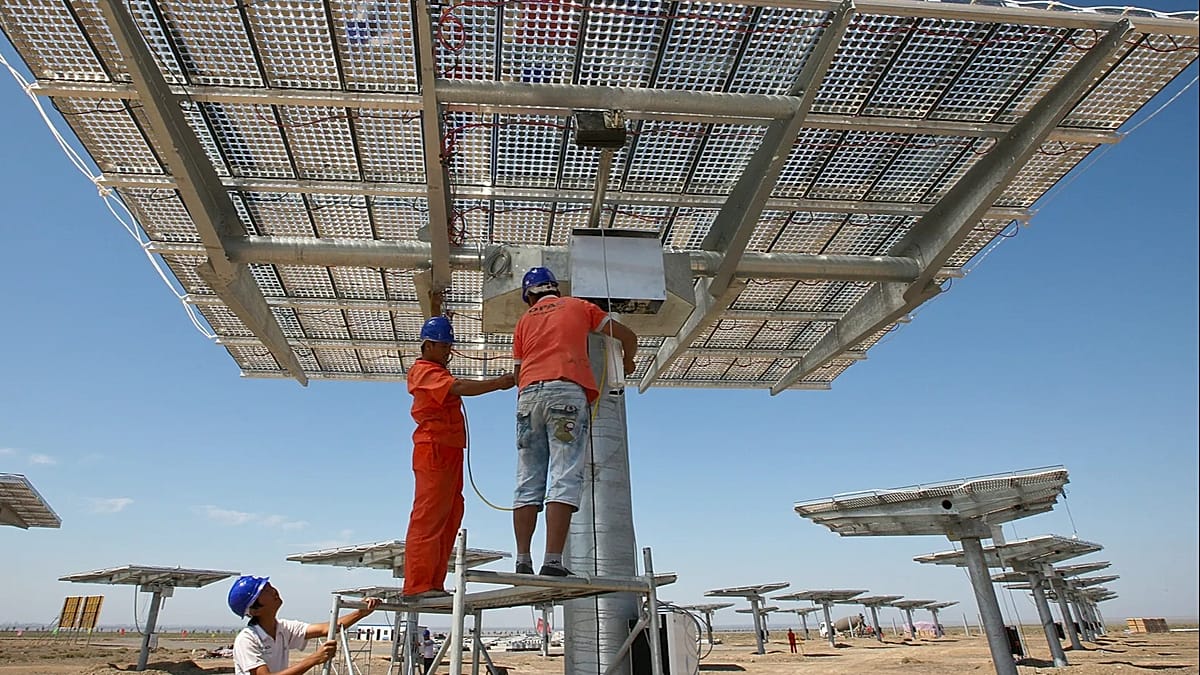
“The main problem is that, given the market of renewable energy technologies, most of the money will likely go to Chinese companies,” a Commission official with direct knowledge of the matter told European Pulse, speaking on condition of anonymity. The official highlighted particular concern over high-risk solar inverters, which the EU is actively trying to phase out due to cybersecurity vulnerabilities that could affect third countries connected to the European energy grid.
The European Investment Bank (EIB) and other European development institutions will act as anchor investors and provide technical assistance for projects such as solar farms in Algeria, wastewater treatment in India, and a light rail line in the Dominican Republic. However, without a “China clause” in the bond framework, these projects may end up procuring equipment from Chinese firms that dominate the global market.
The issue of “global macroeconomic imbalances” – a euphemism for China's trade practices – is set to dominate discussions at the European Council this week. But the Green Bond Initiative was designed before the EU fully developed its economic security doctrine, which aims to counter Beijing's growing dominance in key sectors through heavily subsidised firms that push out competitors.
Cybersecurity Risks to European Energy Grids
Last month, the European Commission circulated guidance requesting that all EU-funded renewable energy projects phase out high-risk power inverters – meaning Chinese-made ones – citing cybersecurity risks to the EU energy grid. The concern is that firms like Huawei, which dominate the solar inverter market, could remotely manipulate energy grids, destabilise them, and in a worst-case scenario trigger blackouts.
However, the guidance only applies to projects outside the EU from 15 April 2027, and the Green Bond Initiative was approved before it was issued. This has raised fears that the investment programme could increase third countries' exposure to risky Chinese technology while creating security risks for Europe's own energy infrastructure. Energy grids do not operate in isolation, making the phase-out of Chinese inverters at home less effective if the same rules are not applied to Europe's immediate neighbours, particularly in North Africa.
“Having EU-financed projects built by Chinese companies is precisely what we want to avoid,” a second Commission official told European Pulse, noting that the Mediterranean region is where China's influence poses the highest risks. The Commission has been pushing the EIB and other European investment institutions to apply the phase-out requirements across the board, but both institutions have pushed back and sought exemptions.
Governance and Procurement Tensions
In the context of the Green Bond Initiative, the absence of an exclusion mechanism means the problem may be as much about governance as procurement. The Commission is expected to exert pressure on the initiative's fund manager, Amundi, Europe's largest asset manager, but it will have to do so against a project pipeline drawn up without those requirements in mind.
For investment banks, the priority is financial viability and return on investment, whereas supply chain considerations cannot translate into commercially unreasonable costs. But in a context where critical dependencies are increasingly weaponised by China, and where the EU is increasingly serious about reducing its reliance on Beijing, geopolitical risk is becoming a decisive factor.
“The EIB wants exemptions on everything, the Commission is pushing back on the whole front,” a third EU official said. “The situation is still unclear; this back and forth will go on for a while.”
This internal struggle underscores a broader challenge for European development finance: how to persuade third countries to buy from more expensive non-Chinese vendors without covering the extra cost. So far, Brussels has been reluctant to do so, leaving the Green Bond Initiative at risk of becoming a vehicle for subsidising Chinese clean tech rather than advancing European strategic autonomy.