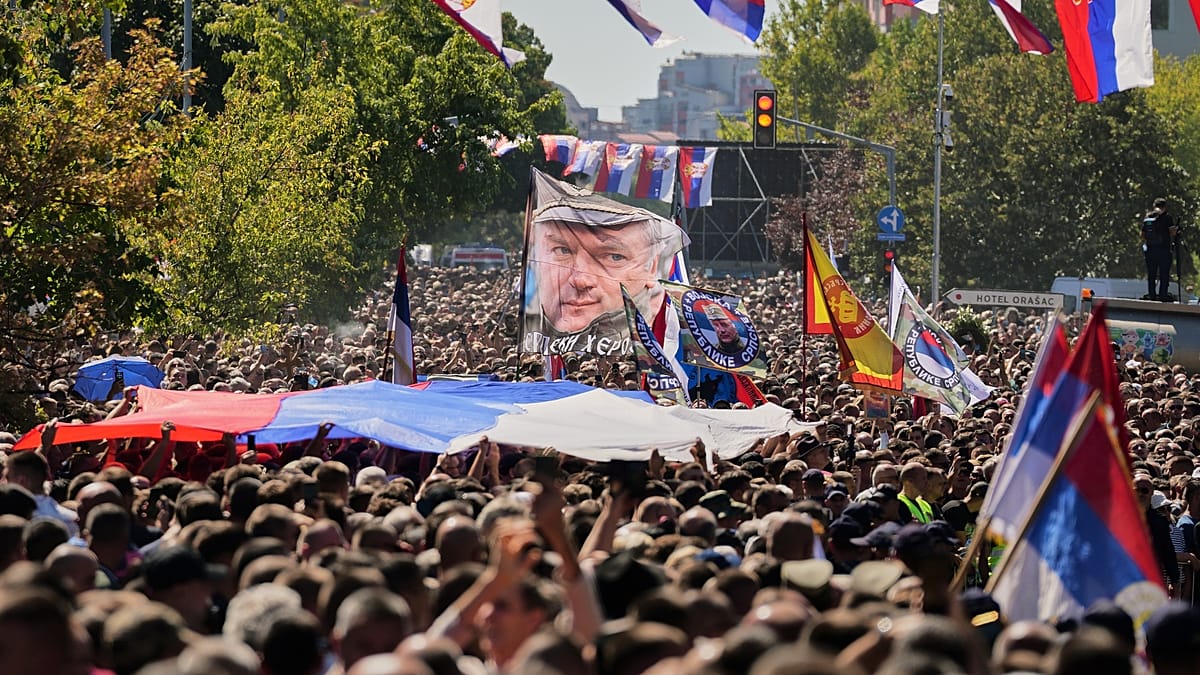
The European Union's two most senior institutional figures have issued a rare joint rebuke to Serbia over the funeral of convicted war criminal Ratko Mladić, describing the official honours as "shocking" and warning that Belgrade's actions contradict the values required for EU membership.
In a statement published simultaneously on X on Tuesday morning, European Commission President Ursula von der Leyen and European Council President António Costa said: "The images from Ratko Mladić's funeral yesterday in Belgrade were shocking. Ratko Mladić was a convicted war criminal. He was responsible for genocide, war crimes, and crimes against humanity."
Mladić, known as the Butcher of Bosnia, died in late August at the age of 84 in a United Nations detention facility in The Hague. The Bosnian Serb general commanded the Army of Republika Srpska during the Yugoslav Wars of the 1990s and was serving a life sentence for genocide, including the 1995 Srebrenica massacre, the worst atrocity on European soil since the Second World War.
His body was flown to Belgrade on a Serbian government aircraft, received a military honour guard, and was draped in the Serbian flag. Senior officials, including five government ministers, sat in the front row at the funeral, which was also attended by the Serbian Orthodox Church and broadcast on state media.
EU escalation from warning to condemnation
The joint statement marks a sharp escalation from earlier diplomatic warnings. On Friday, Enlargement Commissioner Marta Kos had called the funeral an "important test" for Serbia's accession bid, and she subsequently cancelled her planned visit to Belgrade. The Commission's chief spokesperson, Paula Pinho, had initially downplayed the affair, telling journalists that "we had heard that there was a funeral foreseen with state honours, and that has not been the case."
That comment drew fierce criticism from Bosnia and Herzegovina's foreign ministry, which wrote on X: "Five ministers from the Serbian Government were seated in the front row at the funeral, a convicted war criminal was given military honours, and his body was flown in on a Serbian Government aircraft." The ministry called Pinho's statement "a disgrace to the entire European Union."
Von der Leyen and Costa's joint statement appears to settle the matter at the highest institutional level. "He died while serving a life sentence for the Srebrenica genocide and other crimes. The elements of official support and the presence of some senior Serbian officials at the funeral are deeply regrettable," they wrote.
The EU's institutional condemnation is a significant blow to Serbia's already-stalled accession process. In July, the Commission had sought to revive talks by proposing the opening of Cluster 3, a set of negotiating chapters covering competitiveness and inclusive growth. But eight member states blocked the move, citing persistent rule-of-law concerns and Belgrade's refusal to align with EU sanctions against Russia.
"Everyone can see that, following this heinous glorification of Mladić, the opening of Cluster 3 is completely out of the question for now," an EU diplomat told Euronews on condition of anonymity.
The funeral has also reignited debate across the Western Balkans about how the region confronts its wartime past. In Bosnia and Herzegovina, where Srebrenica is commemorated annually, the glorification of Mladić is seen as a direct affront to victims and survivors. The EU's joint statement stresses that Serbia's failure to confront this dark chapter contradicts the fundamental values underpinning EU membership.
For now, the EU's message is clear: Serbia's path to Brussels runs through The Hague, not through Belgrade's glorification of those convicted there. The coming months will test whether Belgrade is willing to change course, or whether its EU bid will remain frozen in the shadow of Srebrenica.



