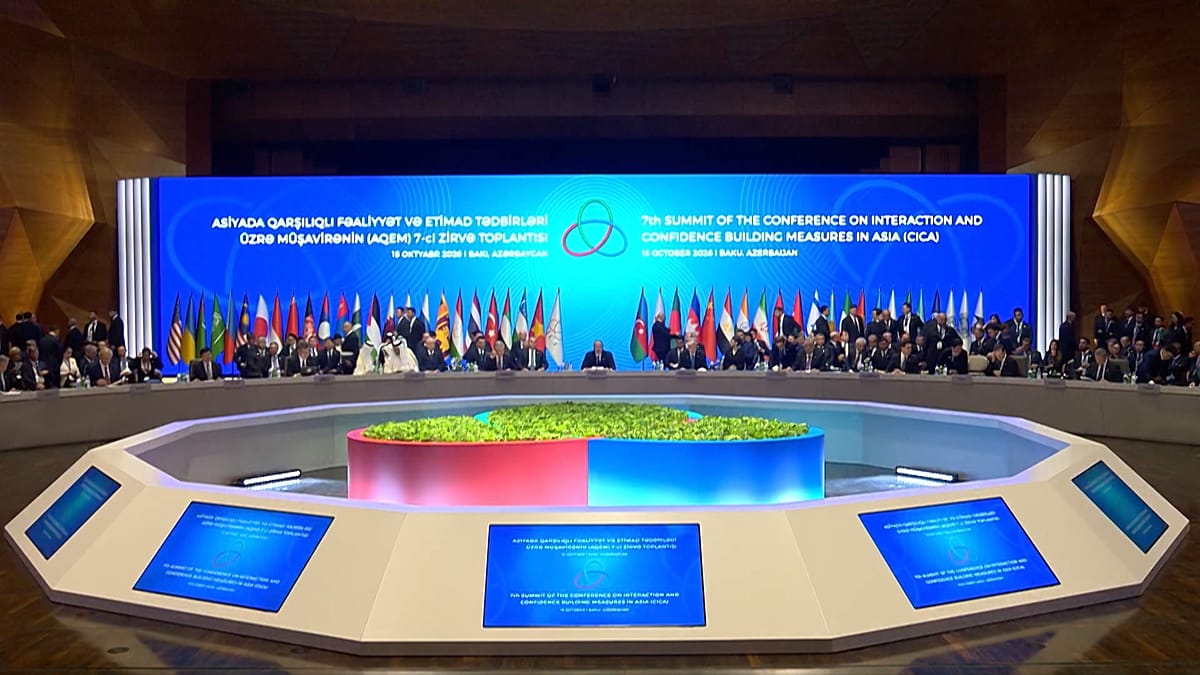
For more than three decades, the Conference on Interaction and Confidence-Building Measures in Asia (CICA) has served as a rare forum where countries with divergent political systems and economic priorities can sit at the same table. Its 28 member states, stretching from the Caucasus to East Asia, are now seeking to move beyond talk and give the organisation a more operational role.
Under Azerbaijan's chairmanship, which began in 2024, the emphasis has shifted towards institutional reform and concrete deliverables. Baku has used its tenure to push for a more structured approach to regional security, economic integration and the management of emerging transnational challenges. The aim, according to officials involved in the process, is to ensure that CICA does not remain merely a talking shop but becomes a platform for tangible cooperation.
From dialogue to delivery
Migration, climate change and artificial intelligence have emerged as priority issues, alongside more traditional topics such as finance, education and business facilitation. These are areas where CICA members see clear potential for joint action, even when their broader geopolitical interests diverge. The organisation's informal, consensus-based nature is seen as an advantage, allowing progress without the rigidities of formal treaty obligations.
Azerbaijan's role as chair has been particularly active. The country has hosted a series of expert meetings and ministerial consultations, and has sought to align CICA's agenda with its own foreign policy priorities, which include strengthening ties with Asian partners. Baku's experience in hosting large international events, such as the COP29 climate summit, has given it visibility and logistical capacity that it is now applying to CICA.
One of the key challenges is to ensure that the organisation's decisions translate into lasting cooperation. Critics have long pointed to CICA's lack of enforcement mechanisms and its reliance on voluntary commitments. Supporters counter that the forum's value lies in building trust and confidence, which can eventually lead to more binding arrangements.
The migration dossier is a case in point. Several CICA members are countries of origin, transit or destination for migrants, and the organisation has begun to explore common approaches to labour mobility and human trafficking. Climate change, similarly, is a shared concern, with many members vulnerable to water stress, desertification and extreme weather events. Artificial intelligence, a newer topic, is being discussed in the context of both economic opportunity and the need for common ethical standards.
Education and business are also on the agenda. CICA has been promoting exchanges between universities and chambers of commerce, with the aim of creating a more integrated regional market for skills and investment. Azerbaijan has proposed the establishment of a CICA business council, which would bring together entrepreneurs from member states to identify joint projects.
The organisation's future will depend on its ability to demonstrate added value. As one European diplomat put it, "CICA cannot compete with the EU or ASEAN in terms of institutional depth, but it can offer a space for dialogue that those organisations do not cover." That space includes countries such as Russia, China, Iran and Turkey, which are not all members of the same regional blocs.
For European observers, CICA's evolution is worth watching. The organisation's membership overlaps with the EU's Eastern Partnership and Central Asian strategies, and its discussions on security and migration have direct implications for Europe. The Azerbaijan's tourism push is one example of how the country is using its chairmanship to project soft power and attract investment, a trend that European businesses may find relevant.
As CICA enters this new phase, the test will be whether member states can agree on concrete projects and allocate the resources needed to implement them. The chairmanship has set out a roadmap, but the real work lies ahead. The organisation's ability to adapt to a rapidly changing geopolitical landscape will determine whether it remains a useful instrument for regional cooperation or fades into irrelevance.