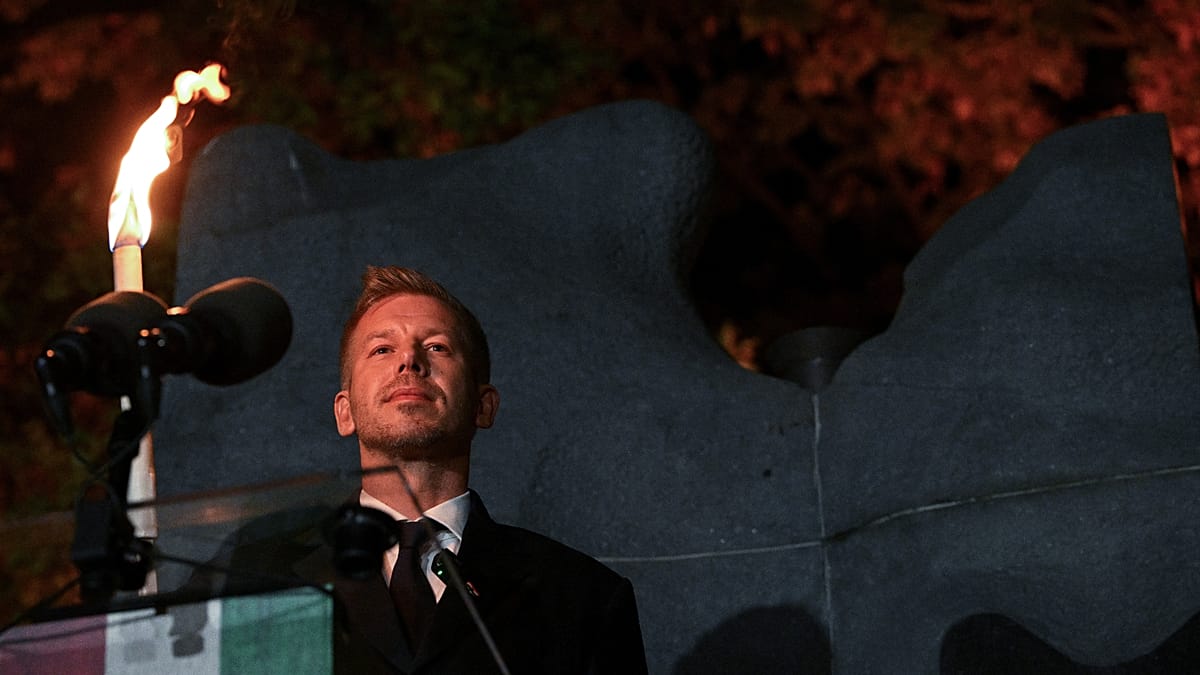
Budapest's grand plans for the 70th anniversary of the 1956 anti-Soviet uprising fell short of expectations, as only the European Union's top two officials joined the commemorations on 23 October. Prime Minister Péter Magyar, who swept to power in a landslide election earlier this year, had hoped to host a gathering of world leaders in the Hungarian capital.
In the end, European Commission President Ursula von der Leyen and European Council President António Costa were the most senior international figures present, signalling Brussels' support for Magyar's pro-European agenda after the long tenure of Viktor Orbán. Their attendance was made possible only after an EU-Gulf Cooperation Council meeting in Riyadh was postponed last week.
Notably absent were French President Emmanuel Macron, Polish Prime Minister Donald Tusk, and Ukrainian President Volodymyr Zelenskyy. Around 40 countries sent delegations, but most EU member states were represented by ministers or parliamentary speakers rather than heads of government. Moldovan President Maia Sandu and Georgian Prime Minister Irakli Kobakhidze did travel to Budapest.
Late invitations and scheduling clashes
Diplomatic sources, speaking on condition of anonymity, said the ceremony was complicated by delays in sending official invitations. Many were not dispatched until September, when leaders' calendars were already full. Tusk had already scheduled a trip to India, while Italian Prime Minister Giorgia Meloni had planned a visit to Kuwait.
One source acknowledged that communication between the prime minister's office and the foreign ministry had been poor, adding: "We will do better in the future." István Szent-Iványi, a former diplomat and foreign affairs expert, told Euronews: "It was a mistake that they set expectations so high. Europe and its individual member states are struggling with a thousand problems, and they didn't feel that it would be worth coming."
Macron's absence and migration remarks
Magyar's public comments linking riots in France to migration may have contributed to Macron's decision to stay away. In a social media post last Sunday, Magyar wrote: "Seeing this senseless destruction and unjustified violence, perhaps it is now clear to everyone why Hungary takes the toughest possible stance on migration." The post drew criticism in Hungary and France, and the French embassy in Budapest announced the next day that Macron would not attend, adding that his visit had never been confirmed.
On Wednesday, Macron hit back at what he called "stupid comments" by foreign leaders, including Magyar, US President Donald Trump, and Tusk, who had made similar remarks. "We've had people claiming that we were invaded by hordes of migrants and Islamists, which is completely false," Macron said. "The fact is that all those speaking ill of our country right now are people who don't love our country. And those people irritate me."
Dániel Hegedűs, deputy director of the Institut für Europäische Politik, said Magyar's social media appearances "can be interpreted as interference in French domestic politics, and obviously did not facilitate Macron's visit."
Zelenskyy invitation controversy
Magyar also faced criticism over his handling of the invitation to Zelenskyy. At an EU summit in Brussels, Zelenskyy expressed openness to visiting Budapest, but Magyar downplayed the possibility just days later, saying everyone had been invited. Zelenskyy's adviser Dmytro Lytvyn pushed back against the remarks. Ukraine was represented at the commemoration by its parliamentary speaker, with the president's office saying the visit was arranged independently and was not intended to replace Zelenskyy's attendance.
Hegedűs argued that Magyar's response "sends the message to the partners that whether they come or not is not a strategic issue."
Georgian prime minister's presence stirs controversy
The guest list also included Irakli Kobakhidze, Georgia's controversial prime minister, whose Georgian Dream party has been criticised by Brussels for its close ties to Russia, its role in derailing Georgia's EU integration path, and its crackdown on dissent. This week, Georgia's Constitutional Court began hearings on a request by the governing party to ban five pro-Western parties.
Szent-Iványi said: "We know it's a pro-Russian oppressive regime, so it doesn't really belong here, in the vicinity of a memorial to the 1956 revolution. But they say here that it's protocol, everyone was invited, and he said he would come."
Despite the modest turnout, von der Leyen struck a supportive tone in Budapest. "Six months ago the people of Hungary voted for a new chapter. To turn the page on years of division, of trust eroded, freedoms rolled back, prosperity undermined," she said. Szent-Iványi noted that the absence of leading European figures does not mean they are turning their backs on Magyar, but rather reflects the practical and diplomatic challenges of the moment.
The commemoration comes amid a broader reset in EU-Hungary relations and as the continent grapples with domestic unrest and political shifts. For Magyar, the event was a test of his ability to project influence on the European stage, a test that yielded a more modest result than hoped.