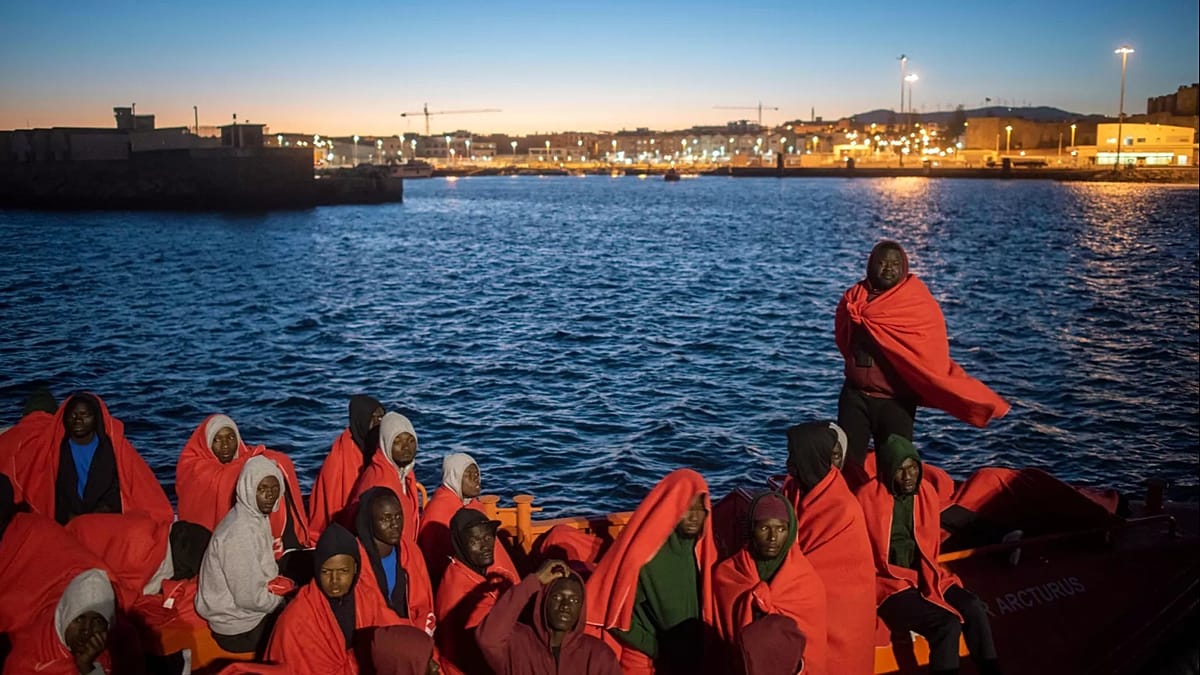
The European Union's new Pact on Migration officially enters into force on Friday, promising a unified framework for managing asylum across the bloc. Yet behind the legislative fanfare, the pact's central pillar—'mandatory solidarity'—has been quietly hollowed out by member states, leaving frontline countries like Spain, Italy, Greece, and Cyprus with far less support than envisioned.
Under the pact, a solidarity pool was designed to require at least 30,000 relocations of asylum seekers and €600 million in financial contributions annually. For 2026, however, the European Commission's proposal already set the bar low, and national governments pushed it lower. The result: fewer than 9,000 asylum seekers will be relocated, and only €76 million in financial contributions will flow to pressured states. This comes as nearly 669,000 individuals sought asylum in the EU last year, with some 800,000 already in the system.
Juan Fernando López Aguilar, a Socialist MEP who negotiated the solidarity mechanism, called the predicted contributions 'ridiculous.' The gap between ambition and reality underscores a persistent tension in EU migration policy: the principle of solidarity clashes with domestic political reluctance.
How the Solidarity Pool Was Diluted
The Asylum and Migration Management Regulation, the pact's core, sets a minimum threshold of 30,000 relocations and €600 million. But the legal text also says the pool should be set 'on the basis of the needs identified by the Commission.' The Council's legal service has interpreted this to mean the threshold can be reduced—a view that the Commission disputes but cannot enforce.
During negotiations for 2026, member states argued that contributions should be prorated, since the new rules only cover the second half of the year. Despite no explicit legal basis, this was accepted, shrinking the pool. In a December 2025 meeting of EU interior ministers in Brussels, the agreed figures were 21,000 relocations 'or other solidarity efforts' and €420 million—already below the minimum. Further reductions followed, as countries opted for financial contributions over relocations, and some refused entirely.
Hungary and Slovakia have deliberately made no contributions, neither relocations nor money, in clear defiance of the 'mandatory' principle. The European Commission has not imposed sanctions, though dialogue continues. New Hungarian Prime Minister Péter Magyar has signaled more willingness to cooperate than his predecessor Viktor Orbán, but has stated his country will not accept any asylum seekers.
Four countries—Czechia, Croatia, Austria, and Poland—were granted full exemptions because they face 'significant migratory situations.' The remaining 19 member states must contribute, but many have chosen the cheapest option: financial payments rather than hosting people.
The result is a system that, as Pope Leo XIV recently criticised, prioritises hardening rhetoric over practical solidarity. The pact's border procedure, which shortens asylum assessment to 12 weeks for certain applicants, may speed up processes, but it does little to address the core imbalance between frontline states and the rest of the continent.
For countries like Italy and Greece, which bear the brunt of arrivals, the shortfall is acute. The European Commission's mantra—'solidarity is mandatory but flexible'—has become a euphemism for minimal compliance. As the pact takes effect, the question remains whether the EU can enforce its own rules or whether national interests will continue to undermine collective commitments.