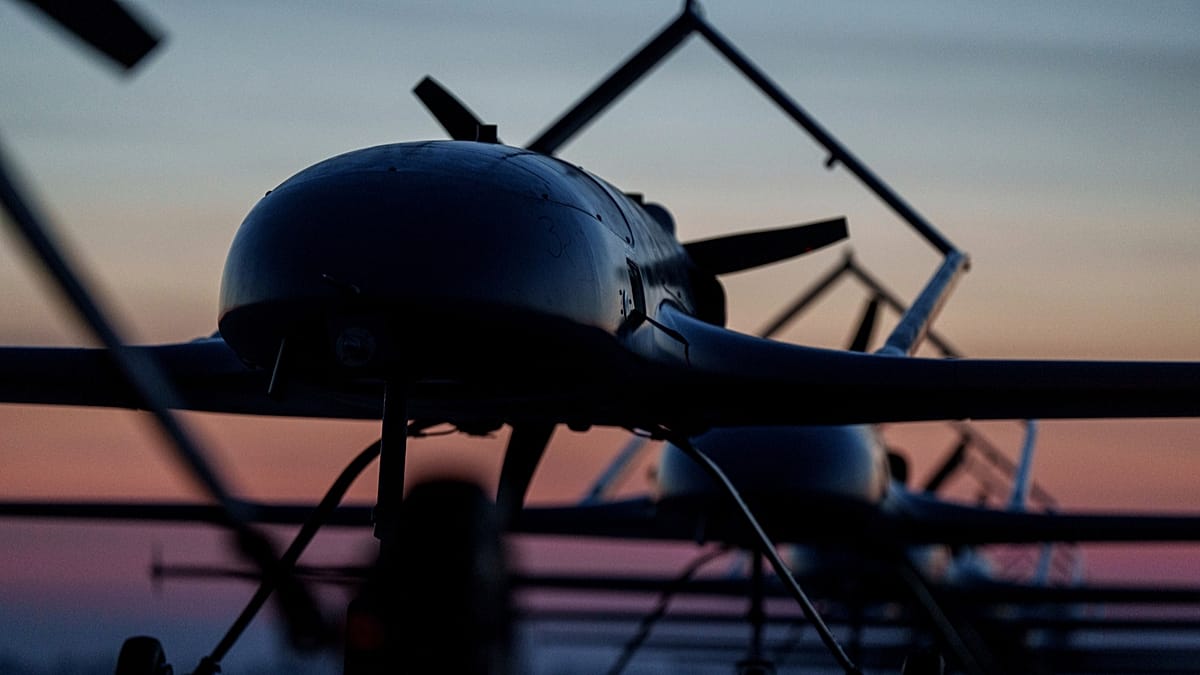
The European Union adopted its 21st package of sanctions against Russia on Thursday, targeting 56 military-industrial entities and individuals that support the Kremlin's war effort. The measures, announced by EU foreign policy chief Kaja Kallas, focus on disrupting the production of long-range drones and a domestic satellite communications network that Moscow sees as an alternative to Starlink.
“More than 50 military-industrial entities are included, (as well as) key actors involved in the production of Russia's long-range drones,” Kallas said. “Russia will only negotiate to end its illegal war and stop killing civilians if it is pressured to do so. Sanctions add to this pressure.”
The package continues the EU's strategy of targeting suppliers of dual-use goods and technologies in third countries, including China and India, which are often found in Russian missiles, drones, and tanks. But EU officials and analysts are paying particular attention to two new components: the Garpiya drone supply chain and the Rassvet satellite system.
Garpiya drones under the microscope
A senior EU official explained that Ukrainian civilians and infrastructure have faced relentless pressure from Russian long-range drone attacks. After a three-day US-brokered truce expired in May, Russia launched over 200 long-range drones at Ukraine, hitting energy infrastructure, residential buildings, and a kindergarten. This prompted the EU to adopt a “different approach” in the latest sanctions.
“What we've done is we focused on one category of long-range drones, Garpiyas, and we've mapped out effectively the entire manufacturing and supply network,” the official said. “In a single blow, we are targeting it today with over 30 designations.”
The package includes 37 new listings tied to the Garpiya and Garpiya-A1 attack drones, covering companies that produce warheads, rocket boosters, catapults, and other components. However, Jacob Funk Kirkegaard, a senior fellow at the Bruegel think tank, cautioned that while the effort is welcome, its impact may be limited. “Russia has multiple types of long-range drones,” he said. “That doesn't mean this is a misguided effort. It's well worth the effort. But we just shouldn't pretend that targeting one out of many long range drones that Russia has or produces is going to shift the needle on the strategic threat posed to Ukraine today, or for that matter, the rest of Europe in the longer run.”
Rassvet: Russia's Starlink rival
The sanctions also target Russian companies involved in military technology, electronics, and communications. The senior EU official implied that a specific satellite system was in the crosshairs: “One thing that I find particularly important is related to the manufacture of a system that Russia is developing as an alternative to Starlink, so the Russian Starlink project is within this package.”
That system is Rassvet, a low-Earth orbit satellite network produced by Russian aerospace company Bureau 1440. Russian media often call it a “Starlink alternative,” designed to provide high-speed internet access. Sixteen Rassvet satellites were launched into orbit in March 2026, with plans to have 250 in orbit by 2027 and 900 by 2035.
Kirkegaard noted that when Russia previously lost access to Starlink, such as in February 2026, it had “very significant implications on their battlefield performance.” Denying Moscow the ability to establish an alternative, he argued, “would obviously be a very important priority.” He added that as Europe prepares to deter Russia independently over the long term, “denying Russia their military capabilities in the next three, four, 10 years from now is very important for our own security.”
The EU's move comes amid broader concerns about Russian aggression. Recent incidents include Romania shooting down a third drone in three days as Russian incursions escalate, and Russian strikes across Ukraine killing at least eight in a 24-hour period. The sanctions package also targets entities linked to Ukraine striking Russian cargo linked to Iran, highlighting the expanding scope of the conflict.
While the effectiveness of the sanctions remains to be seen, the EU's focus on Garpiya drones and Rassvet signals a strategic shift toward disrupting Russia's military-industrial complex at its roots. As Kirkegaard put it, the measures are part of a broader effort to ensure Europe's future security, even if they won't immediately change the battlefield dynamics in Ukraine.