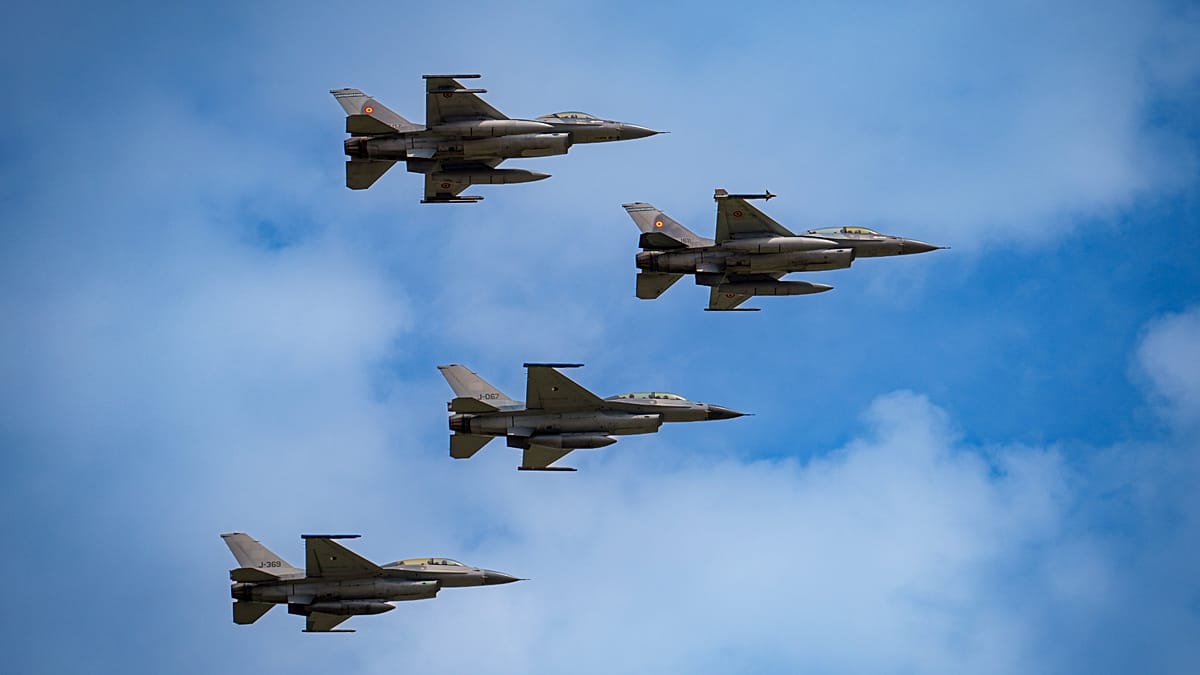
Romanian air force F-16 fighter jets intercepted and destroyed a third unmanned aerial vehicle in as many days on Sunday, President Nicușor Dan confirmed. The incident occurred around 10:13 am local time over Romania's territorial waters in the Sulina–Chilia area of the Danube Delta, close to the border with Ukraine.
Dan praised the pilots and ground crews for their “professionalism, courage and efficiency” in a statement on X. The latest shootdown follows two similar operations on Friday and Saturday, underscoring a sharp rise in aerial intrusions along Romania's eastern flank.
Shahed drone confirmed
Romania's Prosecutor General's Office has determined that the drone intercepted on Friday was a Shahed-type, the same model used extensively by Russian forces in their war against Ukraine. Investigations into the drones shot down on Saturday and Sunday are still ongoing, but Dan described the pattern as “intolerable for the Russian Federation to continue violating Romania’s airspace.” He added: “Such actions are unacceptable and we are treating them with the utmost seriousness, alongside our allies.”
On Saturday, a Romanian F-16 shot down another drone roughly 10 km west of the village of Sfântu Gheorghe in eastern Romania. The Defence Ministry said two jets were scrambled to identify and intercept the target, and the drone was “safely shot down in an unpopulated area near the border.”
Romania, a NATO member situated on the Black Sea coast, has become increasingly exposed to the fallout from Russia's full-scale invasion of Ukraine, which began in February 2022. The country shares a long border with Ukraine and has seen a surge in drone-related incidents over recent months.
In May, a Russian drone carrying explosives crashed into an apartment block in Galați, sparking a roof fire and injuring two people. The following month, a Ukrainian sea drone exploded in the port of Constanța after veering off course due to Russian electronic warfare interference, according to Ukrainian military officials.
Bucharest has pledged to bolster air defence and surveillance measures, and the recent interceptions mark a more assertive posture. The Romanian air force has been operating F-16s as part of a broader modernisation programme, and these incidents are the first time they have been used to shoot down intruding drones in Romanian airspace.
NATO has increased its presence in the region since the start of the war, with allied forces rotating through Romania and other eastern member states. The alliance has also deployed additional air policing missions to monitor the Black Sea area.
President Dan’s condemnation of Russian violations reflects growing frustration in Bucharest. While Moscow has not claimed responsibility for the drone incursions, the use of Shahed drones — which are Iranian-designed but produced under licence in Russia — points directly to Russian military operations.
The situation is being closely watched by other European capitals, particularly those on NATO's eastern flank. Poland and the Baltic states have also reported repeated airspace violations by Russian aircraft and drones since the war began.
Romania's defence ministry has not disclosed whether the drones were armed or purely surveillance platforms, but the decision to shoot them down rather than merely track them signals a hardening of rules of engagement. The incidents also highlight the growing challenge of defending against low-cost drones that can evade traditional radar systems.
As the war in Ukraine grinds on, the risk of further spillover into neighbouring countries remains high. Romania's experience may serve as a template for how NATO members can respond to persistent, low-level aerial intrusions without escalating into a direct confrontation with Russia.