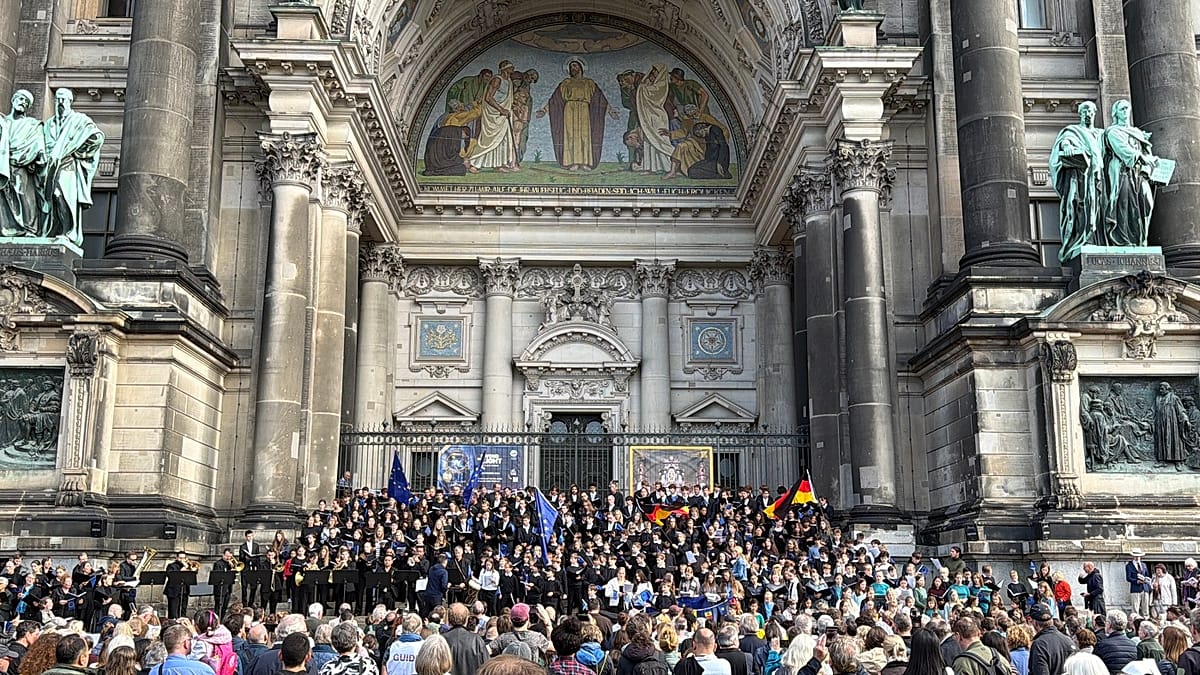
On 3 October, German Unity Day, the vaulted halls of Berlin Cathedral echoed with a rare musical dialogue: 38 students from the Chios Music School joined forces with choirs and ensembles from Berlin's Sing-Akademie zu Berlin. Together, some 240 performers delivered a festive service that spanned Mendelssohn, Poulenc, Britten, Lewandowski, and Holst, alongside works by Greek composers Michalis Adamis and Yannis Christou. The result, by all accounts, was deeply moving.
A message against hatred
Kai-Uwe Jirka, artistic director of the Sing-Akademie, conducted the concert. He explained that this annual service has become a deliberate counter-statement. Three years ago, after the cathedral service, the congregation emerged to find a far-right rally taking place in the Lustgarten. "We all said that this could not be allowed to happen," Jirka recalled. "We had just come out of the service and we wanted to be together without hatred, without racism."
Since then, the choirs have reserved that space for their own voices. "We cannot celebrate only Germany," Jirka said. "Because what is Germany without Europe? And what is Europe without Greece?" This year, he added, "everything that happened was perfect. We have young people from all over Europe coming together, singing side by side and sending a very strong message for Europe."
The collaboration is not new. Last August, as part of the 10th Chios Music Festival, more than 50 young choristers from the Sing-Akademie spent a week on the Aegean island, performing at various venues. That exchange, supported by the Greek-German Youth Foundation (ΕΓΙΝ/DGJW), laid the groundwork for this return visit.
Learning through music
Friederike Stahmer, founder of the Sing-Akademie Girls' Choir, was on Chios this summer. She described the exchange as a two-way learning process. "We learnt some Greek songs, mainly from Chios but also from the wider region," she said. "The pupils of the Chios Music School learnt German songs. Of course, at the beginning such musical collaborations are always challenging: the musical style is different, the language is different and you really have to work hard."
Now in Berlin, the repertoire has taken on new life. "It is very rewarding that the Chios Music School is in Berlin and we have the chance to revisit all the repertoire we had already performed on Chios," Stahmer said. "You can see how it develops and blossoms. And I think it is not only about getting to know one another; creating art together, making music together has an even deeper impact on them. I am sure it will be an unforgettable experience in their lives."
The Greek group stayed eight days in the German capital, performing in three concerts. For the young musicians from Chios, the trip was an opportunity to step beyond the island's edge-of-Europe location. Olga Holdorff Myriagou, co-artistic director of the Chios Music Festival, stressed the importance of such exposure. "The choir that is here in Berlin taking part in the exchange programme has many more opportunities than the children on Chios, which lies on the edge of Europe," she said. "It is therefore a great chance for the children of Chios to come to Berlin and join such a project."
Her colleague Lefteris Veniadis spoke of the "miracle" that unfolded on stage. "Through the common language of music, we witnessed a miracle. German children sharing the stage with the children of Chios, singing German and Greek songs. There was, in other words, a kind of osmosis, a common goal." The concerts on Chios had taken place in "wonderful landscapes that took on a new dimension through music," and now Berlin was offering a similar experience in reverse.
The event comes at a time when Germany's role in Europe is under scrutiny, from debates over EU budget contributions to fiscal policy and security concerns. Yet for the young singers, the message was simpler: music can bridge divides. As Jirka put it, "We cannot celebrate only Germany. Because what is Germany without Europe?"
The collaboration between Chios and Berlin is set to continue, with the next chapter likely to unfold on the island next summer. For now, the echoes of that October service linger—a reminder that even in a continent of many languages, harmony is possible.