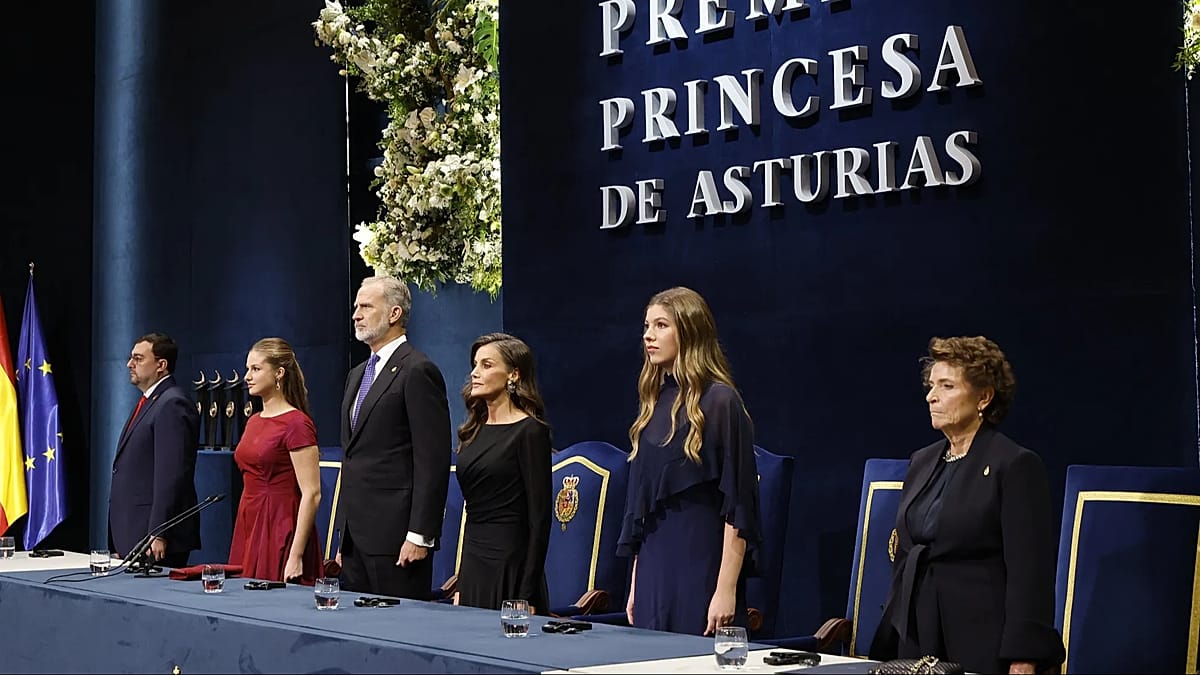
OVIEDO — The 46th Princess of Asturias Awards turned the Campoamor Theatre into a stage for defiance against cynicism, as laureates from across the arts, sciences, and public life used their acceptance speeches to champion hope, solidarity, and democratic values in an era of uncertainty.
Patti Smith, recipient of the Arts award, opened her performance with 'Wing', the revolutionary spoken-word piece that launched her career. Her rendition, which drew the loudest cheers of the evening, playfully mocked the notion that humans can thrive in isolation while celebrating personal freedom. The warmth she received on stage mirrored the affection shown by Oviedo's residents during her visit.
The ceremony's opening remarks came from the president of the Princess of Asturias Foundation, who invoked Meryl Streep's memorable 2023 appearance—when the actress was visibly moved by Asturian bagpipers—to describe the awards as "the echo of the voices of many of our heroes of the 20th century and of this young century of ours."
Unity and democracy take centre stage
Astronaut Christina Koch, awarded the Concord prize, delivered a speech designed to bridge the gap between technical expertise and human emotion. Recalling her first visit to Spain, she admitted, "The first time I came to Spain, I wept openly in the middle of the street." Her message was a call for unity among a "species capable of coming together," bound by "the search for affection."
British historian Timothy Garton Ash, raised in a household that supported Brexit, drew spontaneous applause when he twice referred to Britain as an inseparable part of Europe. A staunch Europeanist, he used his platform to defend the freedoms secured through academia, journalism, and the law, explicitly mentioning the International Criminal Court—a body that has faced fierce criticism and sanctions from the Trump administration.
King Felipe VI addressed the upcoming Spanish general elections, urging citizens to embrace democracy as a continuous commitment. "In a mature society like ours, the practice of democracy also takes time," he said. "It is not exhausted in a single election, like the one we will soon experience, when citizens will once again bear the very great responsibility of defining the political direction of our country."
He added: "Democracy requires daily commitment, civic and demanding, and care for its forms and institutions, so that we can continue to guarantee our coexistence, to foster that search for the common good which, as far as possible, meets and balances the legitimate interests of all citizens."
The monarch also weighed in on artificial intelligence, a theme echoed by his daughter, Princess Leonor. "We live in a world in which Artificial Intelligence sometimes seems to us, because it is so efficient and immediate, more reliable than human intelligence," Felipe VI observed. "Our laureates dismantle that impression: their achievements, lived and worked for down to the marrow, show that only through effort and perseverance can talent turn its potential into tangible, lasting realities."
Literature laureate Julian Barnes opened the winners' speeches with a nod to Diego Velázquez. "When you look at Velázquez you realise that everything has already been said; most writers and artists have at some point in their lives had insights as instructive as his," he said. The sentiment was echoed by Rosalía, who once quipped, "It's all been invented."
Princess Leonor, in her closing remarks, quoted Paul Valéry through a Studio Ghibli character—"The wind rises, we must try to live!"—a line that encapsulates the evening's prevailing spirit. The laureates, she suggested, embody the resilience needed to face the challenges ahead.
The ceremony, held against the backdrop of Messi's arrival in Oviedo for the awards, underscored the continent's cultural and political interconnectedness. As Europe navigates a period of geopolitical strain, the messages from Oviedo served as a reminder of the values that bind its nations together.