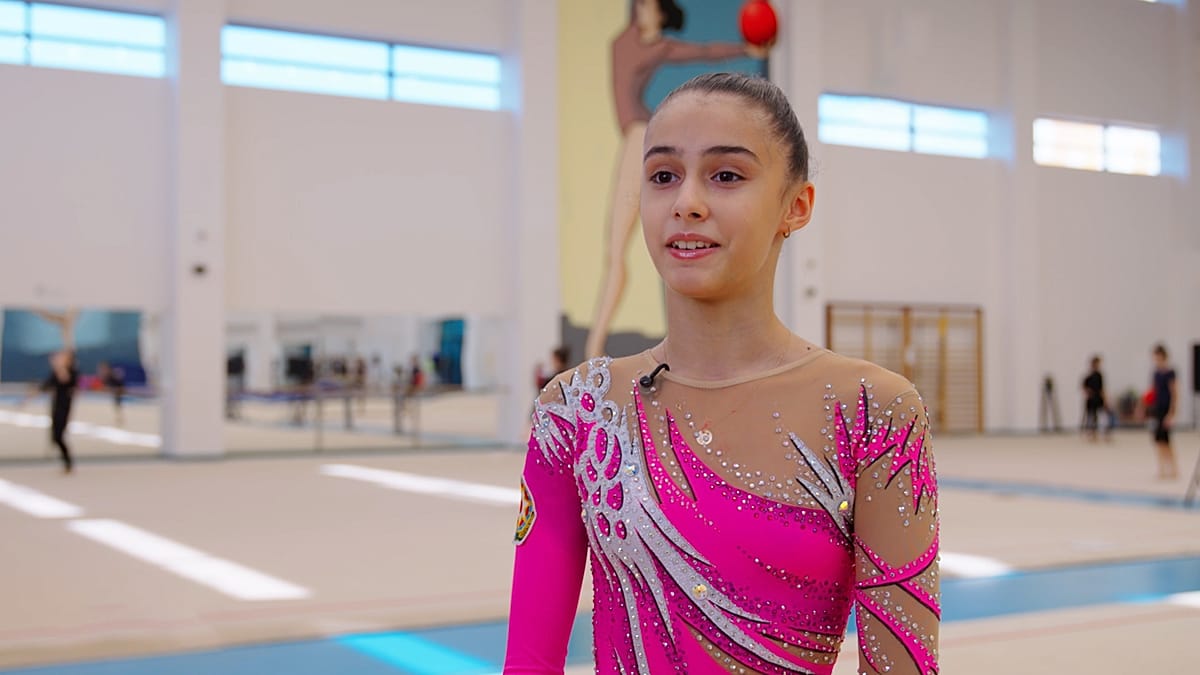
For 15-year-old Azada Atakishiyeva, rhythmic gymnastics is far more than a sport. What began as a childhood pastime in Baku has grown into a discipline that now shapes her daily routine, her ambitions, and her sense of national identity.
At just five years old, Azada competed in her first international event in Tbilisi, Georgia. That early taste of competition set the tone for a journey marked by rigorous training and steady progress. Over the past decade, she has travelled across Europe, representing Azerbaijan in junior categories and learning what it means to carry a flag far from home.
A moment of pride on the podium
Hearing the Azerbaijani anthem at an international competition remains one of the most powerful experiences of her young career. In an interview with European Pulse, Azada described that moment as both a personal milestone and a reminder of the responsibility that comes with wearing the national colours.
“When you stand on the podium and hear your anthem, you realise that all the sacrifices were worth it,” she said. “It is not just about you anymore. You are representing every Azerbaijani who dreams of seeing their country succeed.”
That sentiment resonates across the continent, where young athletes from smaller nations often face outsized expectations. For Azada, the support of her coaches and family in Baku has been crucial in balancing the pressures of competition with the joys of adolescence.
Building towards the senior ranks
Now on the cusp of moving up to the senior category, Azada is focused on refining her routines and increasing her technical difficulty. Rhythmic gymnastics demands a blend of flexibility, strength, and artistry, and she spends hours each day perfecting her ball, hoop, and ribbon exercises.
Her ambition is clear: to become a strong senior gymnast capable of challenging Europe’s established powers in the sport, such as Bulgaria, Italy, and Russia. While acknowledging the gap in experience, she remains optimistic about her trajectory.
“I know the senior level is a different world,” Azada admitted. “But I am ready to work harder than ever. My goal is to make Azerbaijan proud on the biggest stages.”
A broader European context
Azada’s story is part of a wider trend in European gymnastics, where nations like Azerbaijan have invested in youth development programmes to close the gap with traditional leaders. Her journey also highlights the importance of early international exposure, a factor that many European federations now prioritise.
As she prepares for the next phase of her career, Azada remains grounded. She credits her teammates at the National Gymnastics Arena in Baku for pushing her daily, and she dreams of one day competing at the European Championships and the Olympic Games.
For now, every training session brings her closer to that vision. And when she finally steps onto the senior mat, she will carry with her the lessons of a decade spent chasing a childhood dream.