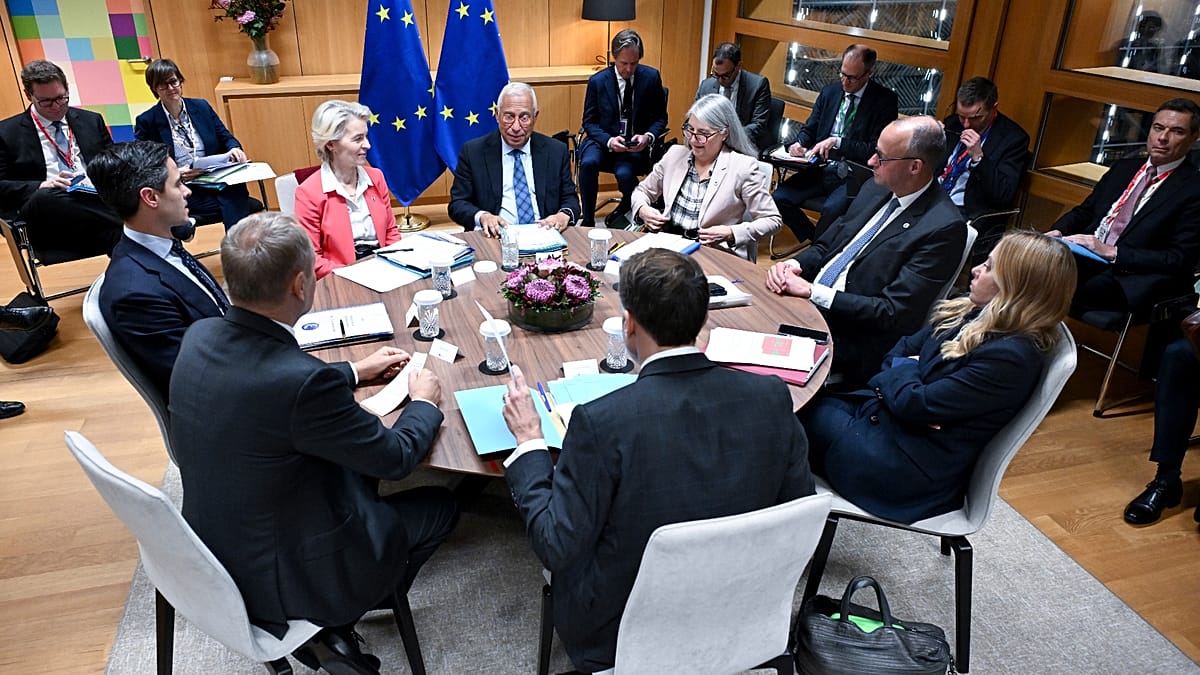
They rushed in, jostled for position, argued over the price, and left with almost nothing to show for it. But this was not Black Friday shopping—it was a special European Council summit in Brussels, convened to break the deadlock over the EU's next long-term budget. After fourteen hours of talks, a boycott, a French presidential ultimatum, and a bruised European Council president, leaders went home shortly after midnight with no deal.
The summit, called specifically to resolve the impasse over the 2028–2034 multiannual financial framework, collapsed in spectacular fashion. European Council President António Costa had proposed a compromise worth €1.78 trillion, shaving €204 billion off the European Commission's original plan. That effort managed to alienate nearly everyone.
A summit of two camps
The seven so-called frugal states—Germany, the Netherlands, Sweden, Denmark, Austria, Finland, and now Belgium—demanded deeper cuts and a reallocation of funds toward defence, innovation, and competitiveness. On the other side, the seventeen-member Friends of Cohesion group insisted on protecting traditional spending for poorer regions and agriculture.
Costa tried to break the logjam by dividing leaders into smaller, geographically mixed groups. The frugals, however, saw this as a tactic to isolate them and boycotted the format. Costa pressed on without them. "We had a lot of physical movement, with all the meetings, but we did not really see any movement on content," one diplomat told our reporters.
The divisions were stark. Italy's Giorgia Meloni described a deal as "light years away," while Hungary's Péter Magyar put the chances of agreement at "pretty much zero." The language sounded more like a physics conference than a political negotiation.
French President Emmanuel Macron, never one to stay in the background, broke away from the talks to hold his own press conference, casting himself as the great European dealmaker. "I'm trying to bring everyone closer together," he declared. His method? Threatening to shut down negotiations after 31 December—an implicit warning that his colleagues might soon be dealing with Marine Le Pen instead. German Chancellor Friedrich Merz was unimpressed, noting that there were 27 bridge-builders, not just one. The Franco-German engine is not exactly purring.
Ukraine aid sidelined
The other supposedly urgent item on the agenda—a €45 billion loan to keep Ukraine afloat next year—was largely swallowed by the budget brawl. Hungary, Slovakia, and the Czech Republic continue to refuse participation. That decision, too, has been kicked to December.
Leaders will try again on 17 December, but several seem remarkably relaxed about the timetable. "For me, there's no deadline," said Dutch Prime Minister Rob Jetten. Yet the new budget must be operational by January 2028, the European Parliament still has to approve it, and next year's electoral cycle could make the political arithmetic considerably uglier.
There is an old Brussels theory that leaders need to exhaust themselves, trade insults, and demonstrate to domestic audiences that they have fought tooth and nail before they can make concessions. "You need to have a bad European Council to have a good one," one diplomat told us. "It was a lot of political theatre." By that logic, December's summit ought to be an absolute triumph.
One concrete result: a new ECB president
Amid the dysfunction, there was one tangible outcome: Pablo Hernández de Cos was confirmed as the next president of the European Central Bank, becoming the first Spaniard to hold the post. The 55-year-old economist is the consummate technocrat. Appointed governor of the Bank of Spain by Mariano Rajoy's conservative government in 2018, he was later championed for the ECB presidency by Pedro Sánchez's Socialist administration. Currently heading the Bank for International Settlements, Hernández de Cos has spent much of his career navigating monetary policy, banking supervision, and financial stability. He is regarded as an orthodox economist, broadly aligned with the ECB's hawks, although he advocated interest rate cuts in 2024. Expect a steady hand rather than fireworks in Frankfurt.
Spain's political shift
Conspicuously absent from the summit, Pedro Sánchez is fighting for his political survival as Spaniards go to the polls on Sunday. His widely anticipated defeat would rob the EU of its highest-profile centre-left leader and further tilt the bloc's political balance to the right. Polls suggest the conservative Popular Party will need the far-right Vox party to govern, bringing the far right into national government for the first time since Spain's democratic transition.
The cost of solidarity is a recurring theme. How can the EU afford another €45 billion loan to Ukraine? The money would be borrowed on financial markets, backed by the EU budget rather than national balance sheets. Bruegel economist Jacob Funk Kirkegaard reckons the sum, equivalent to just 0.2% of EU GDP, is modest compared with the potential cost of defending Europe should Russia prevail in Ukraine.
Elsewhere, tensions in the Gulf are rising. Two Italian technicians working for German defence giant Rheinmetall were killed in a strike on a facility in Kuwait, prompting Rome and Kuwait City to blame Iran. Tehran denied responsibility, describing the incident as suspicious. European Commission President Ursula von der Leyen called for increased pressure on Iran, warning that Gulf security was a concern for everyone.
As the EU lurches from one crisis to another, the art of no deal seems to be the only skill Brussels has truly mastered. The next summit in December will be the test of whether that art can be turned into a science of compromise.



