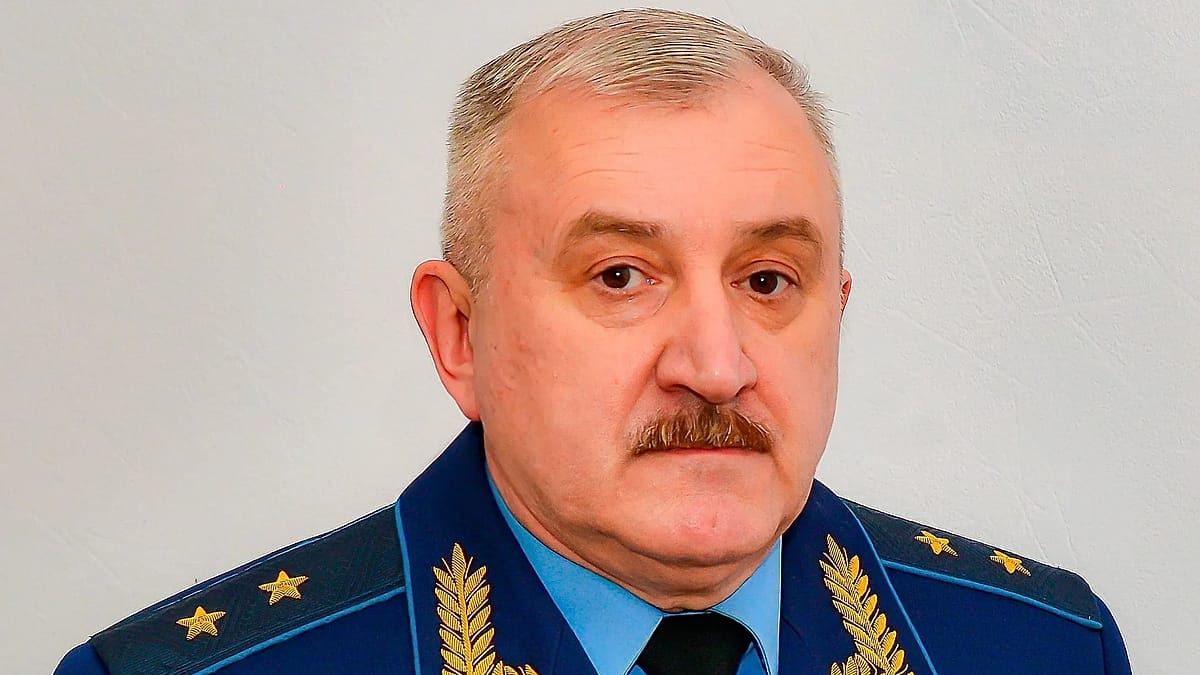
Russian authorities have detained Yuri Grekhov, the deputy commander-in-chief of the Aerospace Forces (VKS), on charges of accepting a particularly large bribe. The arrest marks the latest in a string of corruption cases against senior military figures that began after President Vladimir Putin replaced his defence minister in 2024.
Grekhov, 64, was responsible for procurement of aircraft, munitions, missiles and air defence systems. Under Russian law, the charge carries a prison sentence of up to 15 years. He has been on the European Union sanctions list since 2022, when Brussels held him responsible for Russian strikes on military and civilian sites following Moscow's full-scale invasion of Ukraine.
A career officer since 1979, Grekhov took up his current post in 2021 under Alexander Chaiko, after commanding the air and missile defence forces from 2018 to 2021. Unlike most of the other officials detained in recent cases, Grekhov is a serving officer, making him one of the most senior figures to face investigation while still in active duty.
The VKS controls Russia's military aviation, space operations and strategic missile defence. It has played a central role in the strikes on Ukrainian cities and infrastructure throughout the war, which have intensified as winter sets in. The renewed drone attacks have killed civilians and crippled Ukraine's power grid, underscoring the military's continued relevance.
String of arrests since Shoigu's removal
At least a dozen senior ministry employees and generals have been detained or become criminal suspects since Andrei Belousov replaced the dismissed Sergei Shoigu as defence minister in 2024. Belousov, an economist with no military background, was appointed with an explicit mandate to impose financial discipline on the defence ministry, in what Moscow described as a crackdown on corruption within military ranks.
The most prominent case was the arrest of former Deputy Defence Minister Timur Ivanov in April 2024. A close associate of Shoigu for more than a decade, Ivanov was convicted of taking a particularly large bribe in Defence Ministry contracting work, embezzlement and money laundering. He was sentenced to 13 years in a penal colony and fined 100 million roubles (€1 million).
Former first deputy defence minister Ruslan Tsalikov was detained in March 2026 on charges of creating a criminal organisation, embezzlement and laundering budget funds. In November he received 10 years in a high-security penal colony and a fine of 500 million roubles (€5 million).
Others detained for bribery and embezzlement include former Deputy Chief of the General Staff Vadim Shamarin, sentenced to seven years, former head of the Defence Ministry's Main Personnel Directorate Yuri Kuznetsov, sentenced to 12 years, and former Deputy Defence Ministers Dmitry Bulgakov and Pavel Popov.
Several Western governments have assessed that the prosecutions also serve to selectively remove officials who have fallen out of favour with the Kremlin. The pattern allows Moscow to present itself as enforcing accountability while using criminal charges as a tool of internal political control.
The arrests come as Russia continues to face international scrutiny over its military actions. NATO has responded to incidents near the alliance's borders, including drone incursions over Latvia and missile crossings into Poland, which have heightened tensions in the Baltic region. Meanwhile, the EU has maintained its sanctions regime, and enlargement talks with Montenegro and Moldova continue, reflecting the bloc's broader security concerns.



