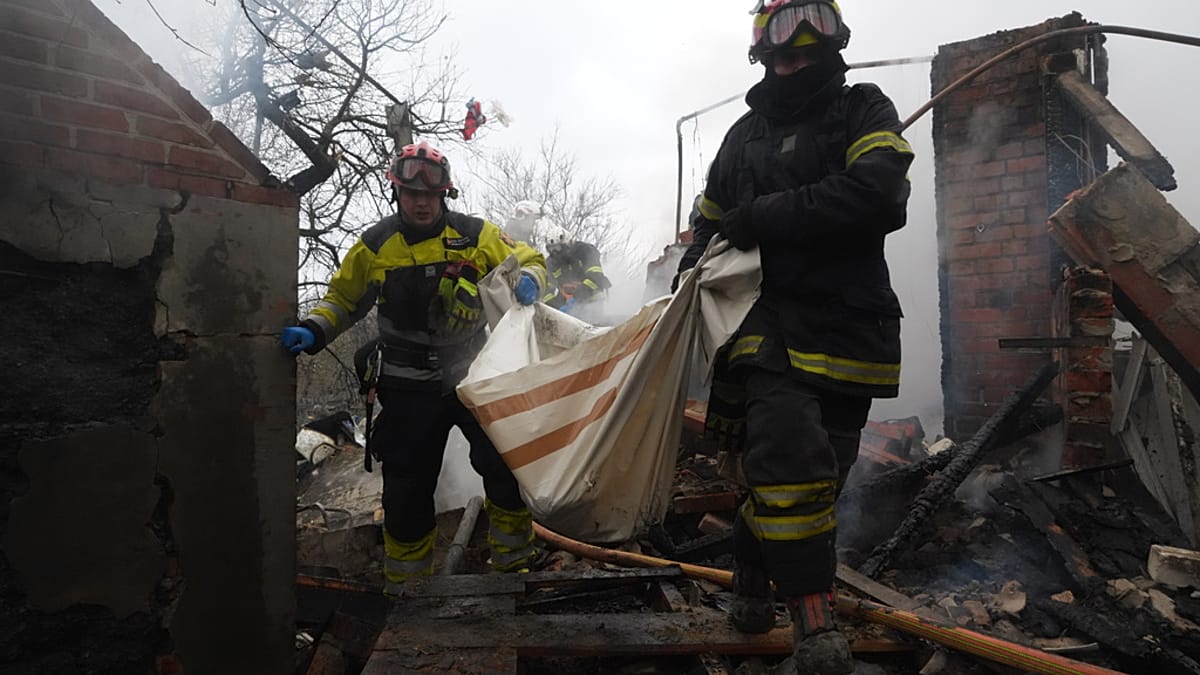
Russian forces launched a massive wave of drone attacks on Ukraine overnight, striking energy infrastructure, railways, and residential areas across nine regions. Ukrainian air defences intercepted 110 of the 155 drones, but impacts were recorded in multiple locations, leaving thousands of households without power as winter temperatures bite.
Prime Minister Denys Shmyhal said the strikes targeted civilian infrastructure, including railway lines, power stations, and factories. In the Chernihiv region city of Nizhyn, two people were killed at an industrial site, with fears that more may be trapped under the rubble. In Izium, Kharkiv region, an 86-year-old woman died and six others were injured when residential buildings and vehicles were hit. Another person was killed in Kryvyi Rih, and three more were wounded in Kharkiv city.
The attacks forced Ukraine to halt all electricity exports, while imports reached their highest level since mid-June, according to the Centre for Economic Strategy. Since September, Russia has carried out more than 1,000 strikes on Ukraine's power grid, targeting not only generation facilities but also high-voltage substations that deliver electricity to consumers. The latest strikes damaged equipment in Dnipropetrovsk, Zaporizhzhia, Kirovohrad, Sumy, Kharkiv, and Kherson regions, prompting emergency shutdowns.
Ukraine's counter-strikes
In response, Ukrainian drones struck a combined heat and power plant in Yefremov, Tula region, which is part of the Rosatom state corporation, as well as a synthetic rubber plant that produces components for solid rocket fuel, including for Iskander ballistic missiles. This was at least the third attack on the chemical complex in the past year. The plant has been under Ukrainian sanctions since May 2023.
Ukrainian forces also reported destroying a camouflaged oil depot in occupied Luhansk region that was supplying fuel to Russian units. President Volodymyr Zelensky said Ukrainian strikes on Russian refineries and defence industry facilities had produced "results" in several regions, including Samara, Nizhny Novgorod, Krasnodar, Rostov, Volgograd, Stavropol, Bryansk, Perm, and Tula, as well as in Bashkortostan and Tatarstan, and in the Black Sea.
"Ukraine is absolutely right to respond to every Russian strike," Zelensky said. "And I thank our Ukrainian defence forces for ensuring that the responses are accurate."
The Russian Defence Ministry claimed to have shot down 318 Ukrainian drones over ten regions and illegally annexed Crimea. In Novorossiysk, three people were injured in a drone attack, while two were killed in Bryansk region. A massive drone attack was also reported on Saint Petersburg and the Leningrad region, with authorities saying 45 drones were downed.
The escalation comes as European allies watch closely. The EU's €45 billion loan to Ukraine remains a key lifeline, but EU leaders are deadlocked over the bloc's budget, with Ukraine aid hanging in the balance. Meanwhile, NATO has sent AWACS surveillance planes to Poland after Russian missiles crossed into its airspace, and Estonia has closed all five road crossings on its Russian border amid security concerns.
As winter deepens, the humanitarian toll of Russia's campaign against Ukraine's energy infrastructure is likely to grow. The World Health Organization has warned that millions of Ukrainians face a difficult winter without reliable heating and electricity. The latest strikes underscore the urgent need for continued international support for Ukraine's air defences and energy grid repair.



