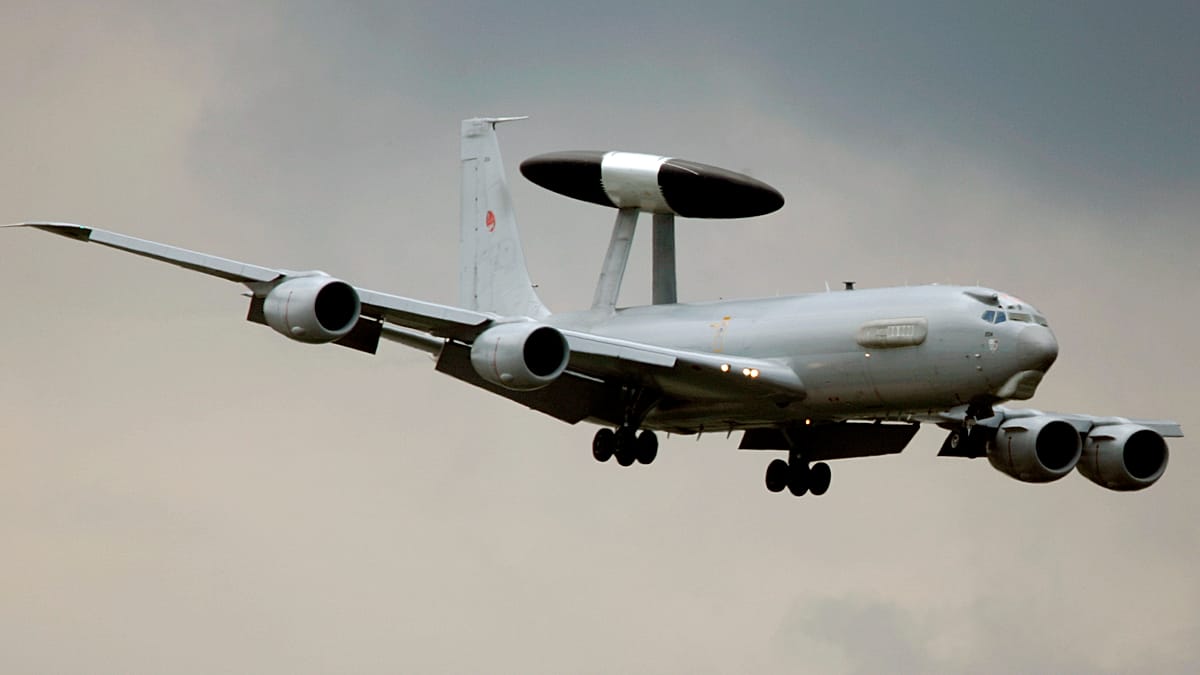
When a radar sits on the ground, the horizon limits its view. Low-flying aircraft or cruise missiles can slip behind hills or the curvature of the Earth, invisible until they are dangerously close. NATO's answer has long been to lift that radar into the sky, aboard a modified Boeing 707, where a rotating dome scans the horizon from above and a crew of specialists interprets the signals, relays warnings, and, when necessary, directs fighter jets.
That capability is now being deployed to Poland. On 20 November, the Polish prosecutor's office reported that three Russian H-101 cruise missiles had crashed on Polish soil. Three days later, NATO confirmed that General Alexus Grynkewich, commander of Allied Air Command, had authorised the forward deployment of an AWACS aircraft. The fleet, based at Geilenkirchen in Germany, has been a fixture of the alliance's eastern flank monitoring since 2022, but this marks a more visible step in response to a direct incident.
More than a flying radar
AWACS stands for Airborne Warning and Control System. The most recognisable feature of the Boeing E-3 Sentry is the nine-metre rotating radome mounted above the fuselage. That dome houses a radar that scans the surrounding airspace, while the crew on board cross-checks the detections with data from other sources to build a comprehensive picture of air traffic.
That picture is not just for the crew. It can be transmitted in real time to fighter aircraft, ships, and ground control centres, allowing units from several countries to follow the same air situation and coordinate their response. In a fast-moving incident, this shared awareness is often as important as early detection itself.
The incident in Poland is a case in point. When a missile crosses a border, the critical questions are: how quickly is it detected, how fast is the alert passed to the right people, and does the pilot of an allied fighter see the same picture as the Polish control centre? A flying radar helps answer all three.
A Cold War tool with a busy history
NATO's first E-3s entered service in 1982, giving the alliance a jointly operated surveillance and control capability. By the end of the Cold War, they were already needed elsewhere. After Iraq invaded Kuwait in 1990, AWACS aircraft were deployed to eastern Turkey to reinforce the alliance's southern flank.
In the 1990s, the Balkans became their main theatre. From 1992, AWACS monitored the airspace over the former Yugoslavia, later helping to enforce the no-fly zone over Bosnia and Herzegovina. They were also used during the 1999 Kosovo crisis, where continuous surveillance was increasingly complemented by the coordination of multinational air operations.
One of the fleet's most unusual missions came after the terrorist attacks of 11 September 2001. At Washington's request, seven NATO AWACS flew to the United States to help monitor American airspace. Operation Eagle Assist involved 830 personnel from 13 allied countries and flew more than 360 sorties until May 2002. It was one of the first measures taken after NATO invoked Article 5, the collective defence clause.
In Libya in 2011, AWACS helped enforce the no-fly zone and supported naval forces enforcing an arms embargo. The final flight of NATO's Libya operation was an AWACS sortie. Between 2011 and 2014, they performed airspace surveillance and air traffic control duties in Afghanistan. From 2016, aircraft flying from Konya in Turkey provided surveillance data to the international coalition against Islamic State, though directing air strikes remained the responsibility of participating nations.
The same monitoring capability has also been used in peacetime, for example to secure the 2004 Athens Olympics and the 2006 football World Cup in Germany.
What comes next?
The E-3 fleet is ageing, and NATO is already planning its replacement. At the alliance's summit in Ankara in July, eleven allies announced they would jointly acquire Saab GlobalEye aircraft. The Swedish system, mounted on a Canadian Bombardier airframe, uses an elongated radar fairing rather than the distinctive circular dome. According to NATO, the new aircraft will be able to track targets on land and at sea as well as in the air.
Technology is changing, but the incident in Poland shows why the capability introduced during the Cold War is still essential. In a border-area incident, the time between first detection and alert can be a matter of seconds, and the ability to share a common air picture across national boundaries is what makes collective defence work. A flying radar, whether it is a Boeing E-3 today or a Saab GlobalEye tomorrow, remains a vital part of that equation.



