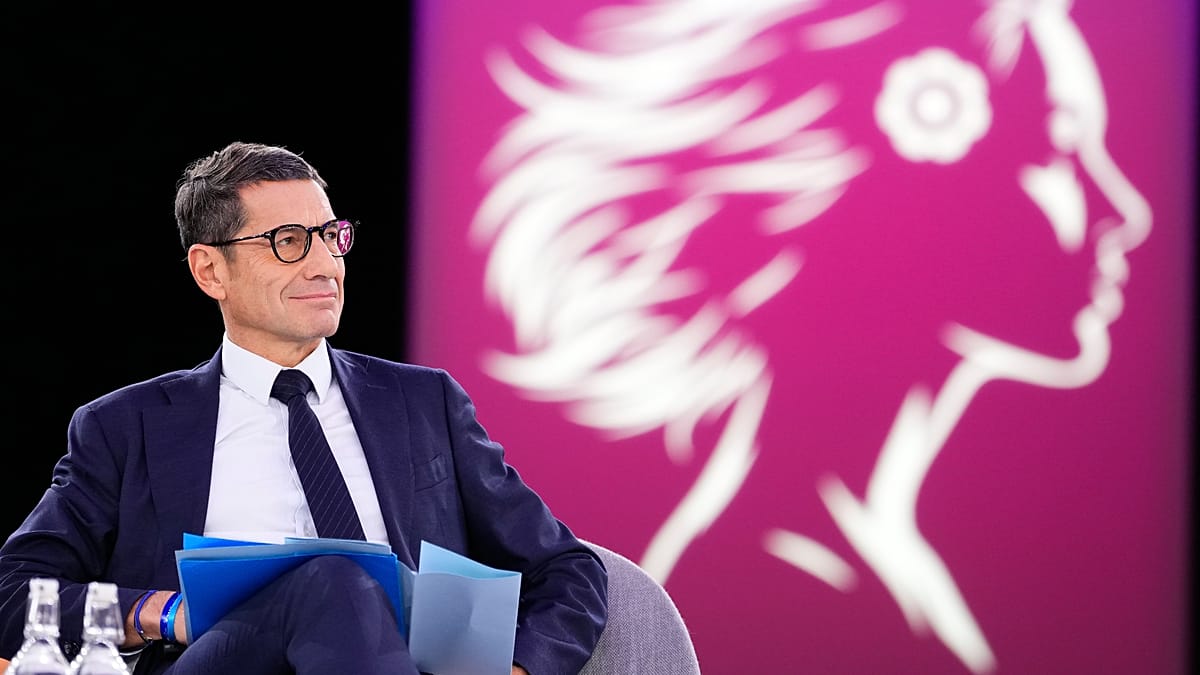
Five months before France's presidential election, the annual congress of the Association of Mayors of France (AMF) in Paris turned into a political marketplace. With around forty declared or potential candidates, the race is crowded, but only those who gather 500 endorsements from elected officials—most of them mayors—will make the ballot.
The congress, held this week, gave contenders a chance to court the roughly 34,000 mayors who represent the largest pool of potential sponsors. Many of these local officials run without a party label, making them a coveted audience for candidates seeking to demonstrate grassroots support.
Lisnard: local action against 'harmful' rules
David Lisnard, the mayor of Cannes and leader of the conservative Nouvelle Énergie party, was re-elected as AMF president on Wednesday. Speaking to Euronews, he framed his presidential bid around a critique of over-centralisation and bureaucratic red tape.
“We must regain the ability to act and let the local level show the way,” Lisnard said. He argued that while rules are necessary, “like cholesterol or technocrats, too much is harmful.” His remarks resonate with a broader frustration in rural France, where many feel decisions are made in Paris without regard for local realities.
Lisnard's programme includes cutting public spending and taxes, easing business regulations, and sharply reducing immigration. He has cited Argentine President Javier Milei as a model for radical economic reform and promised to “turn off the tap” on immigration. His stance has drawn criticism from Marine Le Pen, who accused him of seeking to “grind down” workers' rights.
On foreign policy, Lisnard warned against “illiberal empires” with expansionist ambitions, naming Russia and China, and also called out radical Islamism as a threat to democracy.
His rising poll numbers come amid divisions within the centre-right, with some scenarios placing him ahead of former Prime Minister Édouard Philippe, once seen as a strong challenger to Le Pen.
De Villepin: France's triple debt
Dominique de Villepin, a former prime minister who failed to secure the required endorsements in 2012, is trying again. He told Euronews that France must address its “triple” debt—financial, ecological, and social—to restore its credibility.
“We have a significant financial debt to settle,” he said, adding that the country also faces an ecological debt and a social debt “in a country where inequalities are increasing.” De Villepin called for a “strong France” that can regain its health and standing in Europe and the world.
Glucksmann: Europe's eyes on France
Centre-left hopeful Raphaël Glucksmann, leader of Place Publique, stressed the European dimension of the vote. “The eyes of Europe are on France,” he told Euronews, noting that the outcome will shape the continent's future. He referred to the 18 November summit in Shenzhen involving Donald Trump, Xi Jinping, and Vladimir Putin, describing them as “masters of the world who intend to share it.”
Glucksmann's warning echoes his broader argument that France's 2027 election will be a turning point for Europe. As he has argued before, the choice French voters make will resonate far beyond the country's borders.
The race remains fragmented. Polls currently put Marine Le Pen of the National Rally in the lead, followed by Jean-Luc Mélenchon of France Unbowed on the left. Lisnard's centrist-right candidacy adds another layer of uncertainty, as does the possibility of other contenders entering the field.
For the mayors gathered in Paris, the endorsements they grant could prove decisive. As Lisnard himself acknowledged, the AMF's role is not just administrative but political—a fact that has drawn scrutiny over whether he is using his position to advance his presidential ambitions.
With the first round of voting set for April, the coming weeks will reveal which candidates can clear the 500-endorsement hurdle. For now, the congress has offered a glimpse of the competing visions for France's future—and the stakes for Europe as a whole.



