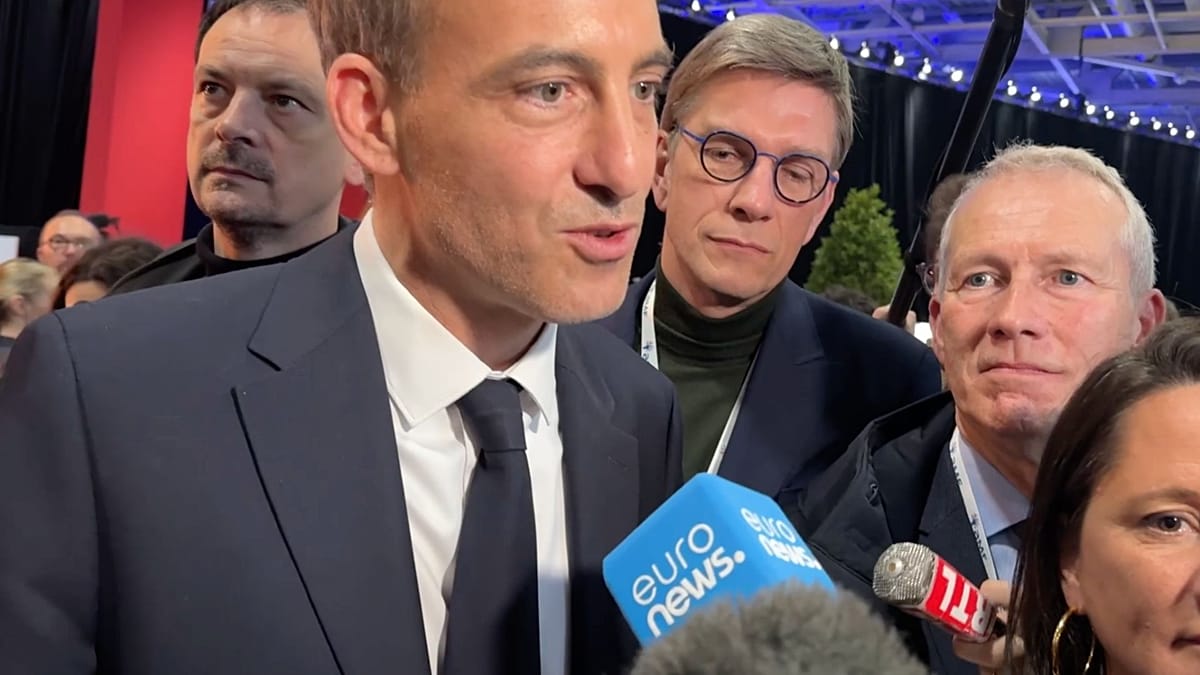
With five months to go before France's presidential election, MEP and Place Publique leader Raphaël Glucksmann has cast the vote as a turning point not just for his country but for the entire continent. Speaking on the sidelines of a mayoral congress in Paris on Wednesday, he warned that “the entire European project risks being lost if France falls into the anti-European camp.”
The centre-left candidate, who is polling between 8 and 11.5 percent, is struggling to break through in a fragmented political landscape. But he insists that the stakes could hardly be higher: “France's vote will shape the destiny of the entire European continent.”
A divided left and a resurgent far right
Polls currently put Marine Le Pen's far-right National Rally ahead, followed by Jean-Luc Mélenchon's hard-left France Unbowed. Glucksmann, who advocates a pro-European, social-democratic model, faces an uphill battle. The traditional left and right have struggled to define themselves since Emmanuel Macron's centrist victory in 2017, and the left remains split between those who want to reform the EU from within and those who want to defy it.
Critics, including within France Unbowed, dismiss Glucksmann as a Macron-lite figure offering insufficient change. He pushed back in an early November interview with BFMTV, saying: “If I were in the slightest bit attracted to Macronism, I would have accepted all the offers made to me over the past ten years.”
Europe at the centre of the campaign
The future of France's relationship with the EU has become a defining issue, with divisions over integration, sovereignty, and support for Ukraine. The outcome is already casting a shadow over negotiations on the bloc's long-term budget for 2028–2034. Macron has reportedly pressed EU leaders to reach a deal by December, warning he might withdraw from talks if no agreement is reached by then.
A senior European diplomat acknowledged that the French election is the “primary concern” hanging over the budget discussions. “The prospect of a potential Le Pen victory — and its consequences — is always in the back of everyone's mind,” the diplomat said.
Both Le Pen and Mélenchon advocate greater national sovereignty and challenge aspects of European integration, albeit from different ideological angles. Le Pen wants to cap France's net contribution to the EU budget at €5 billion a year and scrap a range of EU regulations on business, agriculture, energy, and the environment. She insists that “being pro-France does not mean being anti-Europe.”
Mélenchon's party, meanwhile, backs scrapping rules that conflict with French interests, including the EU migration pact and parts of European defence policy. He has called for France to “disobey anything coming from Europe that conflicts with the interests of the French people” and to amend the EU's founding treaties, warning that otherwise “we will perish politically, socially, and industrially.” His party has also proposed cutting France's net EU contribution by around €9 billion.
Ukraine: a stark contrast
On Ukraine, Glucksmann advocates a significant increase in French and European military and financial support. He proposes seizing approximately €210 billion in frozen Russian state assets to finance Ukrainian assistance, expanding European military cooperation, and protecting parts of Kyiv's airspace against Russian missile and drone attacks.
The National Rally has said it will not continue financial assistance to Ukraine beyond existing commitments, citing the EU's €90 billion support loan and pledging “material donations, humanitarian aid, and more active diplomacy.” Le Pen has faced scrutiny over her past ties to Russia, including a 2017 meeting with Vladimir Putin and a party loan from a Russian bank that was repaid by 2023.
France Unbowed's 2027 programme broadly supports Ukraine but draws red lines on long-range missiles, ground troops, and Ukraine's EU accession. The party has faced accusations of ambiguity, particularly after Mélenchon suggested that Ukraine's deep-strike attacks might be linked to the escalation of the Russian threat.
As the campaign intensifies, the rest of Europe is watching closely. The outcome of France's vote will not only determine who leads the country but could also reshape the EU's direction on everything from budget and defence to the very future of integration. For Glucksmann, the choice is existential: “The only obstacle in this sharing of the world is a powerful, independent and free Europe.”



