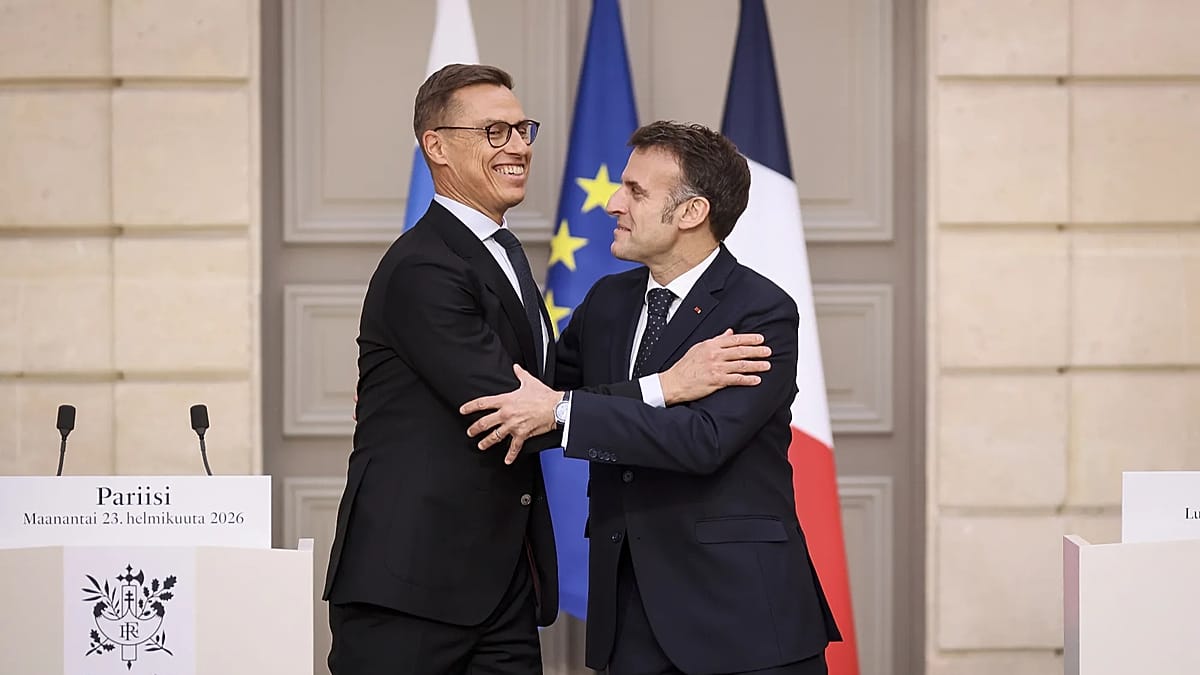
Finland and France have agreed to deepen their defence partnership, with Helsinki formally signing up to Paris's initiative on forward nuclear deterrence. The move, announced on Monday, is intended to bolster European security at a time when the continent's defence architecture faces renewed scrutiny.
In a joint statement, the two governments described the decision as an "important step for European security, and for bilateral cooperation." They said it would "strengthen their partnership, and offer opportunities for strategic signalling, as well as the ability to manage escalation below the nuclear threshold." A "Nuclear Steering Group" is to be established within the coming months to oversee implementation.
Finnish President Alexander Stubb was quick to frame the agreement within existing alliances. In a post on X, he said Finland's "foremost priority" remains acting as part of NATO and the European Union, and that the French initiative would not "replace or overlap with NATO's nuclear deterrence." He added that Finland "does not intend to station nuclear weapons on its territory in peacetime."
The French initiative, which has already attracted the United Kingdom, Germany, Poland, Sweden, the Netherlands, Belgium, Greece, Denmark, and Norway, aims to deepen nuclear cooperation across Europe through joint exercises and shared strategic thinking. Under the framework, participating countries could potentially host French nuclear-capable aircraft on a temporary basis, though Paris retains exclusive control over its arsenal, with the final decision on use resting with the French president.
Estonia may follow
Estonian Prime Minister Kristen Michal told AFP that Tallinn is also "in discussion" with Paris about possible cooperation. Speaking on the sidelines of the European Arctic Summit in northern Finland, Michal noted that joining is not a simple matter: "This is not this kind of (initiative) that you just join ... It needs certain capabilities, readiness and so on."
He also underscored Estonia's existing security arrangements: "We are under NATO's nuclear umbrella already. And France is also backing up our independence with the troops in Estonia. So if the cooperation can be deeper in nuclear field, that probably will go so." France has maintained a contingent of around 300 troops in Estonia since March 2017 as part of NATO's enhanced forward presence in the Baltic states.
The development comes as European leaders grapple with questions about the continent's long-term defence posture, particularly in light of concerns over NATO's deterrence and the need to counter hybrid threats. While the initiative is separate from NATO structures, it is seen as a complement to the alliance's nuclear umbrella, offering an additional layer of strategic dialogue and capability-sharing among European partners.
For Finland, which shares a long border with Russia and joined NATO in 2023, the decision reflects a broader shift in its security policy. The country has historically maintained a policy of military non-alignment, but Russia's full-scale invasion of Ukraine prompted a rapid reassessment. Joining the French initiative does not alter Finland's nuclear stance, but it does signal a willingness to engage more deeply in European defence cooperation.
The French proposal, first floated by President Emmanuel Macron, has gained traction as a way to foster greater European strategic autonomy without duplicating NATO's role. Participating countries engage in joint exercises and discussions on nuclear doctrine, but the ultimate decision-making authority remains in Paris. This arrangement has been carefully designed to reassure allies that the initiative is not a substitute for NATO's collective defence guarantees.
Analysts note that the initiative also carries symbolic weight, reinforcing the idea that European nations are willing to take on more responsibility for their own security. At the same time, it raises questions about the future of nuclear sharing arrangements in Europe and the balance between national sovereignty and collective defence.
As more countries consider joining, the initiative is likely to become a central element of European security discussions. For now, Finland's participation marks a significant step, and Estonia's potential involvement could further expand the framework's reach. The coming months will show how the Nuclear Steering Group translates these commitments into concrete cooperation.