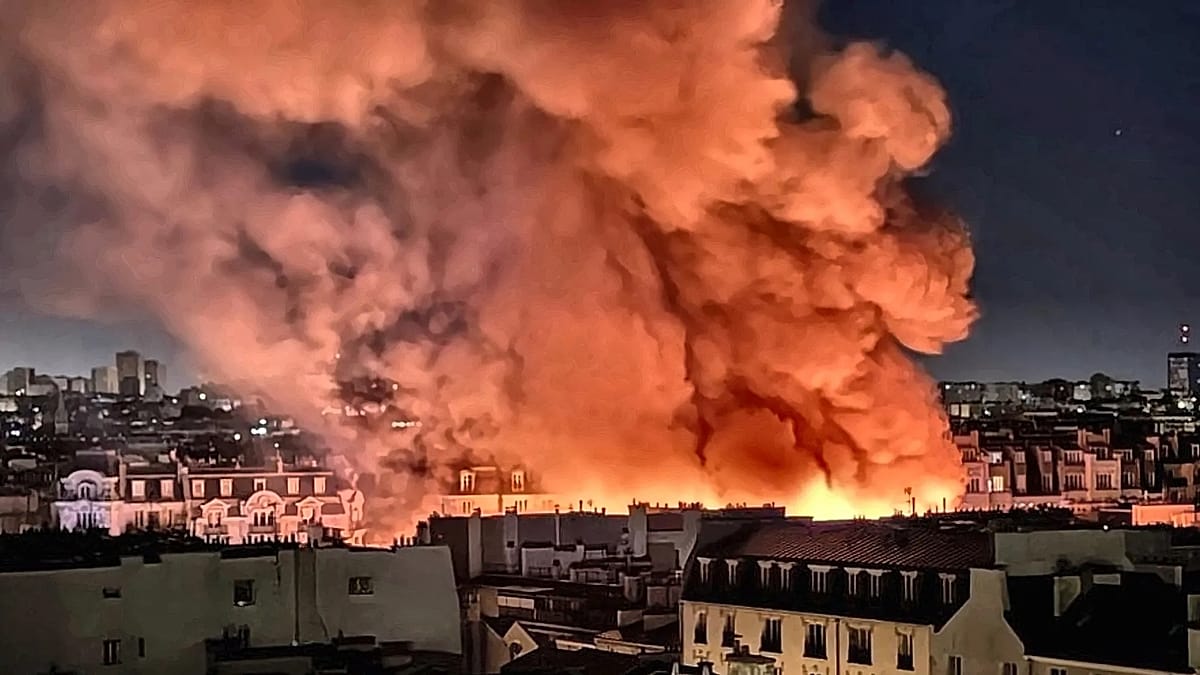
A fire has destroyed the Marché Couvert des Enfants Rouges, the oldest covered food market in Paris, in the early hours of Monday morning. The market, in the central Marais district, had been in continuous operation since 1615 and was a fixture of the city's street-food scene.
Lieutenant Colonel Pierre de Bouvier, speaking to reporters at the scene before dawn, confirmed the scale of the damage. "The market was completely destroyed," he said, adding that its metal frame had "partially collapsed" inside. "Nothing remains of the covered market."
The fire broke out overnight from Sunday to Monday. Ariel Weil, mayor of the central Paris district, said he was relieved that the blaze had been brought under control and did not spread. "The worst has been avoided," he said. "No neighbouring buildings have been affected." No casualties have been reported.
A name rooted in the city's charitable past
The market's name — Enfants Rouges, or "red children" — refers to the red uniforms worn by orphans at a nearby hospital until 1772. The site has served as a food market for more than four centuries, surviving revolutions, occupations and waves of urban redevelopment that erased much of the surrounding medieval fabric.
In recent decades it became best known for prepared food rather than raw produce, with stalls offering Moroccan, Japanese, Italian and West African dishes alongside traditional French fare. This year, the US magazine Food & Wine ranked it fifth worldwide among street-food destinations, behind venues in London, Bangkok, Lyon and Mexico City — a rare international accolade for a Paris market better known to locals than to tourists.
The loss will be felt well beyond the Marais. The market's traders were small, independent operators, and its closure removes one of the few remaining affordable eating spots in a district increasingly dominated by luxury retail. For visitors, it was a counterpoint to the city's grand covered halls such as Marché Bastille or the Marché d'Aligre, offering a more intimate, improvised version of Parisian food culture.
What happens next
Authorities have not yet indicated a cause. An investigation is expected to examine whether the fire was accidental or deliberate, and whether the structure's age and metal framing played a role in how quickly it spread. The City of Paris has not announced plans for the site, though the market's historic status and its location in a protected district mean any reconstruction would face scrutiny from heritage authorities.
For now, the immediate question is what becomes of the traders who worked there. Many operated under short-term arrangements typical of covered markets, and a prolonged closure could push them to relocate or close altogether. Local officials have said support will be discussed in the coming days.
The fire is the second major blow to a Paris food landmark in recent years, following the 2019 blaze at Notre-Dame Cathedral, which also prompted a national debate about the fragility of the capital's historic fabric. Unlike Notre-Dame, the Enfants Rouges market was not a monument in the conventional sense — it was a working space, and its value lay in daily use rather than architectural grandeur.
That distinction may shape how the city responds. Rebuilding a cathedral is a matter of state; rebuilding a market is a matter of neighbourhood. But for the residents of the Marais and the traders who built their livelihoods there, the loss is no less concrete.