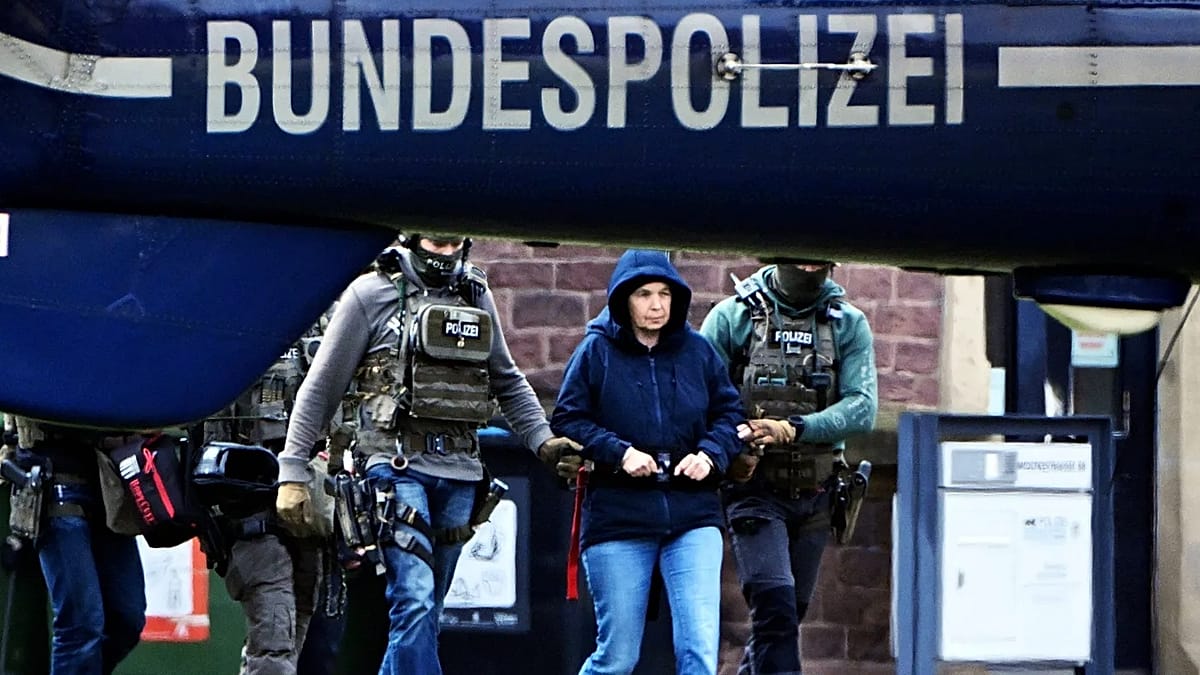
A German court in Celle sentenced Daniela Klette, a 67-year-old former member of the Red Army Faction (RAF), to 13 years in prison on Wednesday for a series of armed robberies carried out while she was a fugitive. The verdict, delivered under tight security, marks the first major conviction of a former RAF militant in decades.
Klette was arrested in February 2024 at her apartment in Berlin's Kreuzberg district, where she had lived under a false identity for roughly 20 years. Police found a Kalashnikov assault rifle, explosives, and large sums of cash at the scene. She had been on the run since the late 1990s, after the RAF formally disbanded in 1998.
Robberies to finance a life in hiding
The court found Klette guilty of six counts of "particularly serious robbery" committed between 1999 and 2016, along with charges of extortion and arms violations. Prosecutors said the trio—Klette, Burkhard Garweg (now 57), and Ernst-Volker Staub (now 72)—stole a total of €2.4 million from supermarkets, cash-in-transit vans, and other targets. The robberies were carried out with a division of labour: Klette often acted as the getaway driver and once wielded a realistic-looking dummy bazooka while her male accomplices carried assault rifles.
Presiding Judge Lars Engelke noted that the three lived in hiding since at least 1999, rented getaway cars under false identities, and referred to the armed robberies as "their work" and primary source of income. Police continue to search for Garweg and Staub, who are believed to be still alive.
Klette's trial drew a small crowd of sympathisers to the public gallery. According to an AFP journalist, some shouted "Free Daniela!" and one woman was removed by security personnel. The case has revived public memory of the RAF, a radical left-wing group that emerged from the student protest movement of the 1960s and 1970s. The group, also known as the Baader-Meinhof Gang, targeted what it saw as US imperialism and a German state still tainted by former Nazis. The RAF is blamed for 34 deaths, including police officers, judges, American soldiers, and a former SS officer turned industrialist.
Separate proceedings for earlier attacks
Klette faces additional charges in a separate court for three politically motivated attacks in the 1990s, while the RAF was still active. Prosecutors accuse her of involvement in a plot to bomb Deutsche Bank's offices in 1990, a machine-gun attack on the US embassy in Bonn in 1991, and a bombing at Weiterstadt prison near Frankfurt in 1993. Those proceedings are ongoing.
The case underscores the enduring legacy of the RAF's "third generation," which operated in the 1980s and 1990s. Unlike earlier RAF members who were captured or killed, Klette, Garweg, and Staub managed to evade detection for decades, blending into urban life. Klette's arrest came after a tip-off and a DNA match from a cold case review.
Germany's wealth inequality has been a recurring theme in public discourse, with a recent report showing that Germany's 5,000 ultra-rich hold over a quarter of the nation's financial wealth, a fact that resonates with the RAF's anti-capitalist rhetoric. Meanwhile, the country's shifting geopolitical alliances—such as Germany's China trade visit undermining EU push for a tougher stance—continue to shape its political landscape.
The verdict in Celle is likely to be appealed. For now, it closes a chapter on one of the longest-running manhunts in German criminal history, even as two fugitives remain at large.