For most travellers, airports are functional spaces—places to grab a coffee, clear security, and wait for a boarding call. But a growing number of terminals are challenging that notion, offering architectural ambition that rivals city landmarks. The Prix Versailles, an international prize celebrating contemporary architecture, has just announced its seven most beautiful airports for 2026, and only one European airport made the cut: Frankfurt Airport's Terminal 3.
Frankfurt's Terminal 3: A City Within an Airport
Opened in April 2025, Terminal 3 is the culmination of one of the continent's largest infrastructure projects. Spanning 1.3 square kilometres—roughly the size of Frankfurt's city centre—the terminal is designed to handle 19 million passengers annually across its three piers (G, H, and J). A future expansion adding Pier K could push capacity to 25 million.
The terminal's opening coincided with the closure of Frankfurt's Terminal 2 for major refurbishment, the first such shutdown in over three decades. As a result, all 57 carriers previously operating from Terminal 2 have begun relocating to the new facility, including Cathay Pacific, China Airlines, Emirates, Etihad Airways, Korean Air, and Qatar Airways.
German architect Christoph Mäckler conceived the terminal not as a mere transit hub but as a place that mimics urban life. Boarding gates and lounges are designed to resemble streets and public squares, encouraging passengers to gather and linger. “Airports tend to receive more visitors than many city centres,” Mäckler noted. “This makes it even more important for airports to also perform some of the same functions as cities. We’re making this happen in Terminal 3.”
The aesthetic choices reinforce that vision. Natural lighting floods the interior, complemented by warm materials such as jura limestone and travertine. Public art plays a central role: suspended in the terminal hall are three disc-shaped sculptures by German artist Julius von Bismark. Titled “The First, the Last, Eternity,” the rotating discs in shades of orange, red, and yellow shift continuously as travellers move through the space, challenging conventional perceptions of motion and stillness.
Jérôme Gouadain, Secretary General of the Prix Versailles, described contemporary airports as “inescapable hallmarks” of their region and era. “They are innovative, because they resolve the apparent conflict between the increasing frequency of travel and the need for speed… and the singularity of a form of tourism that aims to be accessible and that values people’s time in places that, in this day and age, can no longer be described as mere ‘transfer’ spaces,” he said. “And they are inescapable, in that this infrastructure leaves a lasting environmental footprint on the land but also on the history of humanity.”
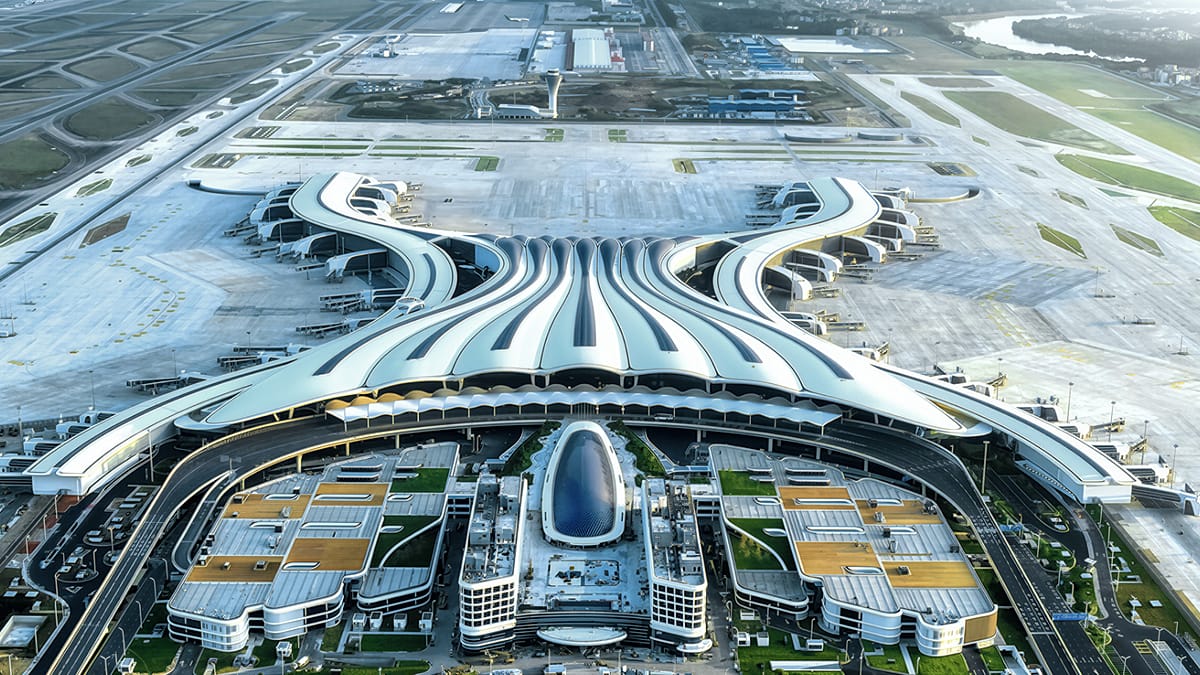
The other six winners span Asia and North America: Guangzhou Baiyun International Airport Terminal 3 (China), Lokapriya Gopinath Bardoloi International Airport Terminal 2 (India), Navi Mumbai International Airport Terminal 1 (India), Techo International Airport (Cambodia), Pittsburgh International Airport (USA), and San Diego International Airport Terminal 1 (USA).
For European travellers, Frankfurt's recognition is a reminder that the continent's airports can compete on design, not just efficiency. While Europe's best and worst airports are often ranked by punctuality and queues, the Prix Versailles list highlights a different metric: the quality of the built environment. As airports increasingly function as gateways that shape first impressions of a city or country, investing in architecture and public space becomes a matter of soft power.
Frankfurt's Terminal 3 may be the only European winner this year, but its design philosophy—treating an airport as a civic space—could inspire future projects across the continent. For now, it stands as a rare example of how infrastructure can be both functional and beautiful.