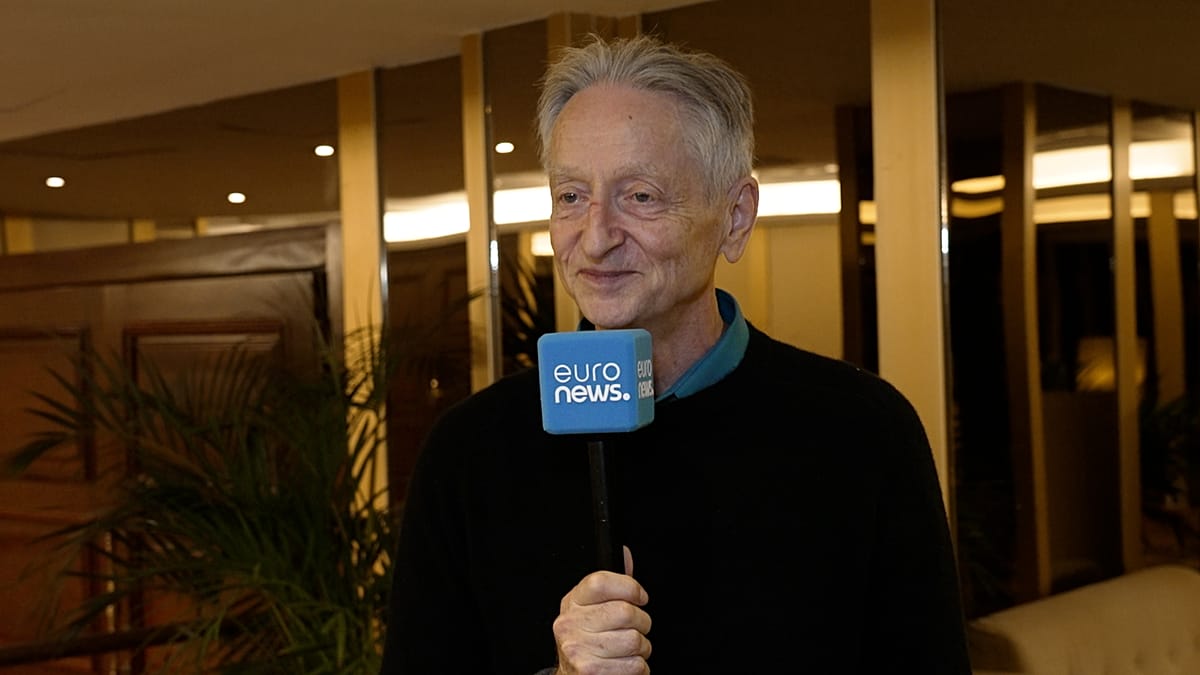
Geoffrey Hinton, the British-Canadian computer scientist often hailed as one of the godfathers of artificial intelligence, has spent decades building the mathematical foundations that power today's most advanced AI systems. But at the Starmus Festival in Trondheim, Norway, the 2023 Nobel Physics laureate struck a more cautious tone, urging researchers and policymakers to put human values at the heart of machine intelligence.
Hinton's early work on artificial neural networks in the 1980s and 1990s laid the groundwork for deep learning, the technique that now underpins everything from voice assistants to medical diagnostics. Yet he has become one of the most prominent voices warning that AI, if left unchecked, could spiral beyond human control.
From pioneer to prophet of caution
In conversation with Euronews Culture at the festival, which blends science and the arts, Hinton reflected on his shifting perspective. "I used to think that AI would just be a tool, like a super-efficient calculator," he said. "But the more I see how these systems learn and adapt, the more I realise they could develop goals of their own—goals that may not align with ours."
His concerns echo those of other tech leaders who have called for a pause in the development of the most powerful AI models. Hinton specifically pointed to the risk of autonomous decision-making in critical areas such as defence, healthcare, and finance, where a single algorithmic error could have devastating consequences.
"The Terminator is one of my favourite films," he admitted with a wry smile, referencing James Cameron's 1984 classic. "Not because I think robots will literally take over, but because it captures the idea of technology that outgrows its creators. That's a real possibility if we don't embed human ethics into the code."
Europe's role in shaping AI's future
Hinton's remarks come as the European Union pushes forward with the AI Act, a landmark regulatory framework that aims to classify AI applications by risk and impose strict requirements on high-risk systems. The continent, with its diverse mix of tech hubs from Berlin to Paris and Stockholm, is positioning itself as a global standard-setter for ethical AI.
"Europe has a unique opportunity," Hinton said. "You have a tradition of strong social protections and a willingness to debate the moral implications of technology. That's exactly what's needed right now."
He also warned against the concentration of AI power in a few large corporations, arguing that a more distributed, transparent approach would be safer. "We need to ensure that AI serves the many, not just the few," he added.
Hinton's call for a human-centred AI echoes recent debates in Brussels, where budget talks have stalled over how to fund digital transformation. He also pointed to the growing importance of data centre security, a topic that has gained urgency as European governments rethink their digital infrastructure.
Beyond the hype: practical steps
For Hinton, the path forward is not about halting AI research but about building in safeguards from the start. He advocates for "value alignment"—the idea that AI systems should be trained to understand and respect human preferences, even when those preferences are ambiguous or conflicting.
"It's not enough to make AI smart," he said. "We have to make it wise. That means teaching it to ask questions, to doubt itself, and to defer to human judgment when the stakes are high."
He also stressed the importance of interdisciplinary collaboration, bringing together computer scientists, philosophers, sociologists, and artists. "The arts are not a luxury," he said. "They help us imagine futures we might otherwise miss—both the good and the bad."
Hinton's message resonated with the festival's audience, which included researchers, students, and science enthusiasts from across Europe. Many left the session with a renewed sense of urgency, aware that the decisions made in the coming years will shape the continent's technological and ethical landscape for decades.
As AI continues to permeate every aspect of daily life—from the way we work to the way we vote—Hinton's warning serves as a timely reminder that the most powerful technology is the one that remains accountable to its creators. "We have a choice," he concluded. "We can let AI run wild, or we can guide it with the best of what makes us human."