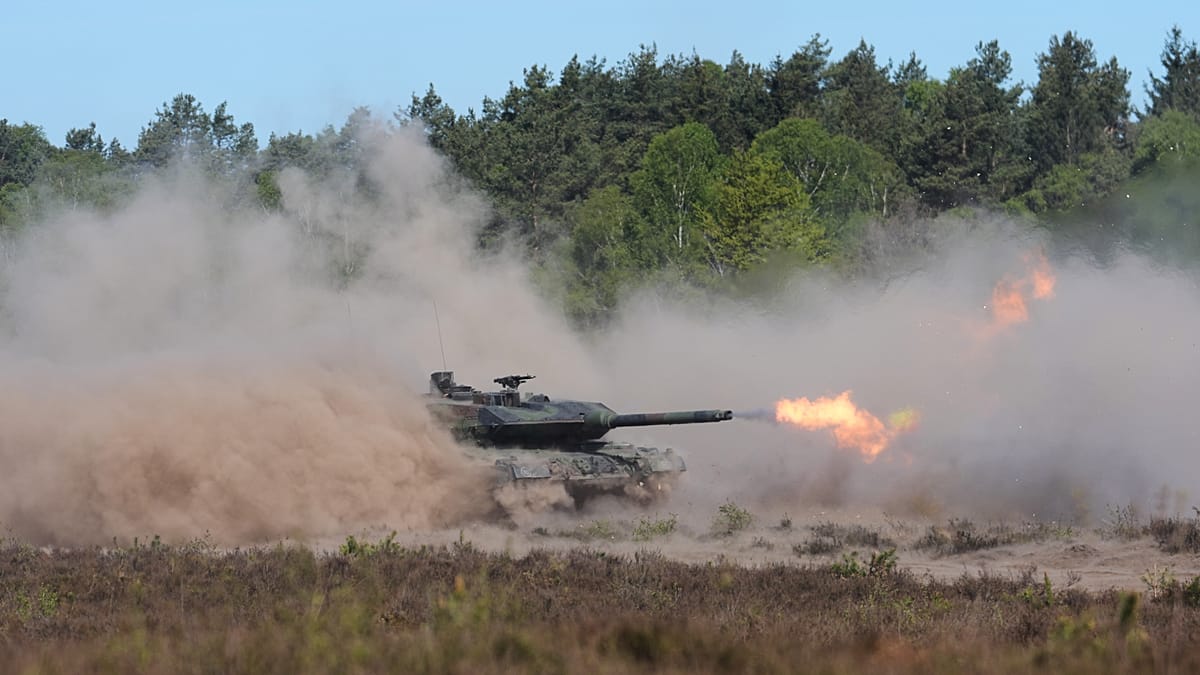
Since Russia's full-scale invasion of Ukraine, the Bundeswehr has returned to the centre of political debate in Berlin, with arguments over rearmament, conscription, and vast increases in defence spending. But how do Germans actually view their armed forces, and has public opinion shifted in recent years?
Dr Timo Graf, a senior researcher at the Bundeswehr's Centre for Military History and Social Sciences in Potsdam, explored those questions in his study, Germany in a Military Leadership Role? Public Opinion on Security and Defence Policy in the Federal Republic of Germany 2025. The research, part of a survey series dating back to 1996, uses around 300 questions to examine public attitudes on foreign policy, defence, and perceptions of the Bundeswehr.
A Sharp Decline in Transatlantic Trust
According to Graf, the clearest trend in the 2025 data was a sharp decline in trust in the United States as a NATO ally. Depending on the specific question, trust dropped by as much as 28 percentage points. At the same time, the figures point to a growing willingness among Germans to invest more in the country's own defence capabilities.
Before 2022, support for higher defence spending was relatively modest. It then rose sharply after Russia's full-scale invasion of Ukraine and has remained just below 60% ever since. The so-called 'Trump effect' provided a further boost. Last year alone, support increased by another seven percentage points to 65%, the highest level recorded since 1996.
Graf noted that the survey was conducted in spring 2025, shortly after Donald Trump returned to office. 'Even then, the damage to the US image in our survey was striking,' he said. Since then, events such as the Greenland controversy, the war in Iran, further criticism of NATO and Europe from Washington, and the US approach to Russia's war against Ukraine have likely influenced public perceptions. However, Graf cautioned that he has not yet seen this year's data, as the survey is still ongoing.
On some questions, only around a third of respondents still view the US as a reliable partner. Graf believes public opinion has now consolidated around a relatively hard core of committed transatlanticists, and that group is unlikely to shrink much further.
Nuanced Views on US Role
Despite the loss of trust, Germans maintain a pragmatic view of the relationship. While support for the statement 'the US is a reliable partner for Germany' has fallen by 28 percentage points, 58% still agree that the US should remain involved in Europe's defence, with only 18% disagreeing. This suggests a clear majority recognises that Europe, and Germany in particular, remains heavily reliant on the United States for security.
Attitudes towards nuclear deterrence reflect this nuance. Around 46% still support keeping US nuclear weapons stationed in Germany as a deterrent against Russia, a figure that has even risen slightly. 'Even under Trump, many Germans would still prefer to have the US on their side, if that remains politically feasible,' Graf said. 'At the same time, there is a growing awareness of just how dependent Europe, and Germany in particular, still is on American military capabilities.'
The findings come as the EU races to finalise its defence omnibus, with divisions over eligibility persisting among member states. Meanwhile, German industry is adapting: Mercedes-Benz has pivoted to defence as the auto sector faces headwinds, reflecting a broader shift in the country's economic and security priorities.
Graf also addressed the idea that Germans, because of their history, have an inherently difficult relationship with the military. While many Germans remain cautious about the use of military force, he cautioned against mistaking that for pacifism. The study shows a relatively high level of public support for the Bundeswehr, with no significant generational divide in attitudes.