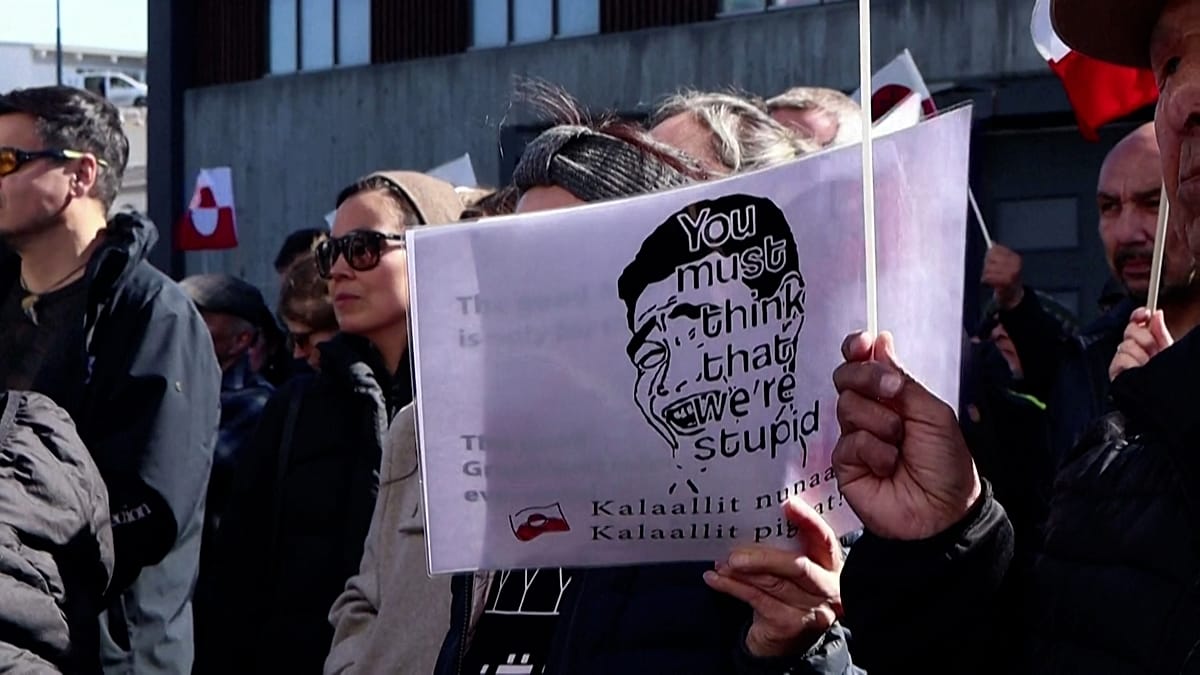
Hundreds of demonstrators gathered in Nuuk on Saturday to protest the United States' expanding military footprint in Greenland, chanting 'We are not for sale' and accusing Washington of treating the autonomous Danish territory as a geopolitical bargaining chip. The rally, organized by local civil society groups, underscored growing unease over what many see as a disregard for Greenland's self-governance.
The protest comes weeks after a US envoy urged Washington to rebuild its military presence on the island, citing strategic interests in the Arctic. Greenland, which gained home rule from Denmark in 2009, has its own government but relies on Copenhagen for foreign and defense policy. The US operates the Pituffik Space Base in the northwest, but recent proposals have included expanding facilities and increasing troop numbers.
Arctic Geopolitics and Local Resistance
Greenland's location between North America and Europe makes it a focal point for Arctic security, especially as melting ice opens new shipping routes and resource extraction opportunities. The US has long viewed the island as vital for missile warning systems and submarine surveillance. However, many Greenlanders resent being treated as a strategic asset rather than a sovereign people.
'We are not a colony anymore,' said Aleqa Hammond, a former prime minister and one of the protest's speakers. 'Our land is not for sale, and our future must be decided by us, not by foreign powers.' The sentiment echoes a long history of external interference, from Danish colonial rule to Cold War-era US bases.
The protest also highlighted tensions within the Kingdom of Denmark. While Copenhagen has generally supported US security interests, it has faced criticism for not consulting Nuuk more closely. Danish Prime Minister Mette Frederiksen has stated that any changes to the US presence would require Greenland's consent, but activists argue that the process lacks transparency.
Similar concerns have been raised in other parts of Europe, where local communities push back against foreign military installations. The protest in Nuuk mirrors broader debates about sovereignty and self-determination, as seen in protests against Russia's cultural return and Poland's growing soft power.
Economic and Environmental Dimensions
Beyond security, the US interest in Greenland is tied to its vast mineral wealth, including rare earth elements critical for green technology. Washington has sought to reduce reliance on China for these resources, and Greenland holds some of the largest untapped deposits outside Asia. However, mining projects have faced local opposition over environmental concerns.
'We see the US coming not just with soldiers but with mining companies,' said Kunuk Platou, a Nuuk-based activist. 'They want our uranium and our rare earths, but they don't care about our glaciers or our way of life.' The protest included signs reading 'Keep Greenland Green' and 'No to Arctic Militarization.'
The European Union has also taken an interest in Greenland's resources, signing a partnership agreement in 2023 to develop sustainable mining. But the EU's approach has been more cautious, emphasizing local consent and environmental standards. The contrast highlights the different strategies of global powers in the Arctic.
Greenland's government has sought to balance economic development with autonomy. Prime Minister Múte Bourup Egede has welcomed foreign investment but insists on strict conditions. 'We are open to cooperation, but it must be on our terms,' he said in a recent interview. 'Greenland is not a prize to be won.'
The protest in Nuuk is unlikely to halt US plans, but it signals a growing assertiveness among Greenlanders. As the Arctic becomes a theater of great-power competition, the island's 57,000 inhabitants are demanding a voice in their own destiny. For Europe, the situation serves as a reminder that security partnerships must respect local sovereignty, a lesson that resonates from the Balkans to the Baltic.
For now, the 'We are not for sale' movement plans further actions, including a petition to the United Nations. Whether Washington and Copenhagen listen remains to be seen, but the message from Nuuk is clear: Greenland will not be traded like a commodity.