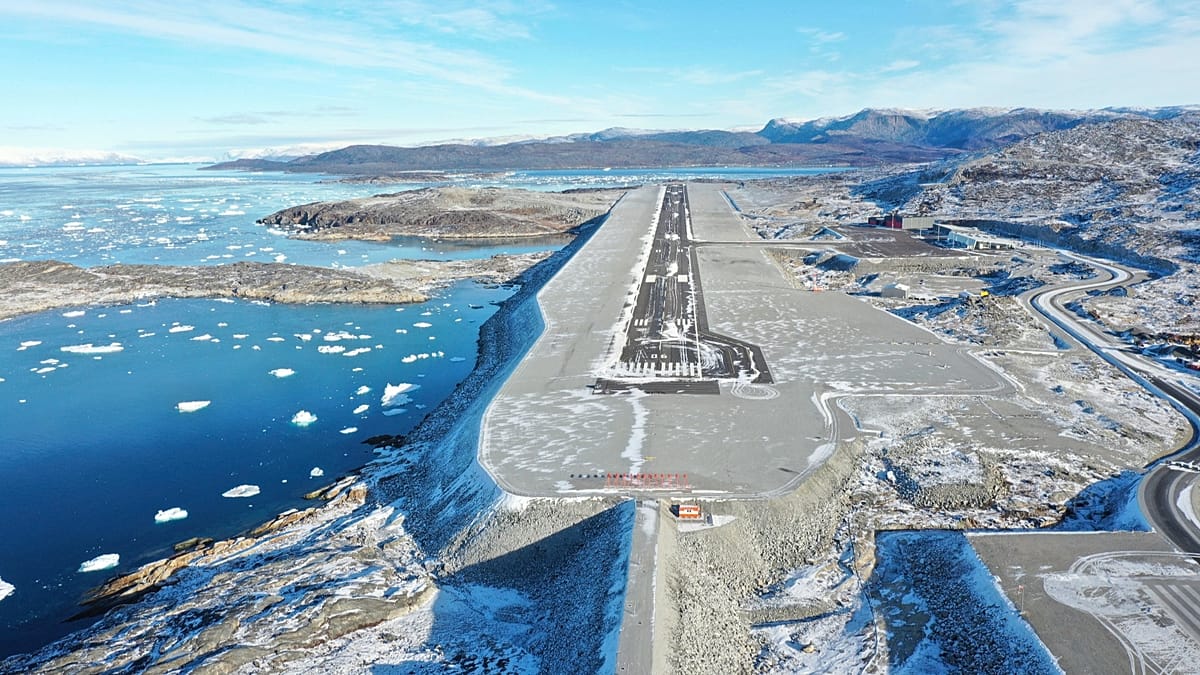
Greenland took a major step toward better global connectivity on Thursday as Ilulissat's new international airport welcomed its first flights. The facility, approved by the Danish Civil Aviation and Railway Authority, is the third and final piece of a nationwide infrastructure programme that began with Nuuk in November 2024 and Qaqortoq in April 2026.
Greenland Airports, the state-owned operator, described the opening as the "final piece in place" in what it calls a "historic airport expansion." The three airports together "form a new backbone" for the territory's transport network, the company said in a statement.
"The opening is a historic milestone for Ilulissat, for North Greenland, and for all of Greenland," said Jens Lauridsen, CEO of Greenland Airports. "The three new airports in Ilulissat, Nuuk, and Qaqortoq fundamentally change how the country is connected internally and how Greenland is connected to the rest of the world."
A gateway to Disko Bay
Ilulissat, Greenland's third-largest town, sits on the west coast about 250 kilometres north of the Arctic Circle, beside Disko Bay—a region renowned for its colossal icebergs and a growing draw for international tourists. The new 2,200-metre runway can accommodate larger aircraft, making it possible to serve the town with direct flights from Europe.
On the day of the opening, Air Greenland launched a direct route between Ilulissat and Copenhagen, Denmark's capital. The service will operate on a regular winter schedule starting in November, initially using a Boeing 737-800 flown by Jettime. Flights are planned primarily on Wednesdays, with additional Monday departures around Christmas, New Year, and in March.
Icelandair will also offer a seasonal connection between Keflavík and Ilulissat from 3 June to 16 October 2027, providing another link to the North Atlantic and beyond.
Operations at the airport will be phased in gradually, with opening hours and activity expanding over time. "The goal is for the airport to be fully operational by the summer 2027 season," Greenland Airports said.
Infrastructure for the long term
The expansion, partly funded by Denmark, is intended to support economic development and tourism in the Arctic territory. Jens Wittrup Willumsen, chairman of the board of Greenland Airports, stressed the long-term nature of the investment.
"Infrastructure is a long-term investment, and its real impact is measured in decades," he said. "With the three new airports, Greenland has a foundation that future generations can build on. Now the task is to ensure that the new facilities benefit the entire country, including the towns and settlements around the airports, as part of the future development of business and tourism."
The opening comes as Greenland seeks to diversify its economy beyond fishing and mining, with tourism seen as a key growth sector. The new airports are expected to make remote communities more accessible, not only to international visitors but also to residents who previously faced lengthy and costly travel within the country.
For travellers, the direct link to Ilulissat opens up the chance to see Disko Bay's icebergs—some of the most spectacular in the Arctic—without the need for a stopover in Nuuk. The town is also a base for boat tours, hiking, and cultural experiences in North Greenland.
While the airport's full impact will take years to materialise, the symbolic significance is immediate. As Lauridsen put it, the completion of the three-airport programme marks a turning point for a territory that has long been one of Europe's most isolated corners.