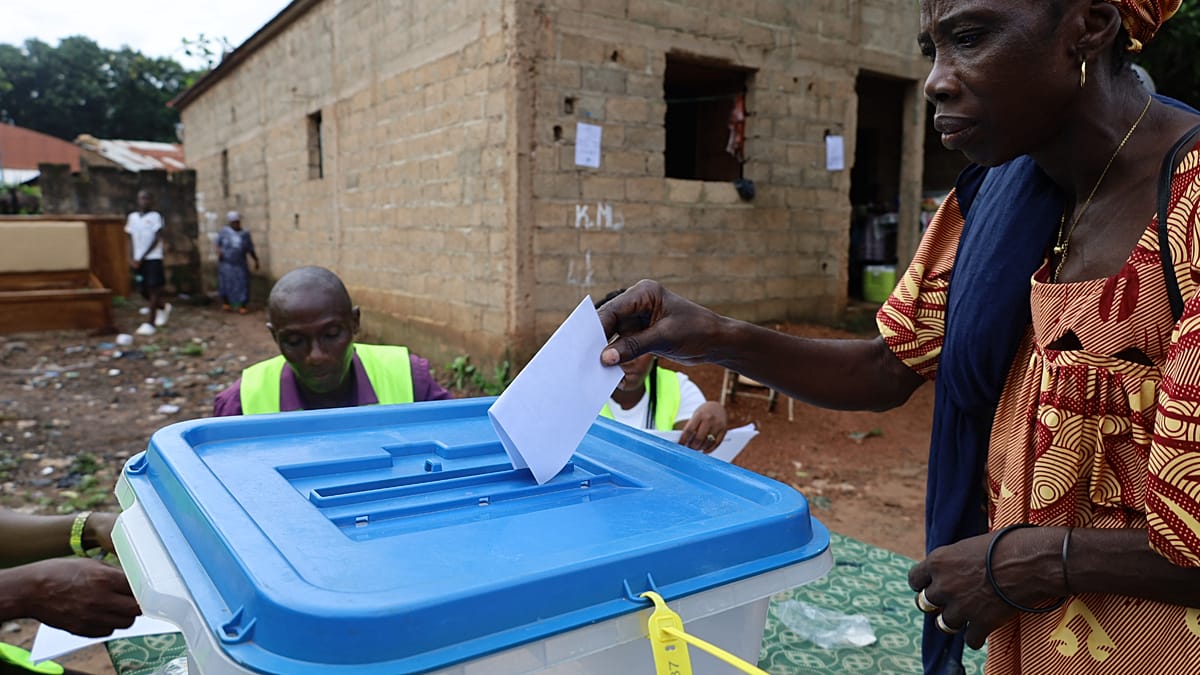
Voters in Guinea-Bissau went to the polls on Sunday to decide on a new constitution that would significantly strengthen the presidency, a move pushed by the military junta that seized power in November 2025. The referendum is seen as a critical step in the junta's promised return to civilian rule, but it has been marred by opposition boycotts and accusations of illegitimacy.
Polling stations opened at 08:00 CET, with a slow start reported in several areas. Security was visibly heightened in the capital, Bissau, with National Guard members and police deployed at strategic points, reflecting the tense atmosphere surrounding the vote.
A charter drafted in secret
The proposed constitution was drafted by the self-styled National Transitional Council, a body appointed by the military. Critics argue that the process was conducted without any meaningful consultation with political parties, civil society, or traditional and religious leaders.
“No one was consulted, neither political parties nor civil-society organisations, let alone traditional and religious leaders, and so on. So everything was done in secret,” said Bubacar Turé, head of the Guinea-Bissau Human Rights League, in an interview with Euronews last week. Turé also noted that campaigners for a “no” vote were not authorised to campaign, adding, “This is not an environment of freedom.”
Political analyst Paulino Quadé echoed these concerns, telling the Associated Press: “The fundamental question is: who drafted this constitution, and on whose behalf? To protect which interests or institutions? Who stands to gain from this constitution?”
From parliamentary to presidential system
The new text would shift Guinea-Bissau from a parliamentary to a presidential system, abolishing the current arrangement where the prime minister emerges from the parliamentary majority. Under the proposed charter, the president would gain the power to appoint and dismiss the prime minister and cabinet members, as well as to dissolve parliament. The National People’s Assembly would be reduced from 102 to 65 seats.
The junta argues that a smaller parliament would lead to more efficient debates and that stronger presidential authority would end the chronic political instability that has plagued the country. However, opposition parties see the changes as a power grab that undermines democratic representation.
“This constitution significantly weakens the prime minister and the government, subordinates the National People’s Assembly and the political parties, and undermines, or even ignores, the popular will expressed at the ballot box, bringing all the inherent risks of division and political and social tensions,” said Muniro Conté, spokesperson for the African Party for the Independence of Guinea and Cape Verde (PAIGC), in a statement to the Associated Press.
A history of coups
Guinea-Bissau, a former Portuguese colony that gained independence in 1973, has endured five coups and numerous attempted coups since 1974. The November 2025 coup, which toppled President Umaro Sissoco Embaló, deepened West Africa's democratic crisis, adding to a growing list of countries under military rule in the region.
The junta, led by General Horta N'Tam as transitional president, has barred itself from standing in future elections under a temporary charter. However, the circumstances of the coup have raised suspicions. Several African leaders described it as a “staged” power grab after Embaló was allowed to hold a press conference announcing his removal and then leave the country under seemingly favourable conditions. Skeptics suggest Embaló handed power to the military after realising he was losing the disputed election.
Embaló had previously dissolved parliament in 2023, citing an attempted coup, and ruled by decree until his ouster. The current referendum follows a pattern seen in other African nations, such as Zimbabwe and Chad, which have amended their constitutions to extend presidential terms or strengthen executive powers.
With a population of around 2.2 million, Guinea-Bissau remains one of the poorest countries in the world despite significant natural wealth. The World Bank notes it has the highest ratio of natural wealth per capita, yet more than half the population lives in poverty. Around 915,000 of the country's inhabitants were eligible to vote in Sunday's referendum.
The outcome of the vote is likely to be contested, and the junta's legitimacy to change the constitution remains a central point of contention. As the country awaits results, the broader implications for democratic governance in West Africa are being closely watched.