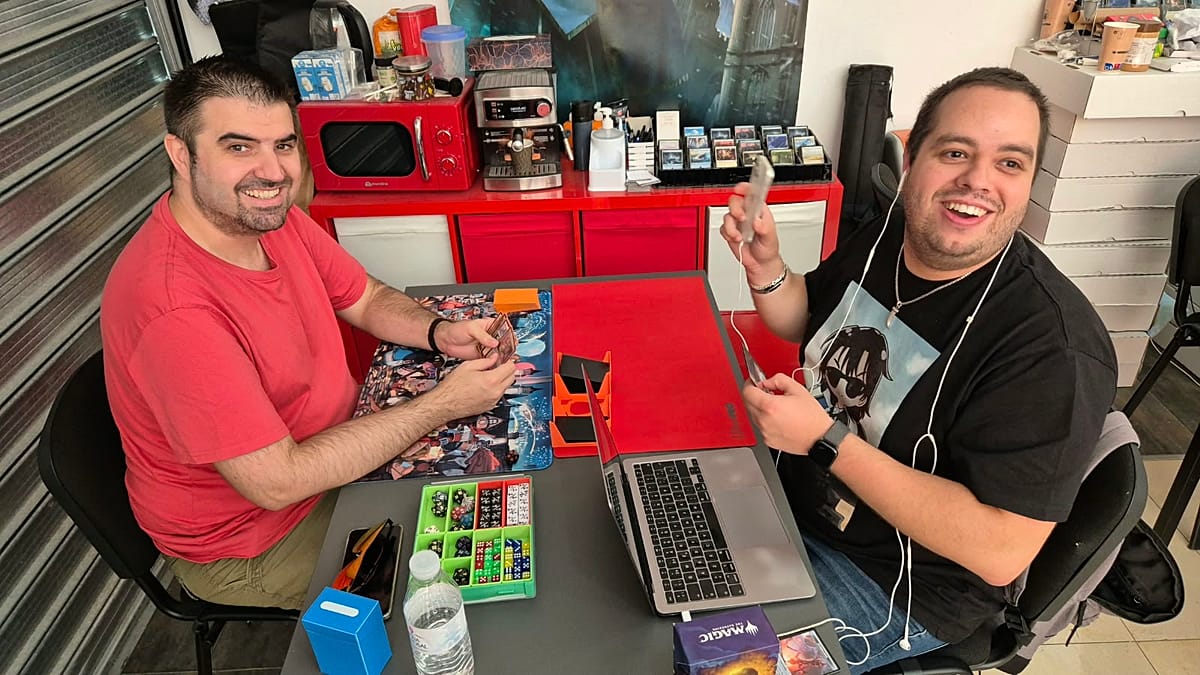
When Cristian M. Amores draws a card during a game of Magic: The Gathering, he doesn't look at it. Instead, he brings his iPhone close to an NFC tag stuck to the sleeve, and VoiceOver reads the card aloud. Amores, who is blind, has been adapting the collectible card game card by card since late 2020, and he shares his methods on social media under the name Magic Accesible.
His story is part of a broader movement across Europe and beyond: players with visual or motor disabilities are finding their own ways to keep playing, while major companies like Microsoft, Sony, and Spain's ONCE organization develop adapted controllers and game editions. Yet accessibility remains far from a standard design principle, whether for a blockbuster video game or a casual board game.
From braille to NFC tags
Amores's first attempt at making cards readable involved braille. Using a label maker, he embossed raised numbers on each card so he could identify them and look up details in a separate database. But the braille made the cards too thick to shuffle, and in official tournaments, marked cards can be seen as a signal of what a player intends to draw—grounds for disqualification.
He then tried QR codes, which he scanned with his iPhone camera. But aligning the camera was slow and unreliable, so he switched to NFC tags. These only need to be brought near the phone, and the screen reader immediately recites the card's text. "Since then I've taken a huge leap as a player," he says.
Amores has built a database where he enters a card's number and the rest of the fields fill automatically. He still needs help from others—someone to read new cards aloud before he adds them, and a print shop to produce the tags—but the system has allowed him to play in local shops and at the National Modern Championship in Soria in December 2024, where he demonstrated his setup. In November 2022, Spanish newspaper El Mundo featured his story, and he now runs a podcast called Magic Accesible.
He has not yet competed in strict tournament play, but judges at Soria were curious. One told him there would likely be no problem using the system in competition. Another checked the rulebook and noted that electronic devices are banned during play except in cases of strict necessity—an exception Amores believes could apply to him, since he cannot know what he has drawn until he scans it. If he ever competes, he says, he will inform organizers in advance, both because of the adaptations and because he may need extra time per round.
A community effort
Amores is not alone in turning to NFC tags. On Reddit, a group of friends under the username jerichodarkstar described how they adapted a Commander deck for a friend born with a degenerative visual impairment. He started playing in 2023, but could only distinguish lands from non-lands by shape; for everything else, he needed someone to read each card aloud. That created what the group called a permanent "telepathy effect," as the whole table knew what he held.
At Christmas 2025, they decided to fix it. Their first attempt was braille, embossed on the sleeves (never on the cards) with the name, mana cost, type, and power/toughness placed near where they appear on the original. But braille on sleeves proved impractical, so they moved to NFC tags, which they now use to read cards instantly.
Amores's ultimate wish is for Wizards of the Coast, the publisher of Magic: The Gathering, to release an accessible version of Magic Arena, the game's official PC client. A community-made mod already achieves this, but it depends on the company not blocking it. "WotC, let the mod carry on existing," he says. On physical cards, he imagines factory-printed QR codes linking to the official database, but doubts it would be worthwhile for the company. "Paper will put up with anything, but reality won't," he concludes.
The games industry has made strides—Microsoft's adaptive controller and Sony's accessibility features are notable examples—but for many players, the burden still falls on individuals and small communities. As Amores and others demonstrate, the demand for inclusive design is real, and the solutions are often ingenious.