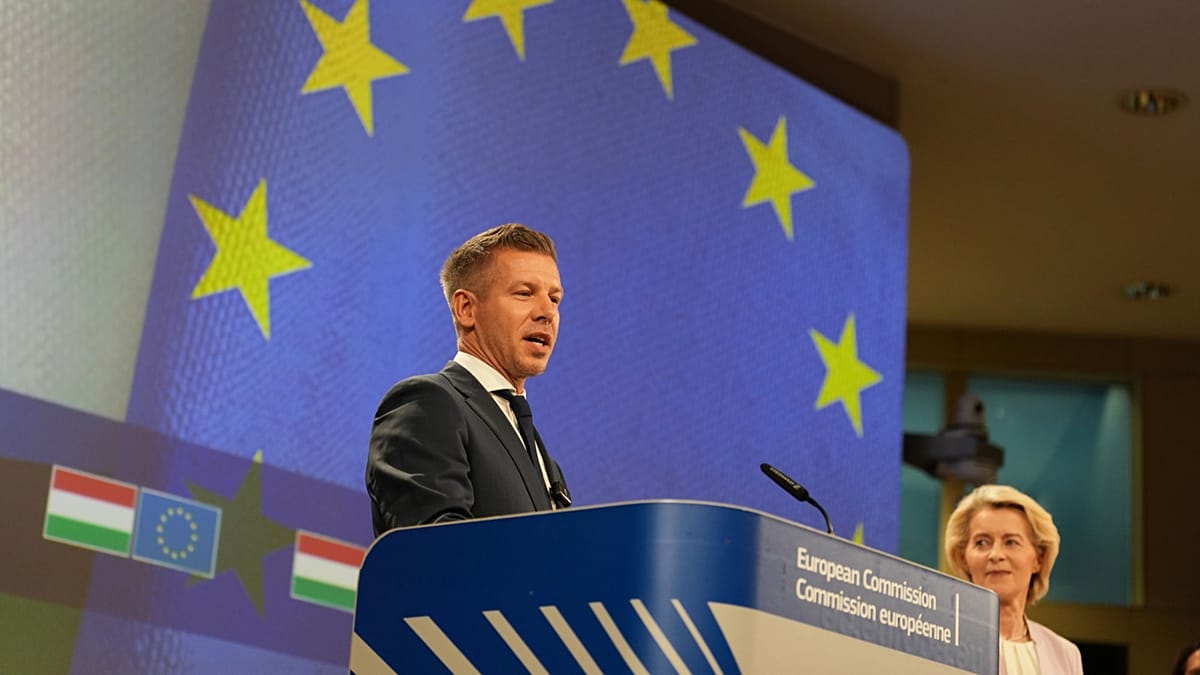
Budapest has dramatically scaled back its participation in the European Union's defence loan scheme, asking Brussels for just €5.4 billion instead of the €16.4 billion sought by the previous administration. The European Commission confirmed the revised figure on Friday, marking a significant shift in Hungary's defence posture under its new prime minister, Péter Magyar.
The original request, submitted under Viktor Orbán, was contested by Magyar after he took office in April. According to sources close to the new government, Magyar wanted to reassess the proposal amid concerns over corruption risks linked to the previous administration. The Commission's spokesperson, Thomas Regnier, acknowledged that the new authorities were given the opportunity to review the allocation. "We were always very clear with the new incoming Hungarian authorities and government that they would be able to take stock of the current situation, and they have now decided to take less than what we initially allocated to Hungary," Regnier said.
The reduction is part of a broader recalibration of defence spending under the EU's Security Action For Europe (SAFE) programme, a low-interest loan scheme launched last year to bolster defence industries and military readiness across the bloc in response to the threat from Russia. The programme has a total envelope of €150 billion, to be distributed among 19 member states.
Italy trims its request too
On the same day, the Commission confirmed that Italy has formally requested €8 billion under SAFE, roughly half of the €14.9 billion originally anticipated by Prime Minister Giorgia Meloni's government. The announcement followed tense negotiations between Brussels and Rome over the allocation, which was never formally finalised but had caused friction between the two capitals.
The Italian reduction reflects a more cautious approach to defence borrowing, even as the EU pushes member states to increase military spending. The SAFE programme is a key component of the Commission's Readiness 2030 plan, which aims to mobilise up to €800 billion in additional defence spending by the end of the decade. It places a particular focus on boosting the procurement of priority defence products, with at least 65% of the value of any weapon system acquired under the scheme sourced from an EU member state, Ukraine, or a country in the European Economic Area or European Free Trade Association.
Hungary's decision to cut its request comes amid a broader realignment of its foreign and defence policy under Magyar, who has promised to tackle corruption and improve relations with Brussels. The move is likely to be welcomed by EU institutions, which had frozen funds for Hungary over rule-of-law concerns. Earlier this year, the EU released €4.2 billion for Hungary after the government implemented judicial reforms, a sign of improving ties.
However, tensions remain. Hungary and Ukraine have clashed over President Zelenskyy's Carpathian Eight forum, and Budapest has been cautious about deepening military commitments. The reduced loan request may also reflect domestic political considerations, as Magyar seeks to distance himself from Orbán's legacy while maintaining a degree of fiscal prudence.
For Italy, the lower request is a pragmatic move given its high public debt and the political sensitivity of defence spending. Meloni's government has been a strong supporter of NATO and EU defence initiatives, but it faces budget constraints and a wary electorate. The €8 billion figure still represents a substantial investment in Italy's defence capabilities, but it is a far cry from the initial ambition.
The SAFE programme is part of a wider European effort to strengthen defence cooperation, with initiatives such as the EU's defence fund and joint procurement projects. The Commission has also been exploring partnerships with private sector firms, including controversial ones like Palantir, which has been courted by Baltic leaders for its AI capabilities. The EU defence chief has backed such collaborations, arguing that innovation is essential for Europe's security.
As the bloc prepares for the next multi-annual financial framework, the debate over defence spending is likely to intensify. The reductions by Hungary and Italy may signal a more cautious approach among member states, even as the security environment remains volatile. The Commission, for its part, insists that the SAFE programme is flexible and can accommodate the evolving needs of member states.
For now, the focus is on implementation. The Commission will work with Hungary and Italy to finalise the loan agreements, which are expected to be signed in the coming months. The funds will be used to modernise military equipment, enhance cyber defences, and support the European defence industry, which has been under pressure to increase production capacity.
The decisions by Budapest and Rome are a reminder that EU defence initiatives are ultimately shaped by national priorities. While the bloc has set ambitious goals, the reality of domestic politics and fiscal constraints often leads to a more measured approach. As the EU navigates these complexities, the hope is that the SAFE programme will still deliver tangible benefits for European security.