Shares in IBM surged more than 12% on Thursday after the Trump administration announced a federal investment package worth over $2 billion (€1.7bn) targeting quantum computing companies. The move triggered a broad rally across the sector, with IBM alone adding more than $27 billion (€23.2bn) in market capitalisation — roughly equivalent to the entire market value of Adidas.
The funding, allocated under the CHIPS Act initiative, is designed to bolster US leadership in quantum computing and domestic manufacturing. IBM will receive $1 billion (€861mn) to build a dedicated foundry for producing quantum computing chips. The remaining $1 billion will be distributed among eight other quantum companies, including GlobalFoundries ($375mn), D-Wave Quantum, Rigetti Computing, Infleqtion, Quantinuum, PsiQuantum, Atom Computing, and Diraq (up to $38mn). In return, the US government will take equity stakes in each recipient, mirroring earlier public investments such as those in Intel last summer.
Shares of publicly traded companies on the list jumped sharply. Rigetti Computing, D-Wave, and Infleqtion all surged more than 30% as traders piled into quantum-related stocks. The rally underscores the market's appetite for a technology widely seen as the next major frontier in computing.
A major step in the global quantum race
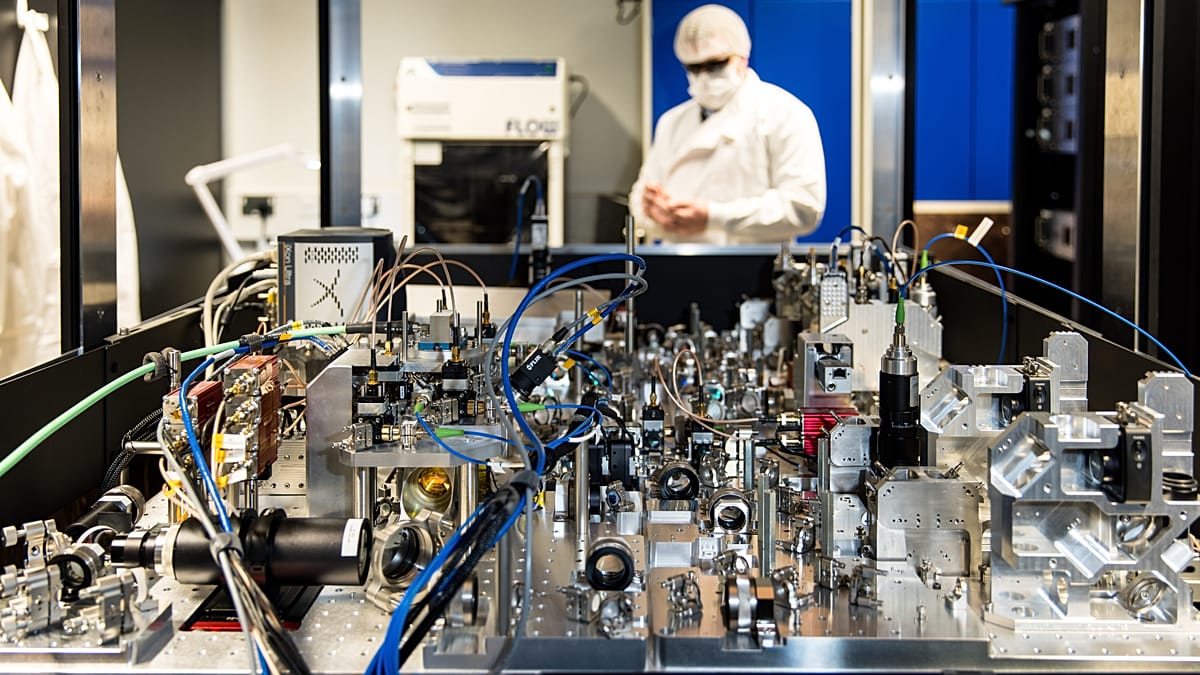
Under the agreement with the US Department of Commerce, IBM is creating a standalone company called Anderon, headquartered in Albany, New York. IBM described it as “America's first pure-play quantum foundry,” tasked with manufacturing advanced quantum wafers at scale. IBM also committed an additional $1bn (€861mn) of its own capital to the project.
“This initiative represents one of the most significant commitments by the US Government to date in quantum R&D to position the United States to manufacture most of the world’s quantum wafers,” IBM said in a statement.
Quantum computing is widely viewed as a transformative technology because of its potential to process certain calculations dramatically faster than conventional computers. According to Boston Consulting Group, the quantum industry could generate up to $850bn (€732bn) in global economic value by 2040. Bill Frauenhofer, Executive Director of Semiconductor Investment and Innovation at the US Department of Commerce, said in the IBM statement: “Quantum computing has significant implications for national defence, advanced materials and biopharmaceutical discovery, financial modelling and energy systems.”
Proponents argue that quantum technology could accelerate drug discovery, optimise supply chains, and improve the training of advanced AI systems. At the same time, one of the biggest strategic concerns is encryption: quantum computers could eventually become powerful enough to break cryptographic systems that currently secure banking networks, communications, and government infrastructure.
Europe’s quantum landscape: promising but fragmented
Europe has developed several prominent quantum technology companies, although funding levels remain significantly below the scale now emerging in the US and China. Finland-based IQM Quantum Computers has raised more than €200mn through private investment and public backing, while France’s Pasqal has secured roughly €140mn. The UK company Oxford Quantum Circuits has attracted capital exceeding £100mn (€115.6mn).
The EU has invested heavily in quantum research through programmes such as the Quantum Flagship initiative, but analysts have repeatedly argued that Europe’s commercial ecosystem remains fragmented compared with the more centralised strategies adopted by the US and China. As the US pours billions into quantum manufacturing, European policymakers face growing pressure to consolidate efforts and boost funding to avoid falling further behind. The contrast is particularly stark given the EU’s ongoing push to strengthen its technological sovereignty, as highlighted by European Commission President Ursula von der Leyen’s recent call to finish the single market and cut red tape for competitiveness.
For now, the US quantum rally has been a windfall for IBM and its peers, but it also serves as a reminder that Europe’s quantum ambitions will require more than just research grants to compete on the global stage.