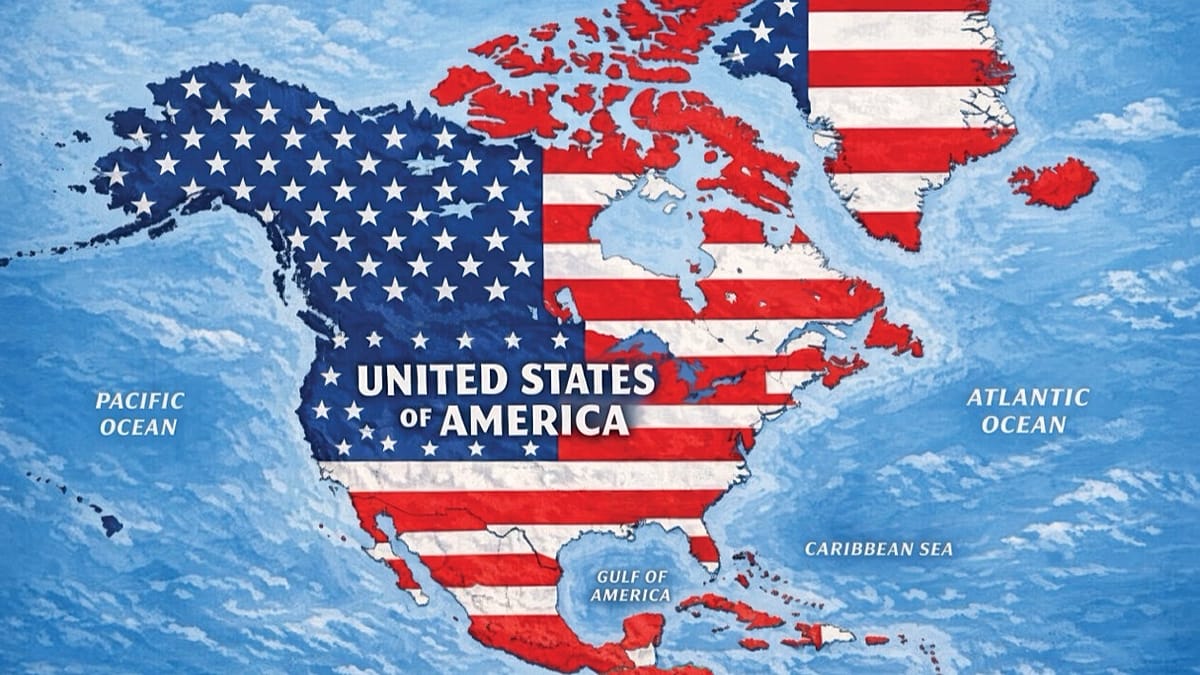
Reykjavik has lodged a formal complaint with Washington after President Donald Trump shared a social media image that appeared to incorporate Iceland into the United States. The Icelandic foreign ministry said Foreign Minister Thorgerdur Katrin Gunnarsdottir summoned the US ambassador to deliver a firm objection, telling the envoy the map was simply not acceptable.
The image, posted Monday on Trump's Truth Social account, showed a redrawn North America with Canada, Greenland, Mexico and Iceland all shaded in stars and stripes, captioned as a single "United States of America." No context or explanation accompanied the post.
The diplomatic rebuke lands at a delicate moment. Just days earlier, Icelandic voters had rejected a government proposal to resume European Union accession talks in a referendum held on August 29, a vote partly shaped by Trump's own designs on Greenland. The outcome was seen as a signal that many Icelanders prefer to keep their distance from Brussels, even as they worry about Washington's intentions.
A security relationship under strain
Iceland's reliance on the United States for its defence makes the incident particularly awkward. The island nation has maintained no armed forces of its own since gaining independence from Denmark in 1944. Instead, it depends on its founding membership of NATO and a bilateral defence agreement with Washington signed in 1951 to guarantee its security.
Reykjavik has had reason to be uneasy about the direction of US policy in the North Atlantic. Trump has repeatedly floated the idea of annexing Greenland, an autonomous Danish territory lying barely 300 kilometres from Iceland's shores. His tariff standoff with Canada has also fed a sense that even the closest US partners can no longer take the relationship for granted.
The map incident is the latest in a series of provocations that have tested transatlantic ties. Earlier this year, Trump's administration threatened to bar Canadian aircraft maker Bombardier from the US market unless it built locally, a move that echoed his broader trade pressure on allies. Meanwhile, the EU has sought to counter US ambitions in the Arctic, with Ursula von der Leyen pledging €200 million to Greenland during a visit that underscored Brussels' own strategic interest in the region.
For Iceland, the stakes are existential. The country's location at the juncture of the North Atlantic and Arctic oceans gives it outsized importance in NATO's northern flank, yet its small population and lack of a military leave it exposed. The defence pact with the US remains the cornerstone of its security, but the Trump administration's unpredictable behaviour has prompted soul-searching in Reykjavik about how reliable that cornerstone truly is.
Gunnarsdottir's protest was diplomatic but unambiguous. According to the ministry statement, she told the ambassador that the map was "not acceptable" and that Iceland expected Washington to respect its sovereignty. The US embassy in Reykjavik did not immediately respond to requests for comment.
The episode also resonates beyond Iceland. It comes as European leaders grapple with a US president who has questioned long-standing alliances, from demanding that Europe repay American military aid to Ukraine to suggesting that US backing for the UK over the Falklands could be conditional. For smaller NATO members, the message is clear: no ally, however loyal, is immune from the whims of the White House.
In Dublin, EU foreign ministers were due to regroup after the Icelandic referendum, a meeting that will now take on added significance. The rejection of EU talks was a setback for those who hoped to draw Iceland closer to the bloc, but the Trump map may inadvertently strengthen the case for deeper European engagement with Reykjavik as a counterweight to US pressure.
For now, Icelanders are left to ponder a paradox: a nation that chose to stay outside the EU, yet finds itself the object of a US president's territorial fantasy. The formal protest has been delivered, but the underlying anxiety about Washington's intentions in the North Atlantic is unlikely to fade quickly.