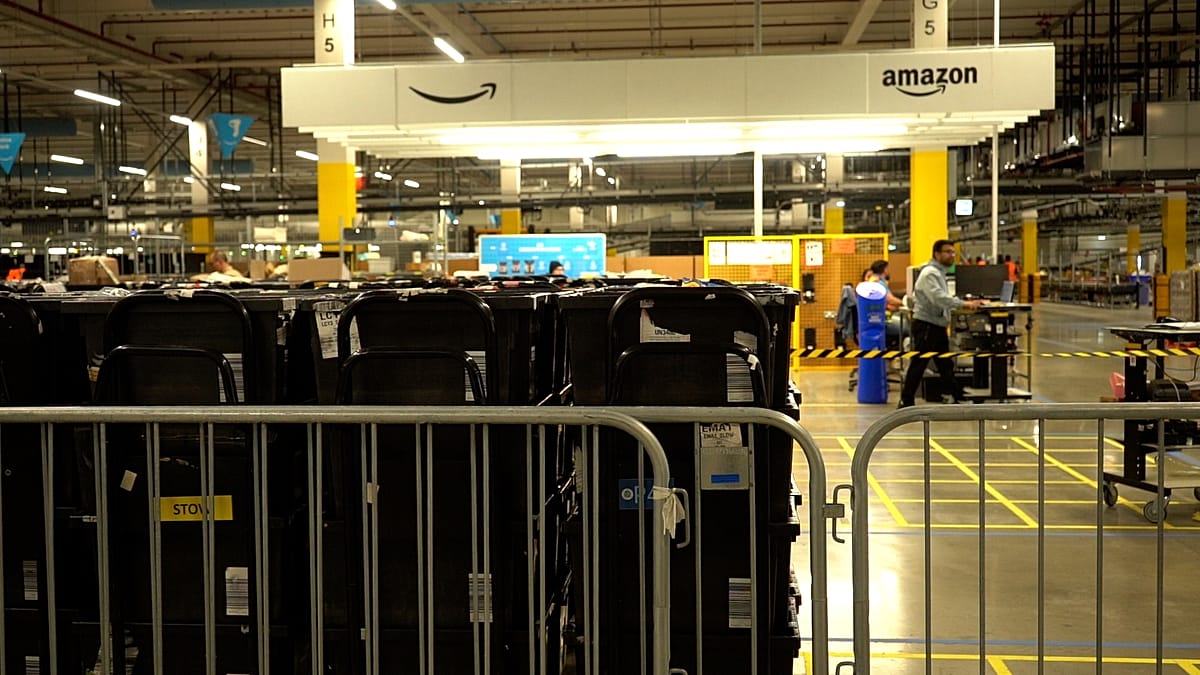
On a grey industrial estate in Dartford, southeast of London, Amazon operates its busiest European warehouse: LCY3. Spanning 216,000 square metres, the facility processes 4 million units each week, relying on a choreographed dance of humans, robots, and lasers. During a recent press event, the company showcased how automation is already reshaping logistics and outlined plans for a new generation of robots that could further transform the continent's supply chain.
The warehouse resembles an industrial amusement park. Thirty-two kilometres of conveyor belts carry boxes and totes overhead at high speed, while warning signs dot the scaffolding. On the second floor, 1,660 mobile robots called Hercules Drives move 21,700 yellow storage pods, each stocked by human workers following AI-generated instructions. The blue robots, which look like oversized vacuum cleaners, can lift up to 567 kilograms, using sensors, 3D cameras, and navigation software to avoid collisions. Martin Newton, Amazon's tours leader, explained that the AI system, Deep Fleet, coordinates the robots like traffic in a city without traffic lights.
Amazon says the system reduces walking distances for employees and improves accuracy. Once an order is packed by a human, it passes through a SICK scanner that measures 3D dimensions, reads labels, and routes parcels to the correct delivery station—all in milliseconds, with the package never stopping. The shipping sorter inside the facility travels 180 kilometres per day.
Despite the automation, thousands of human employees work at LCY3 each day, handling quality control, picking items from inventory towers, and packing at more than 200 stations per floor. Amazon's new investments aim to introduce the next generation of its Proteus autonomous robot, which can lift up to 400 kilograms and respond to conversational prompts from workers. Scott Dresser, vice president of Amazon Robotics, described it as an assistant for material movement that figures out priority, route, and timing. Deployment in Europe is planned for the first half of 2027.
Balancing Efficiency and Worker Welfare
Labour organisations have warned that warehouse automation can increase pressure on human workers to keep pace with machines. Tye Brady, chief technologist at Amazon Robotics, countered that the company builds machines to match human rates and allow employees to focus on critical thinking—such as spotting a leaking pallet of Nutella before a robot moves it through the sortation area. “When we have great employees and have great machines working together, we can gain the productivity and efficiency gains that we see inside of Amazon while creating a safer environment,” he said.
Amazon's European investments are part of a broader push. The company recently announced plans to invest €10 billion in Europe, adding 25,000 jobs and warehouse robots. The Dartford facility is a key node in a network that spans the EU, the UK, Switzerland, Norway, and the Balkans, each with distinct labour markets and regulatory frameworks. As automation accelerates, the balance between speed and worker safety will remain a central debate across the continent.



