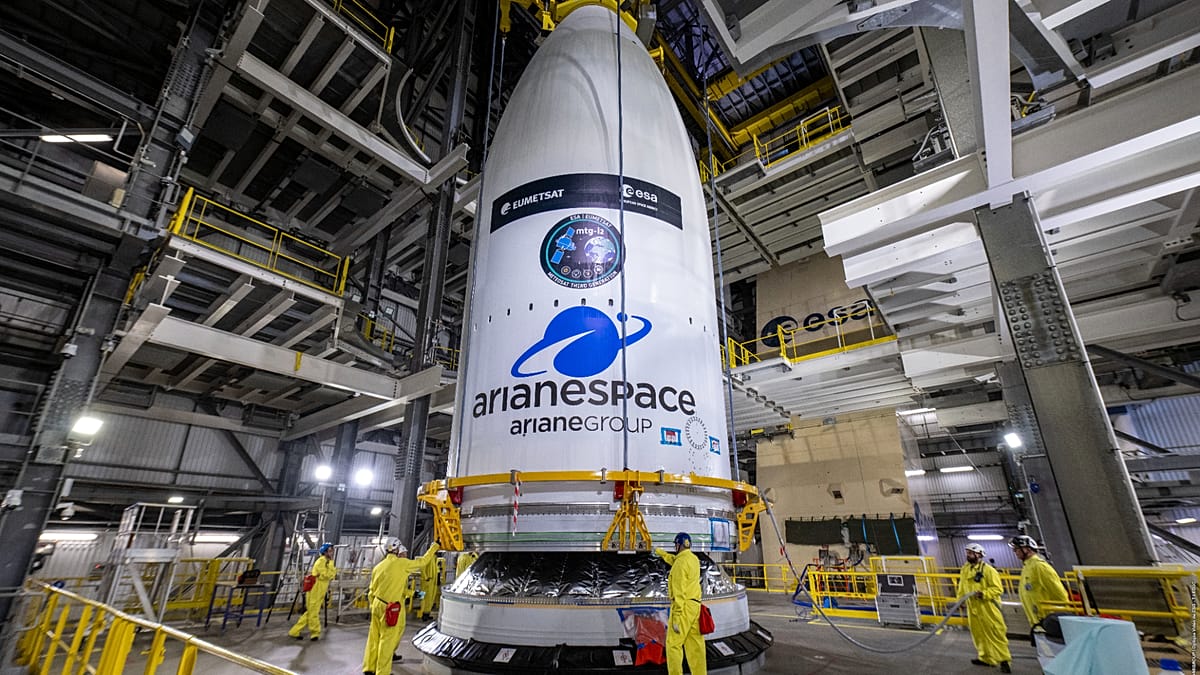
Deep in the French Guiana rainforest, Europe's Spaceport in Kourou is humming with activity. Engineers from ArianeGroup, Arianespace, CNES, Eumetsat, ESA, and Thales Alenia Space are putting the finishing touches on an Ariane 6 rocket and its precious cargo: the MTG-I2 satellite, a 3.8-tonne weather observatory designed to monitor Earth's surface with unprecedented speed and precision.
The mission, which took off on 27 August 2026, is a milestone for Europe's space ambitions. It is the first time an Ariane 6 has flown to a geostationary transfer orbit (GTO), the most distant orbit the rocket has attempted, and it comes with a two-and-a-half-hour launch window instead of a fixed instant—a flexibility that gives the team room to handle unexpected issues.
From Paris to the pad: a journey of 7,000 kilometres
Getting to this point involved more than just a long flight. The rocket's main stage is built and tested entirely in France, while the upper stage comes from Germany. Both are shipped to Kourou aboard the Canopée, a striking cargo vessel with massive sails that also picks up components in Bordeaux and Rotterdam. Once unloaded, the stages are ready to fly—no additional functional checks are needed.
The solid-fuel boosters, however, are manufactured locally in Guiana at the Regulus and Europropulsion plants. As one engineer put it, "It's much more practical and convenient to manufacture the boosters here than to ship that type of propellant from Europe."
Assembly is a horizontal affair, guided by automated vehicles that align the stages with millimetre precision. But it's not fully automatic: technicians verify each step before triggering the next sequence. From arrival to rollout, the central core is ready in about ten days, and the facility's two parallel assembly lines allow work on the next rocket to begin immediately.
The satellite: a delicate eye on the skies
Just a few metres away, in the encapsulation building, the air is filtered and humidity-controlled to extreme standards. MTG-I2 is an optical instrument highly sensitive to contamination—any stray particle could degrade its future images. The facility even has light traps for insects and birds, because if a bird slips in when the giant doors open at night, it could jeopardise the payload's cleanliness. "We obviously can't open the container and let it out with a bird inside," explained one facility manager, who has spent nearly a year coordinating this final phase.
The satellite is part of Europe's next-generation weather fleet, which aims to speed up mapping of Earth's surface to monitor disasters and help prevent floods and wildfires from devastating communities across the continent. This mission completes a trio of satellites that will provide near-real-time data to forecasters and emergency services.
Countdown in the Jupiter control room
Eleven hours before liftoff, the centre of operations shifts to the Jupiter control room at CNES, France's National Centre for Space Studies. A large screen shows all systems in green, the planned trajectory, and the countdown clocks. The deputy launch director, Frédéric (surname withheld for security), walks us through the final timeline.
Filling the rocket with propellant is not like filling a car at a petrol station. "It takes two hours, and then another hour and a half of thermal stabilisation, because the liquid oxygen is at about -150°C and the liquid hydrogen at -250°C," Frédéric explained.
The upper stage, powered by the Vinci engine, can be reignited in flight thanks to a helium pressurisation system that settles the propellant before each restart—a capability Ariane 5 lacked and a key selling point for Ariane 6 in a competitive international market.
This launch is a testament to European collaboration, bringing together expertise from France, Germany, and beyond. As the EU pushes forward with initiatives like the IRIS² satellite network, the success of Ariane 6 and MTG-I2 reinforces Europe's position in space technology. And with climate change intensifying, the ability to shift from response to prevention in disaster management is more critical than ever.