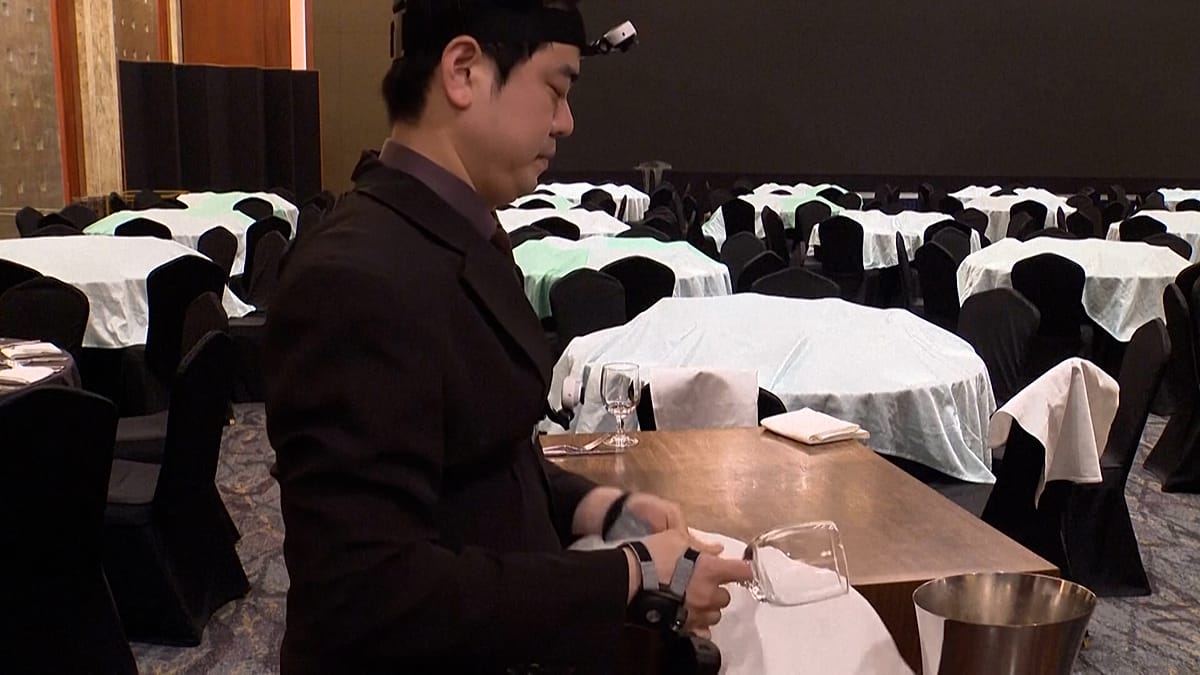
In a high-end hotel in Seoul, David Park folds napkins and polishes glasses while cameras strapped to his head, chest, and hands capture every movement. He is not being monitored for performance—he is training humanoid robots.
Park participates about once a month in a data-collection project run by RLWRLD, a South Korean artificial intelligence company. The firm is developing AI systems for five-finger robotic hands that aim to replicate human touch and dexterity. The cameras record finger positioning, joint angles, and the force applied during tasks. Developers then use that data to train robots equipped with humanlike metal hands and onboard cameras.
In demonstrations, these robots sort cutlery, lift cups, organise trays, and fold cloth napkins inside recreated hotel environments. But current humanoid systems remain far slower than humans. RLWRLD says a robot would need several hours to clean a hotel room that a human can prepare in about 40 minutes. Still, the company believes advances in AI software and robotic hardware are accelerating rapidly, and it hopes its technology can be deployed in industrial AI robots by 2028.
Why Hospitality Work Matters for Robot Training
Hospitality tasks require precision and subtle hand control, making them ideal for training. “For example, with Lotte Hotel, if you were to have a robot fold napkins, a gripper wouldn’t be able to achieve the precise and crisp folds expected of hotel service quality,” said Hyemin Cho, RLWRLD’s business and strategy executive. “It wouldn’t be able to achieve a level that can be used in service.”
RLWRLD is also collecting similar data from logistics workers at South Korean conglomerate CJ Group’s warehouses and from staff at Japanese convenience store chain Lawson, where workers’ hand movements are tracked as they arrange food displays and handle goods. The goal is to build AI software that can operate across robots used in factories and other workplaces in the coming years, before potentially expanding into homes.
The project is part of South Korea’s growing push into “physical AI”—a sector focused on robots that can perceive, decide, and act in real-world environments. Just as chatbots such as ChatGPT and Gemini train on vast troves of internet text, AI robots require extensive data on human action to handle advanced physical tasks.
South Korean companies believe they may have an advantage because of the country’s manufacturing base and its large pool of skilled industrial workers, whose expertise can be translated into robot training systems. The government recently announced a $33 million (€28 million) national project aimed at recording the “instinctive know-how and skills” of experienced technicians to help train AI-powered manufacturing robots.
Major corporations are also investing heavily. Hyundai Motor plans to introduce humanoid robots developed by Boston Dynamics at its factories from 2028. Samsung Electronics says it aims to convert all manufacturing facilities into “AI-driven factories” by 2030 using humanoids and task-specific robots across production lines.
The development has raised concerns among some labour groups that robots could eventually replace jobs. However, Park, who has worked in hospitality for nine years, sees the innovation as more exciting than worrying. “If you look at the entire process of preparing for an event in the back-of-house space, we think humanoids might be able to take over about 30% to 40% of that workload,” he said. “However, I think it will be difficult for them to replace the remaining 50%, 60%, 70% of the work, which involves the actual 'human-to-human' interaction. In that sense, it’s more exciting than concerning.”
While the United States and China continue to lead the global AI robotics race, South Korea is betting that its semiconductor and manufacturing strengths can give it an edge. For now, the hotel workers in Seoul are helping to build the foundation for a future where robots handle the repetitive tasks—and humans focus on the interactions that machines cannot replicate.