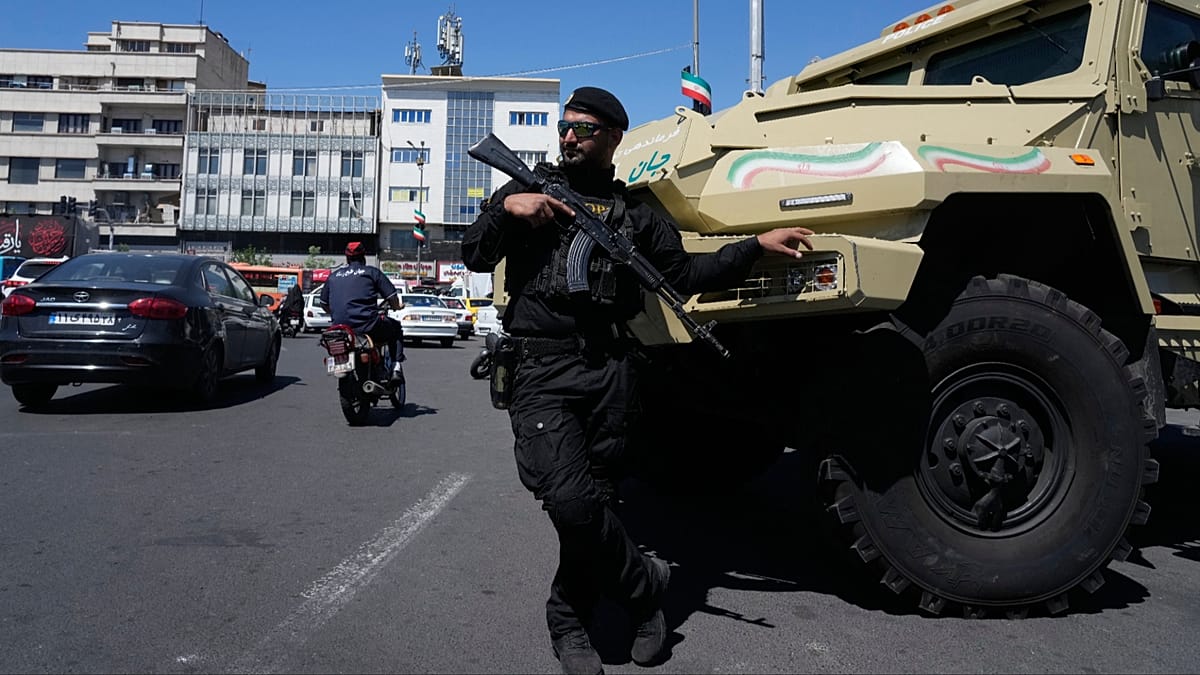
Iran has firmly rejected any US role in determining the timeline for war or peace, as a four-day lull in military exchanges raises cautious hopes for renewed diplomacy. Speaking at his weekly press briefing on Monday, Foreign Ministry spokesman Esmaeil Baghaei declared that Tehran would not allow Washington to dictate the terms of conflict or negotiation.
“We will not allow the United States to determine the timing of war and peace,” Baghaei said. He added that any future talks would be guided solely by Iran’s national interests and that the country would continue to defend itself “for as long as necessary.”
In an interview with Austria’s ORF television on Sunday, Baghaei acknowledged that Tehran and Washington were still exchanging messages through intermediaries. However, he argued that US military actions had undermined the conditions for meaningful negotiations, with Iran’s immediate priority being the protection of its sovereignty and territorial integrity.
US President Donald Trump told reporters that Iran had requested talks “through intermediaries and directly,” claiming that military pressure had driven Tehran to the table. “We are holding deep talks with Iran,” Trump said. “If they fail, we will return to a wide-scale military operation.” He said he had responded positively to mediators’ requests for a diplomatic pause but would not allow talks to drag on indefinitely. “I have plenty of time,” he added, while insisting Iran had “taken a beating” over the past two weeks.
Strait of Hormuz remains a critical flashpoint
Despite the diplomatic overtures, the crisis in the Strait of Hormuz shows no sign of resolution. Baghaei confirmed that talks with Oman over the administration of the strategic waterway were continuing but stressed they were strictly bilateral and unrelated to the US. “The Strait of Hormuz remains closed,” he said.
Deputy parliament speaker Haji Babaii reinforced that position, stating that any arrangement with Oman must not conflict with Iran’s sovereignty and that Washington should have no role in the matter. He insisted that decisions over the strait would ultimately be determined by Iran’s leadership and people.
The Strait of Hormuz, through which roughly one-fifth of the world’s traded oil and gas passed before Iran effectively closed it following the start of the war on 28 February, remains the central sticking point in any settlement. Iran claims sovereign authority over the waterway and the right to designate approved transit routes—a position rejected by the US, Gulf states, and most of the international community under the UN Convention on the Law of the Sea (UNCLOS), which Tehran has signed but never ratified.
Iran’s Islamic Revolutionary Guard Corps (IRGC) said it intercepted six vessels attempting to transit through routes not approved by Iranian authorities, forcing them to turn back after warning shots. Meanwhile, Iran’s Khatam al-Anbiya Central Headquarters accused the US of imposing an illegal naval blockade by threatening Iranian commercial vessels and oil tankers operating inside Iran’s territorial waters. For its part, US Central Command (CENTCOM) said it had redirected 17 commercial vessels, disabled two others, and boarded two ships to enforce compliance with maritime restrictions.
Oil markets reacted positively to the absence of new military strikes, with Brent crude prices falling after reaching two-month highs last week. However, the broader economic picture inside Iran remains grim.
Economic pressure mounts at home
The temporary military pause has done little to ease conditions inside Iran. The country continues to grapple with electricity shortages, fuel imbalances, inflation, and declining purchasing power. In a recent report, Euronews Persian documented how rising prices are forcing many Iranians to cut back even on essential food purchases.
Leila, a 42-year-old translator living with her mother in western Tehran, said many families can no longer afford fruit despite Iran being one of the region’s largest producers. “The reality is that many families’ incomes have not kept pace with inflation,” she said. “After paying for rent, bread, rice, meat and dairy products, we are forced to reduce purchases of things like fruit, even though they are important.” Another interviewee, retired Tehran resident Mohammad Bagher, said his family’s fruit consumption had fallen by roughly 70% compared with previous years despite receiving a relatively high pension.
The economic strain is compounded by the broader regional crisis. Iran-backed Houthi forces have intensified attacks on Saudi oil infrastructure and shipping in the Red Sea, with recent strikes targeting facilities around Jizan and Yanbu. Saudi Arabia has launched retaliatory air strikes across Yemen. Commercial shipping through the Bab al-Mandeb Strait—which carries around 12% of global maritime trade—has slowed significantly as insurers reassess security risks. The escalation comes despite a separate US-Houthi understanding reached in May 2025, under which the group had agreed to pause attacks on US-linked vessels. That arrangement has not prevented the Houthis from attacking Saudi and other Gulf targets.
For European readers, the crisis carries direct implications. The disruption of oil flows through the Strait of Hormuz and the Red Sea affects energy prices and supply chains across the continent. The EU has already deployed a naval mission to the region, as EU foreign policy chief Kaja Kallas recently visited to assess the situation. Meanwhile, the broader geopolitical standoff between Washington and Tehran continues to shape diplomatic dynamics, including ongoing peace efforts involving Ukraine and other global flashpoints.