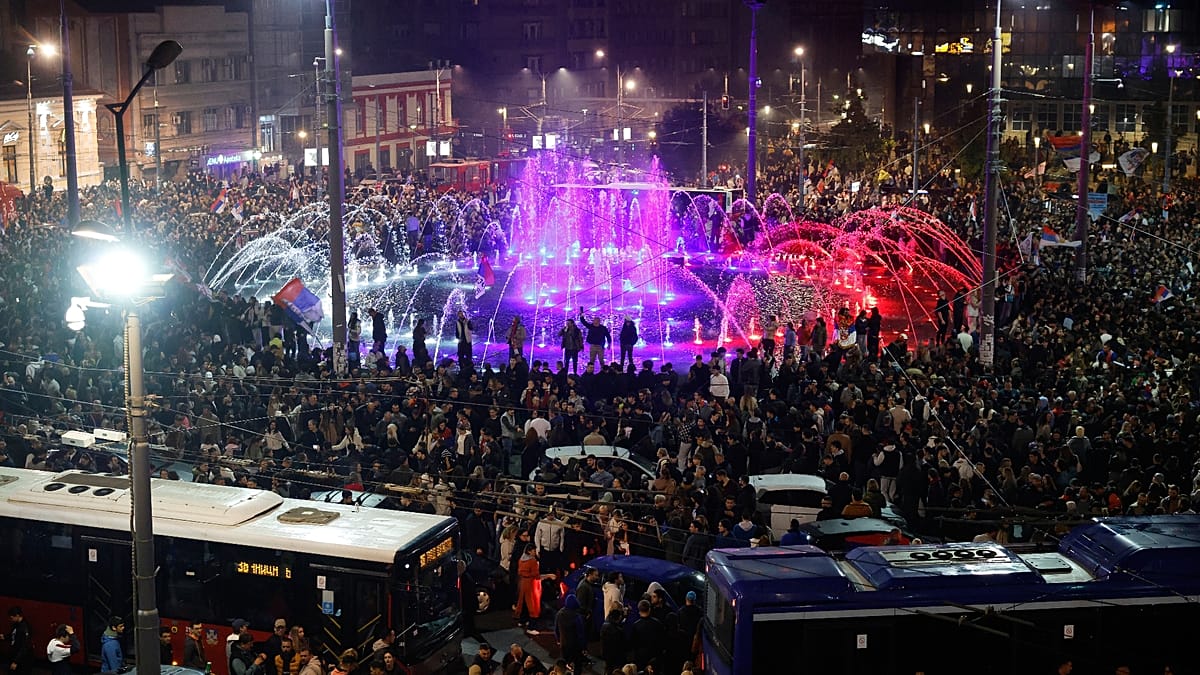
Serbia's political landscape shifted dramatically on Sunday as the Student List, a movement born from months of protests, secured an absolute majority in parliamentary elections. The result ends the 14-year rule of Aleksandar Vučić's Serbian Progressive Party (SNS) and has sparked cautious optimism in Brussels about a potential reset in relations with Belgrade.
The Student List emerged from a student-led movement that began after a deadly disaster at a renovated railway station in November 2024, which raised questions about government accountability and corruption. Over nearly two years, the protests grew into a nationwide challenge to Serbia's political establishment, demanding institutional reform and democratic accountability.
“We are at the very beginning of the new path. But at least it’s a new path. We have no guarantees of anything. There’s just one guarantee that now we have the possibility, we have hope. And this is a huge achievement,” said Matjaž Nemec, a Slovenian MEP from the Socialists & Democrats group.
The movement's electoral list includes students, professors, doctors, artists, and businesspeople, reflecting its roots outside traditional politics. For Brussels, this is an encouraging sign that Belgrade could align with EU values and push through much-needed rule of law reforms. However, the movement is heterogeneous, and beyond opposing Vučić, its precise political programme remains unclear.
“Ousting Vučić from power was the pre-requisite for Serbia's European future,” said Jelena Vasiljević, a senior research associate at the University of Belgrade. “Now I hope we will be able to have an open, democratic discussion on the EU accession path.”
A democratic shift with uncertain foreign policy
The Student List's door-to-door campaign focused on corruption and accountability, drawing parallels with the ousting of Viktor Orbán in Hungary after 16 years. Hungary's new Prime Minister Péter Magyar, who ran on a similar platform, was the first foreign leader to congratulate the Student List. “I was delighted to hear how much strength our victory in April had given them during this difficult struggle,” he wrote on X.
The fair and competitive vote, followed by Vučić's concession and a peaceful transfer of power, has been seen as proof that Serbia's democratic process is functioning. Yet, whether this change will translate into a broader realignment with Brussels remains uncertain.
“It is not exactly clear what their take on foreign policy is. Many EU countries will be watching very closely,” an EU diplomat told Euronews, pointing to Serbia's weak alignment with the bloc on foreign policy. “It remains to be seen if that will change.”
Serbia has refused to align with EU sanctions on Russia following Moscow's full-scale invasion of Ukraine in 2022. The student movement has stated it will retain a “principled stance” against such measures, citing Serbia's historical experience with sanctions. Belgrade also relies heavily on Russian gas and maintains close ties with Moscow.
On Kosovo, the Student List has not yet articulated a clear position, leaving Brussels cautious about the prospects for normalisation talks.
EU accession: cautious optimism
Senior EU officials have welcomed the result. Enlargement Commissioner Marta Kos said “the door to the EU is open, and we are ready to move forward together.” In July, the European Commission pushed to open Cluster 3 of Serbia's accession talks, but eight member states blocked the move citing democratic backsliding and foreign policy misalignment.
The Student List's published programme focuses solely on domestic governance: public procurement, education, media freedom, judicial independence, and health care. Bojan Vranić, a political science professor at the University of Belgrade, cautioned EU officials against excessive enthusiasm. “So far, the Student List has been very conservative when it comes to the European Union. They aim to, firstly, improve the system within. And once they become a credible partner in a negotiation, then the European Union will be their partner,” he said.
History also tempers optimism. In 2003, Serbian Prime Minister Zoran Đinđić was assassinated by former security officials for pursuing a pro-Western agenda. The EU executive is due to publish its enlargement package next week, which will offer a first sign of whether the bloc's approach to Serbia is shifting, though the new government is unlikely to be in place before the reporting period ends.
A key test may be how the Student List-led government treats Montenegro, the EU frontrunner. Vučić and the SNS tried to undermine its accession by sowing divisions based on identity politics. Montenegrin Prime Minister Milojko Spajić wrote on X: “I firmly believe that a new chapter lies ahead for Montenegro and Serbia, based on respect and open dialogue, without unnecessary escalation of tensions.”
For now, Brussels is watching closely, balancing hope with caution. The student movement's victory is a historic moment, but the path to EU membership remains long and uncertain.