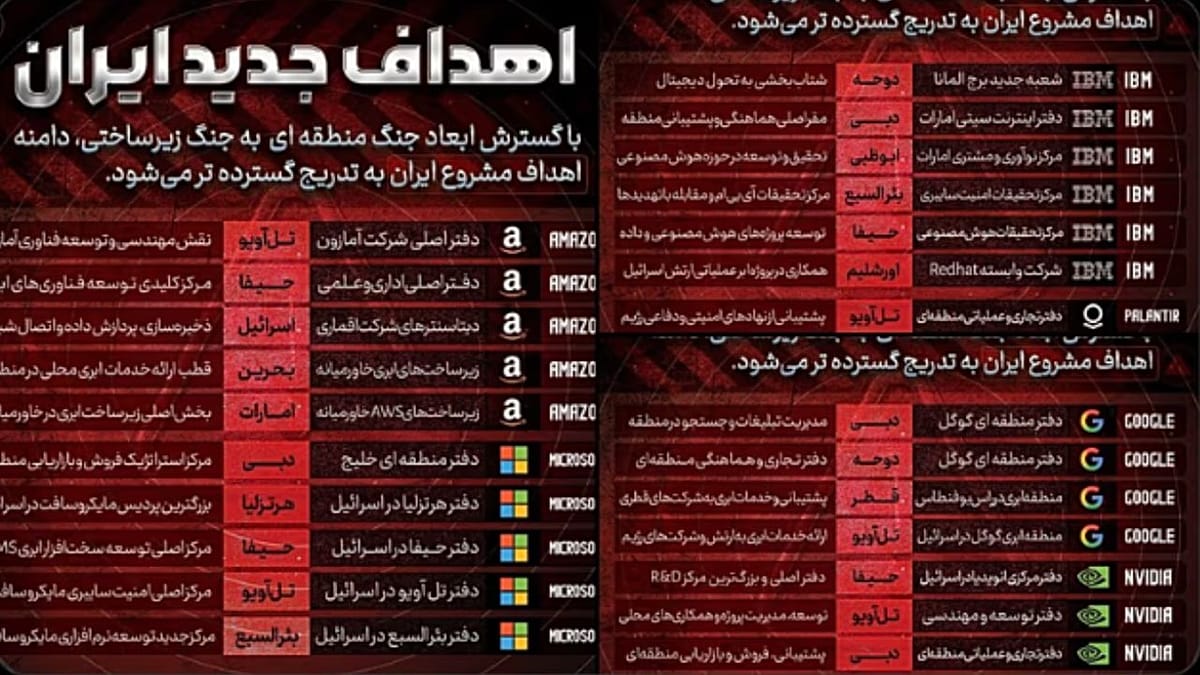
Iran's Islamic Revolutionary Guard Corps (IRGC) has issued a stark warning that it will target 17 American technology companies operating in the Middle East, effective from April 1. The list, published on Telegram in Farsi, includes major names such as Microsoft, Apple, Google, Meta, Nvidia, Palantir, Cisco, HP, Intel, Oracle, IBM, Dell, J.P. Morgan Chase, Tesla, GE, Spire Solution, and Boeing, as well as the Emirati firm G42.
The IRGC accuses these companies of being "the main element" in designing and tracking what it calls "terrorist operations" conducted by the United States against Iran. "We will target American technology companies for every assassination in Iran," the post reads, adding that tech employees should leave their workplaces "immediately to save their lives."
Escalating Threats and Previous Attacks
This latest warning follows a series of escalations. In early March, two Amazon data centres in the United Arab Emirates were hit, and a third in Bahrain was damaged by falling debris. The IRGC claimed responsibility, stating the attacks were aimed at identifying the role of these centres in supporting enemy military and intelligence activities. The threats also come weeks after Tasnim, an Iranian news agency with ties to the IRGC, published a list of 30 Big Tech bases across the Middle East, labelling them "enemy technology infrastructure."
Among the locations highlighted by Tasnim were offices in Dubai and Tel Aviv, including Palantir's main office, Amazon and Microsoft facilities, and Nvidia's engineering centre. The post specifically cited four offices of Oracle, IBM, and Google in Jerusalem, Tel Aviv, and Abu Dhabi for allegedly providing infrastructure to "military entities."
Military Contracts Under Scrutiny
The threats are deeply intertwined with the companies' contracts with Israel. Amazon and Alphabet (Google's parent) were awarded a $1.2 billion (€1 billion) contract in 2021 under Project Nimbus, which provides Israel with core cloud and AI technologies. A 2025 report by UN rapporteur Francesca Albanese on human rights in occupied Palestine noted that these companies, along with Microsoft, grant Israel "virtually government-wide access to their cloud and AI technologies." The report also alleges that IBM has trained Israeli military and intelligence personnel, and that there is "reasonable ground" to believe Palantir provided automatic predictive policing technology to generate target lists in Palestine.
Oracle, though not mentioned in Albanese's report, has been reported by The Middle East Monitor as pushing to embed a "love for Israel" in American culture. The US Department of War recently awarded Oracle an $88 million (€74.4 million) contract to integrate its cloud computing software with the US Air Force.
For European readers, these developments underscore the growing entanglement of global tech infrastructure with geopolitical conflicts. The threats against companies like G42, based in the UAE, highlight how the Middle East's tech hubs are becoming flashpoints. European policymakers, already grappling with issues of digital sovereignty and the spread of disinformation, may need to consider how to protect European tech assets in the region. A broader European strategy for stabilising the Middle East could help mitigate such risks, but the immediate focus remains on the safety of personnel and infrastructure.
The IRGC's threats also raise questions about the security of cloud and AI services that underpin much of the global economy. As European companies increasingly rely on these technologies, the potential for disruption from state-sponsored attacks grows. The situation remains fluid, with no immediate response from the targeted firms.