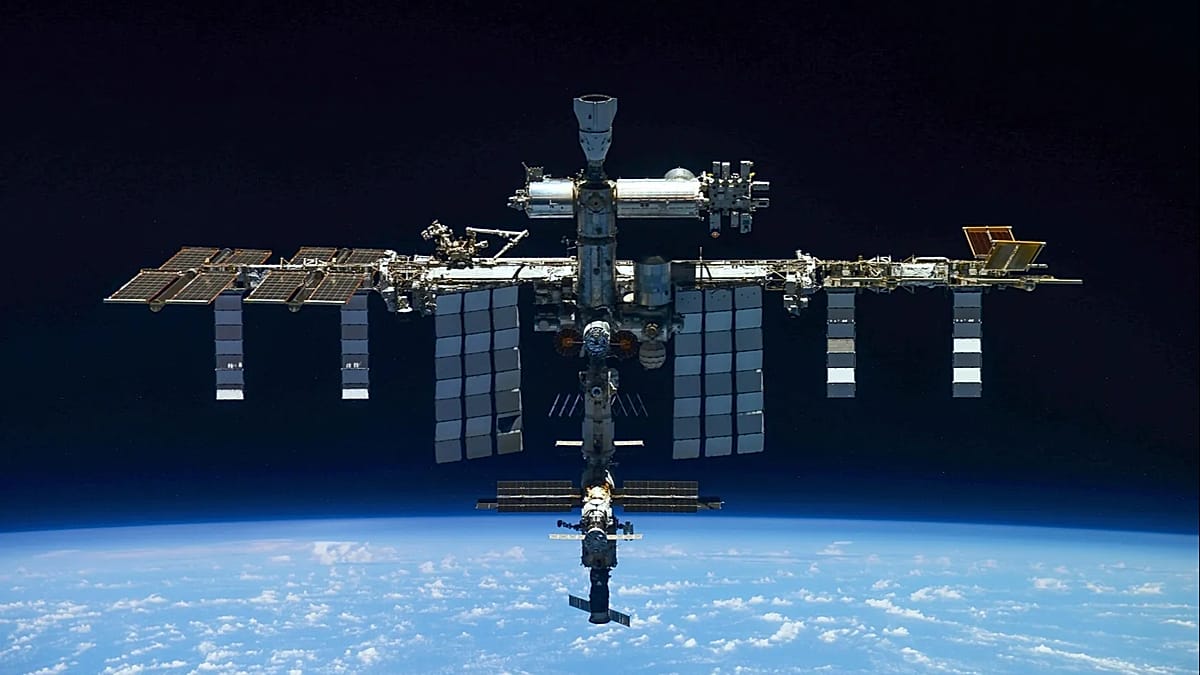
NASA instructed the four astronauts currently aboard the International Space Station (ISS) to take shelter in the SpaceX Crew Dragon capsule on Monday after a worsening air leak in the Russian Zvezda service module. The precautionary measure, which involved the crew donning spacesuits and moving to the docked spacecraft, came as Roscosmos engineers carried out repairs on the PrK transfer tunnel, a section that has been leaking since 2019.
The leak rate had been relatively stable at around half a kilogram of air per day in recent months, but it doubled to one kilogram per day on Monday. For context, an average adult inhales and exhales between 10 and 15 kilograms of air daily. While still minor in absolute terms, the increase prompted NASA to order the crew to adopt maximum safety procedures.
European Astronaut Among Those Affected
The Crew-12 mission includes two American astronauts, one French national, and one Russian cosmonaut. The French astronaut, representing the European Space Agency (ESA), underscores the multinational nature of the ISS partnership. The station, which orbits roughly 400 kilometres above Earth, is a joint project involving the United States, Russia, Europe, Japan, and Canada.
Bethany Stevens, a NASA press officer, stated on X that “the transfer tunnel of the Zvezda service module, known as the PrK, has long had cracks and leaks, which Roscosmos has contained as far as possible up to now.” She added that Roscosmos decided to carry out more extensive repair work on Friday, 5 June, and that NASA ordered the crew to shelter in the Dragon spacecraft as a precaution.
“We continue to work with our Russian counterparts and with the rest of the international community to support the International Space Station, with the aim of reaching a permanent solution,” Stevens said.
The order from NASA mission control came at 9:04 a.m. US East Coast time on Monday. The crew remained in the Dragon capsule for several hours while Roscosmos completed its repairs. After checks confirmed the situation was under control, the astronauts returned to their normal duties aboard the station, which remains fully operational.
This incident is the latest in a series of technical challenges for the aging Russian segment of the ISS. The Zvezda module, launched in 2000, has experienced multiple cracks and leaks over the years. NASA and Roscosmos have been in discussions for months about the root cause and potential long-term fixes, but no permanent solution has yet been implemented.
The ISS, which is roughly the size of a football pitch, has been continuously inhabited since November 2000. Its future beyond 2030 remains uncertain, with NASA planning to transition to commercial space stations and Russia considering its own orbital outpost. The European Space Agency, which has contributed the Columbus laboratory module and other key components, is also evaluating its post-ISS options.
For now, the crew is safe, and the station continues to operate normally. But the recurring leaks serve as a reminder that even the most sophisticated human outpost in space requires constant maintenance—and that international cooperation remains essential to keeping it aloft.