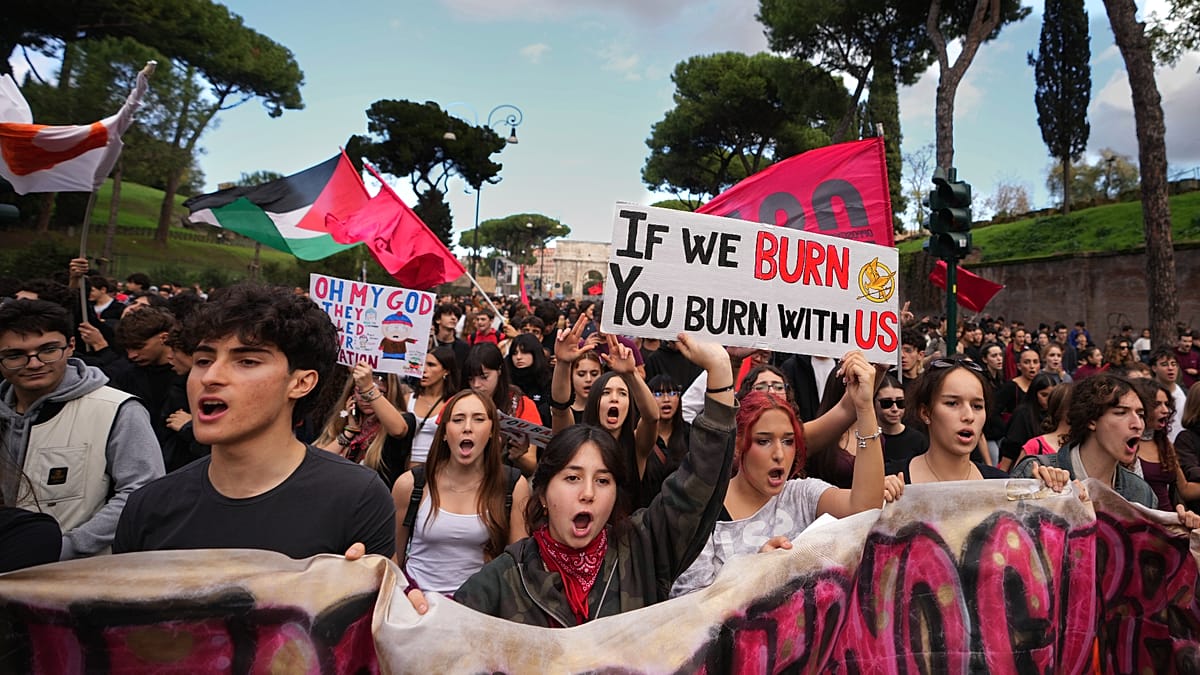
Rome witnessed a significant mobilization on Friday as workers and students took to the streets, joining a nationwide strike that underscored growing discontent over economic pressures and government spending choices. The protests, which also unfolded in Milan, Naples, and Turin, were organized by major trade unions and student collectives, reflecting a broad coalition of grievances.
Stagnant wages and soaring costs
At the heart of the demonstrations is a stark disconnect between wage growth and the cost of living. Italian workers have seen their purchasing power erode over the past decade, with real wages barely keeping pace with inflation. According to recent data from the national statistics institute, consumer prices have risen by nearly 15% since 2021, while average salaries have grown by only 6% in the same period. This squeeze has been particularly acute in urban centers like Rome and Milan, where housing and transportation costs have climbed sharply.
"We are not asking for charity; we are asking for a living wage that reflects the reality of today's prices," said Marco Bianchi, a union representative from the CGIL, speaking at the Rome rally. "Our members are forced to choose between heating their homes and putting food on the table."
Education underfunding and military spending
Protesters also directed their anger at the government's budgetary priorities, particularly the decision to increase military spending while cutting funds for public education. Italy's defense budget has been boosted in line with NATO commitments, but university students and teachers argue that this comes at the expense of crumbling school infrastructure and underpaid academic staff.
"We see billions allocated for tanks and jets, yet our lecture halls are overcrowded and our professors are forced to take second jobs," said Giulia Romano, a student leader from the University of Rome. "This is not a question of security; it is a question of values."
The education sector has been particularly hard hit by years of austerity, with per-student spending in Italy remaining below the European Union average. A recent report by the European Commission highlighted that Italy invests only 4.1% of its GDP in education, compared to the EU average of 4.7%.
Government response and political fallout
The government of Prime Minister Giorgia Meloni has defended its spending plans, arguing that increased defense outlays are essential for national security and that targeted measures have been introduced to support low-income families. However, critics within the opposition and even some coalition partners have expressed sympathy with the protesters' demands.
"The government cannot ignore the streets," said Elly Schlein, leader of the Democratic Party, in a statement. "This strike is a wake-up call that the social contract is fraying."
The strike also comes amid broader European debates about the cost of living and the balance between defense and social spending. Similar protests have occurred in France and Germany, where inflation has also eroded household budgets. The cost-of-living protests in France last year led to significant property damage and insurance claims, highlighting the potential for unrest to escalate.
Impact on public services
The strike disrupted public services across the country, with schools, public transport, and municipal offices experiencing reduced operations. In Rome, the metro ran a limited service, and many schools remained closed or operated with reduced staff. Hospitals maintained emergency services but postponed non-urgent procedures.
Union leaders have threatened further action if the government does not enter into meaningful negotiations on wage increases and education funding. "Today is just the beginning," warned Maurizio Landini, secretary general of the CGIL. "We are prepared to escalate if necessary."
The protests in Italy are part of a wider pattern of social unrest across Europe, driven by similar economic pressures. As governments grapple with the dual challenges of inflation and geopolitical tensions, the tension between defense spending and social welfare is likely to remain a flashpoint. The situation in Italy will be closely watched by other European capitals, as it may signal a broader shift in public sentiment.
For now, the streets of Rome have returned to calm, but the underlying issues remain unresolved. The government has announced plans to hold a summit with union leaders next week, but it remains to be seen whether that will be enough to defuse the growing frustration.