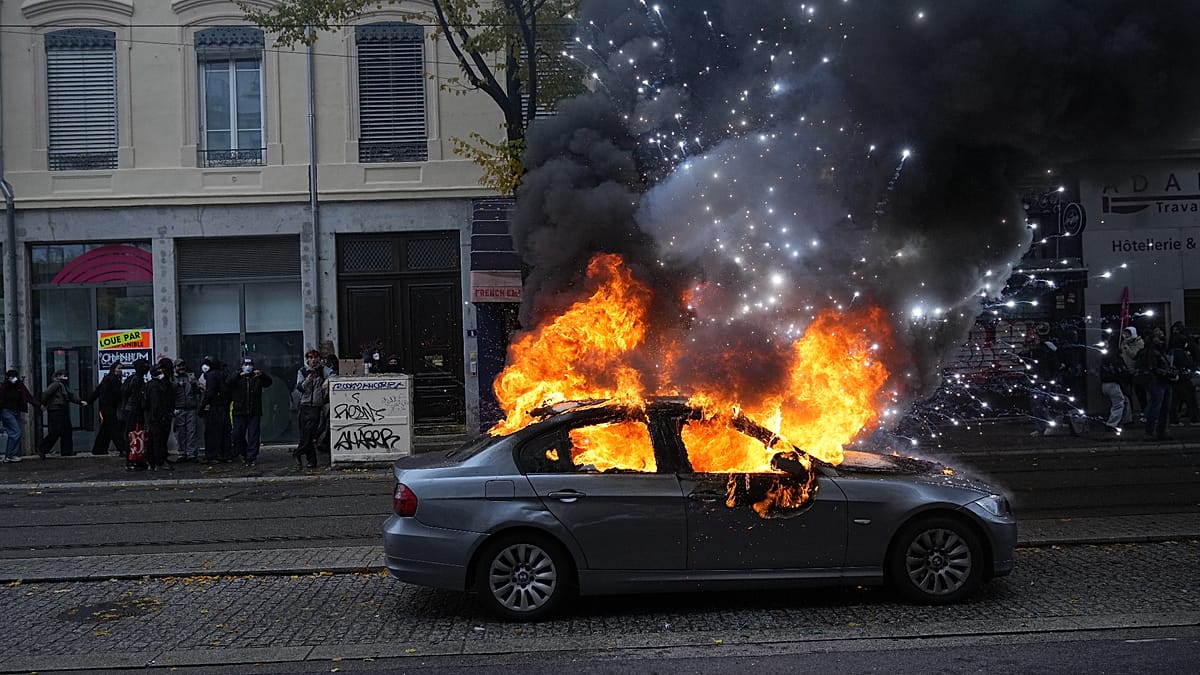
The wave of urban violence that accompanied France's cost-of-living protests in mid-October could leave insurers with a bill of €207 million, according to an initial assessment from France Assureurs, the industry's representative body. The estimate, based on claims data collected up to 12 November, covers 5,280 individual claims linked to the unrest on 17 and 18 October.
Business property accounts for the overwhelming share of the damage, with an estimated €198 million across 4,050 claims. Damage to private vehicles is put at €6 million (860 claims), while damage to individuals' property is estimated at €3.5 million (370 claims).
Florence Lustman, president of France Assureurs, said the cost was "particularly high in view of the brevity of the events" – a reference to the fact that the violence was concentrated into a 24-hour period. For context, the 2005 riots, which lasted four weeks, cost insurers €209 million, while the Yellow Vests movement of 2018–2019, which stretched over several months, generated €256 million in insured losses.
Government support for small businesses
In response to the damage, the French government has published rules in the Journal Officiel for a grant scheme aimed at small businesses with fewer than 50 employees that suffered losses during the unrest. The grants, ranging from €1,000 to €10,000, are available to firms that were affected by damage during demonstrations held between 17 October and 19 November, the date the decree was signed.
Eligible businesses must apply through the Démarche numérique online platform within six weeks of the decree's signature. The scheme is designed to help the smallest companies, which are often the most vulnerable to sudden disruptions and may lack the reserves to cover repairs or lost revenue.
Decisions will be made by a committee in each region, chaired by the regional prefect or a representative. The committee will assess applications on a case-by-case basis, taking into account the scale of operating losses, the nature and extent of the damage, and whether the business has received support from other national or local schemes.
The unrest, which erupted in response to rising living costs, has added to political pressure on the government of President Emmanuel Macron. The protests have drawn parallels with the Yellow Vests movement, which began in 2018 over fuel taxes and evolved into a broader challenge to the president's economic reforms. The current episode has also intersected with a fragmented political landscape, as seen in the entry of Dominique de Villepin into the presidential race, a sign of the centre-right's divisions.
For insurers, the October events underscore the financial risks of social unrest. France Assureurs has noted that the concentration of damage into a single day makes this episode particularly costly, even though the total is lower than the multi-week riots of 2005 or the prolonged Yellow Vests protests. The industry body is still collecting data, and the final figure could change as more claims are processed.
The government's grant scheme is a targeted measure, but it does not cover all losses. Businesses with more than 50 employees, or those that suffered indirect losses such as a drop in footfall, may need to rely on their insurance policies or other support. The regional committees will also consider whether applicants have received aid from other sources, aiming to avoid duplication.
As France grapples with the economic fallout of the protests, the insurance bill is a reminder of the broader costs of social instability. The unrest has also drawn attention to the role of online platforms in organising demonstrations, a topic that regulators are beginning to examine. In a separate development, France's media regulator Arcom has been tasked with policing YouTubers for political bias ahead of the 2027 election, a move that could affect how protest movements communicate.
For now, the immediate priority for many small business owners is to repair their shops and restart operations. The grant scheme, while modest, offers a lifeline to those who have seen their livelihoods damaged in a single night of violence. The full economic impact of the protests, however, may extend well beyond the insured losses, as consumer confidence and local commerce in affected areas could take time to recover.