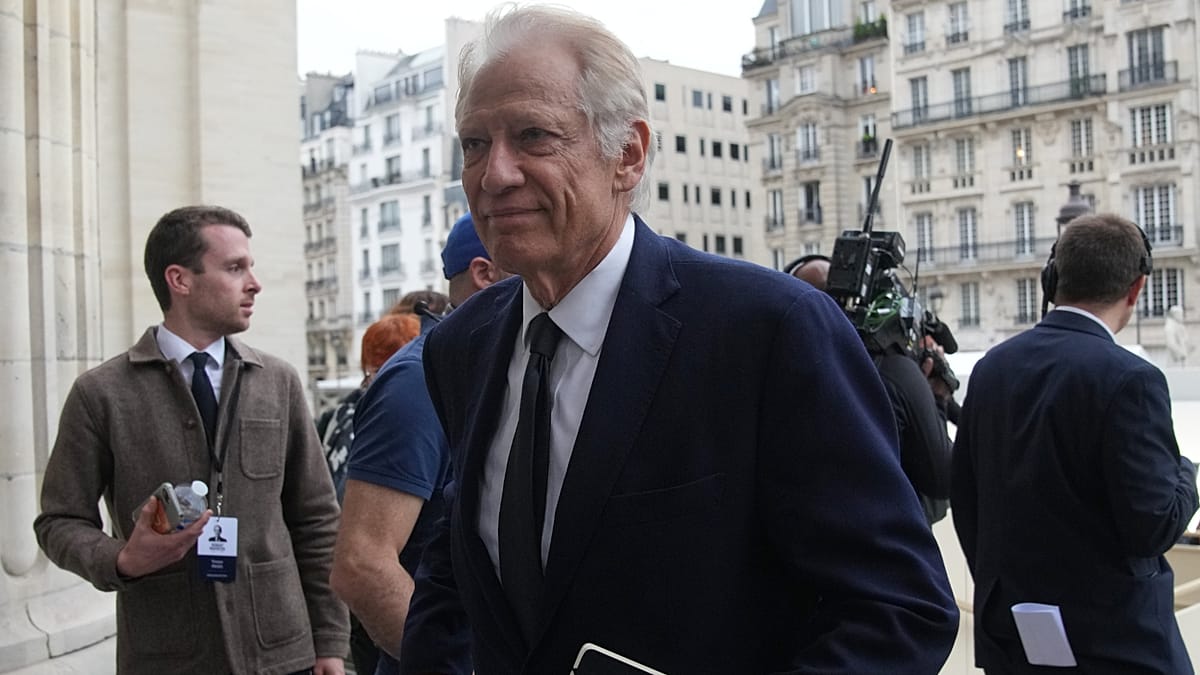
Dominique de Villepin, who served as France's prime minister under Jacques Chirac, formally entered the presidential race on Friday, casting himself as a corrective to what he called the country's "decaying" political and social climate. The 73-year-old diplomat and author, known for his opposition to the 2003 Iraq war, criticised the rise of "radical forces" in French politics, in an apparent swipe at both the hard-left France Unbowed (La France insoumise) and the far-right National Rally (Rassemblement national).
Speaking to supporters, de Villepin accused President Emmanuel Macron of having "paved the way" for these extremes, a charge that reflects growing frustration with the centrist project that brought Macron to power in 2017. He later clarified that he did not equate the two parties, saying that while both represented a threat to democratic norms, they were not morally or politically equivalent.
A fractured political landscape
De Villepin's candidacy comes at a moment when France's traditional centrist and conservative forces are struggling to find a unified voice. Recent polls show that the centre-right bloc, which includes figures such as former prime ministers Gabriel Attal and Édouard Philippe, as well as interior minister Bruno Retailleau, has failed to break through. The centre-right's fading influence has left the field open to more polarising candidates.
The fragmentation is a direct consequence of Macron's 2017 victory, which shattered the old left-right divide and created a new political landscape dominated by his centrist party, La République En Marche (now Renaissance). That realignment has left both the Socialist Party and the Republicans weakened, and has yet to produce a stable alternative.
According to an Ifop-Fiducial survey published on 18 November, Marine Le Pen of the National Rally leads the race with 32–36% of voting intentions, while Jean-Luc Mélenchon of France Unbowed trails with 17–19.5%. No centrist or conservative candidate currently reaches double digits, underscoring the depth of the crisis facing the moderate camp.
Economic and European priorities
De Villepin placed economic recovery at the heart of his platform, noting that France carries one of the highest public debt burdens in the eurozone. He pledged to bring the debt below 3% of GDP, a target that would require significant fiscal consolidation, while also proposing higher taxes on the ultra-wealthy. His plan echoes proposals from the left, but de Villepin insists his approach is neither left nor right, but pragmatic.
On Europe, he lamented the European Union's absence from the international stage, arguing that the bloc has failed to assert itself as a geopolitical actor. He also said France struggles to make its voice heard within the union, a complaint that resonates with many in Paris. To address this, he proposed the creation of a European security council comprising the bloc's major powers: France, Germany, Italy, Spain, and Poland. Such a body, he argued, would allow Europe to speak with one voice on defence and foreign policy.
His European vision is likely to be tested against the realities of a continent facing war on its eastern flank and economic uncertainty. The ongoing conflict in Ukraine and its ripple effects across Europe will be a central theme of the campaign.
A crowded field and a contested primary
De Villepin is the third candidate to announce a bid in November alone, following former judoka Teddy Riner and the far-right leader of Reconquête, Éric Zemmour. The entry of such diverse figures highlights the volatility of the race, which remains dominated by the extremes.
As the centrist and conservative blocs struggle to unite, the prospect of a primary to select a joint candidate has become a contentious issue. Édouard Philippe, a former prime minister and popular figure, has refused to take part in any such contest, further complicating efforts to consolidate the moderate vote. De Villepin, for his part, has not ruled out participating in a primary, but insists that his candidacy is not about positioning for a coalition.
Whether de Villepin can translate his intellectual gravitas and diplomatic experience into electoral support remains uncertain. His appeal may be limited to a narrow slice of the electorate that yearns for a return to Gaullist grandeur, but in a political landscape defined by anger and polarisation, his message of national renewal could find an audience.
As the campaign unfolds, the question of who can unite the centre will be central. With the far right and hard left setting the agenda, the coming months will test whether France's moderate forces can overcome their divisions and offer a credible alternative.