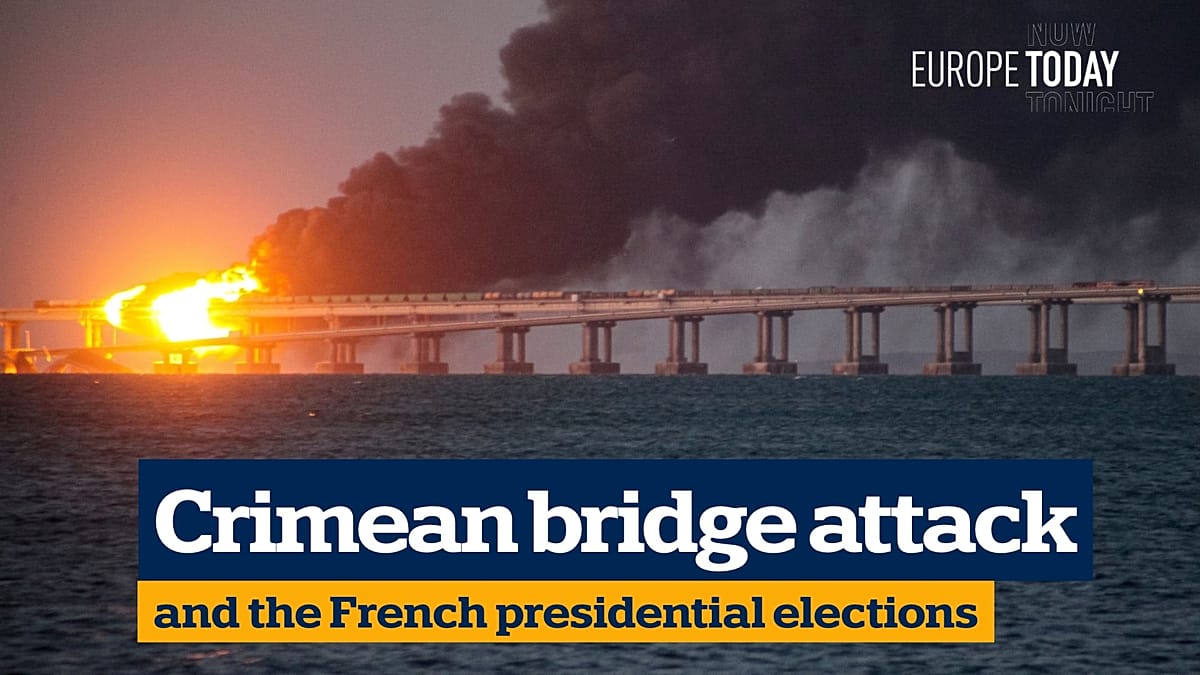
Ukrainian forces launched a coordinated attack on the Crimean Bridge, using drones and missiles to hit both the road and railway sections of the strategically vital structure. The operation, which Ukrainian officials describe as a seven-stage mission, partially destroyed one of Russia's most heavily defended infrastructure assets. Our Ukraine correspondent Sasha Vakulina reports on the impact, while Roman Kyslyi, Ukraine's Chief AI Officer, explains the role of drones and artificial intelligence in targeting the bridge.
Ukraine's evolving strike capabilities
The attack on the Kerch Bridge, as it is also known, underscores how Ukraine has refined its long-range strike capabilities. According to Ukrainian officials, the operation involved a combination of naval drones, aerial drones, and missiles, with AI-assisted targeting playing a key role. The bridge, which connects the Russian mainland to the annexed Crimean peninsula, has been a symbolic and logistical target since the start of the full-scale invasion.
Russia has repeatedly claimed to have defended the bridge with layered air defenses, but this latest strike suggests that Ukraine has found ways to penetrate those defenses. The seven-stage operation reportedly involved feints, electronic warfare, and simultaneous attacks on multiple sections, overwhelming Russian systems. The damage to the road and rail sections could disrupt Russian supply lines to Crimea, though Moscow has not yet confirmed the full extent of the damage.
Meanwhile, Norwegian Foreign Minister Espen Barth Eide told our correspondent Angela Skujins that Oslo's participation in any peace talks is essential. "Norway has a long history of engagement in conflict resolution, and we believe that a just and lasting peace must involve all parties," Eide said. His comments come as European leaders debate the format of future negotiations between Kyiv and Moscow.
French presidential race takes shape
In France, the race for the Élysée Palace is already taking shape, with several candidates positioning themselves ahead of the first round. The campaign is expected to focus on issues such as purchasing power, immigration, and France's role in Europe. President Emmanuel Macron has not yet announced whether he will seek a second term, but his potential rivals are already making their moves.
The French political landscape has been shaken by recent events, including a public sector strike that intensified as budget talks stalled. The strike, which affected transport and schools, highlighted the challenges facing the government as it tries to balance fiscal discipline with social demands. The outcome of the strike could influence the presidential campaign, with opposition parties seeking to capitalize on public discontent.
In a separate development, French football chief Philippe Diallo has announced he will challenge Gianni Infantino for the FIFA presidency, a move that could have implications for the sport's governance. Diallo's candidacy adds another layer to the political dynamics in France, where sports and politics often intersect.
Dutch government survives crisis
The Dutch government has survived a dramatic four-day crisis that threatened to bring down the centre-right coalition. The crisis, which centered on migration policy, was resolved after intense negotiations. MEP Raquel Garcia Hermida-Van der Walle told us that the coalition's survival does not mean the underlying tensions have disappeared. "The coalition has shown it can hold together, but the cracks are visible," she said. "The question is whether they can govern effectively until the next elections."
The crisis has raised questions about the stability of the Dutch political system, which has seen a series of coalition governments in recent years. The outcome will be closely watched by other European countries facing similar migration challenges.
Serbian students keep up pressure
In Serbia, students have been maintaining their protests against the government, demanding accountability and reforms. The protests, which have drawn thousands of demonstrators, have become a symbol of broader discontent with the political establishment. The students have organized blockades and rallies in Belgrade and other cities, calling for an end to corruption and greater transparency.
The movement has gained momentum despite government attempts to dismiss it. The students have also received support from opposition parties and civil society groups. The protests are seen as a test for President Aleksandar Vučić, who has faced criticism for his handling of the economy and the rule of law.
Gaza's humanitarian crisis continues
More than a month into the ceasefire, the humanitarian situation in Gaza remains devastating. Willy Nyeko, Emergency Coordinator in Gaza for the UN World Food Programme, described the challenges facing aid workers. "The needs are enormous, and the access is limited," Nyeko said. "We are doing everything we can, but the scale of the crisis is overwhelming."
The ceasefire has brought a reduction in violence, but the destruction of infrastructure and the blockade have left the population in dire conditions. The international community has pledged support, but the delivery of aid remains a logistical challenge. The situation in Gaza is a reminder of the broader instability in the Middle East, which has implications for European security and migration.
As Europe faces these multiple challenges, from the war in Ukraine to political crises and humanitarian emergencies, the need for coordinated action has never been clearer. The coming months will test the resilience of European institutions and the political will of its leaders.