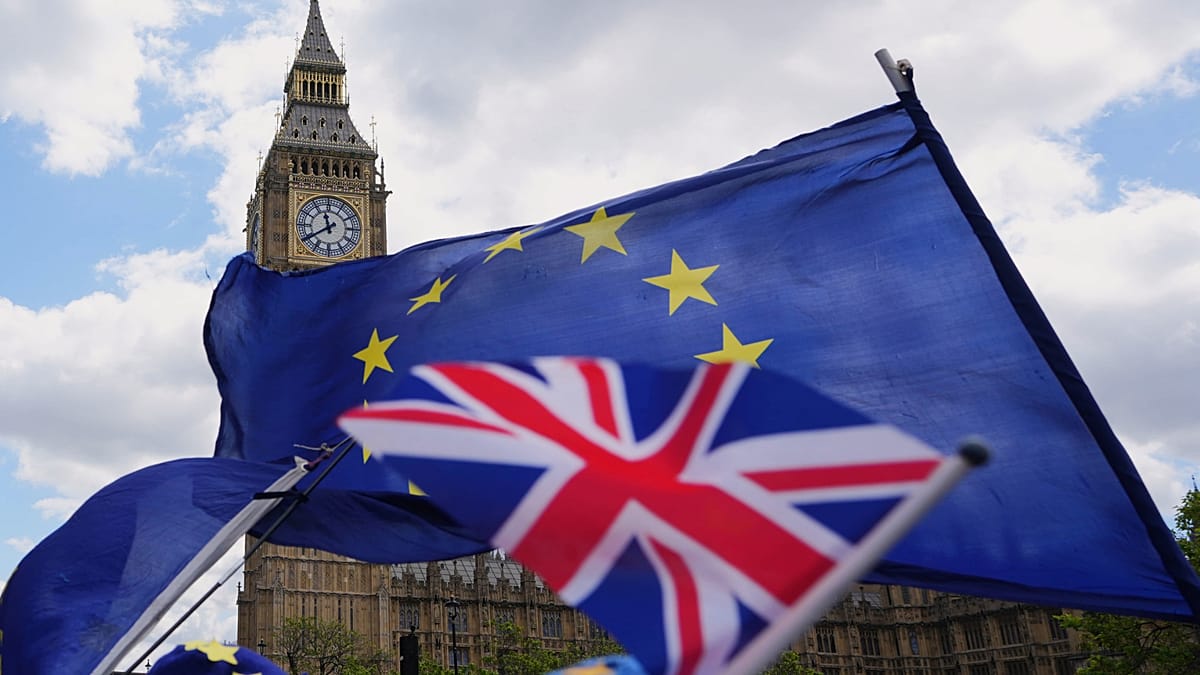
When EU and UK leaders gather in Brussels on Friday, they will attempt to close the most turbulent chapter in post-war European relations. A decade after the referendum that tore Britain from the Union, both sides are preparing a series of agreements that would restore a degree of cooperation unseen since 2020. But a leaked draft of the summit conclusions, obtained by Euronews, reveals that the rapprochement has clear limits, with several politically charged issues still unresolved.
British Prime Minister Andy Burnham, who has made repairing ties with Europe a central goal since taking office in July, has been blunt about his dissatisfaction with the status quo. He has described the current relationship as "not good enough" and has even floated the idea of rejoining the bloc. His stance, combined with mounting pressure on Europe to bolster its own security and economic competitiveness, has created a rare window for progress on both sides of the Channel.
Trade and energy: progress and friction
The most concrete achievement is an agreement to align agrifood standards, which would eliminate border checks and certification requirements for the vast majority of animal and plant products traded between the UK and the EU from 1 March 2028. This would remove a significant barrier for British farmers and European exporters alike.
On energy, the two sides are expected to confirm a link between their emissions trading systems, which would remove the need for carbon border levies on bilateral trade. However, the draft statement sets no date for implementation. A more contentious issue is the UK's integration into the EU electricity market. Britain suffers from some of the highest energy prices in Europe, while Brussels insists on a financial contribution to the bloc's cohesion funds as a condition. Both sides have committed to concluding negotiations by 2027.
The summit will also launch a digital partnership in early 2027, covering secure connectivity, artificial intelligence, and digital identities. Yet a reference to applying the EU's AI Act and Cyber Resilience Act to Northern Ireland under the Windsor Framework has been struck out, a sign of lingering sensitivities.
Youth mobility: a sticking point
Youth mobility remains one of the most difficult files. EU member states want their students to receive equal treatment at British universities, particularly on tuition fees. The UK, which attracts far more European students than it sends to the continent, has resisted. The draft statement offers two options: equal treatment for EU nationals or "significantly reduced undergraduate fees." The issue has been moved to a parallel agreement.
Despite the friction, both sides have set a timeline for the Youth Experience Scheme, which would allow young people to live, work, or study in each other's territory for up to three years. The goal is to finalise the agreement by 2028 and have the scheme operational by January 2030. The number of participants is still under discussion, but sources suggest it could reach around 100,000.
Defence: closer cooperation, but with caveats
Defence industry cooperation has been a source of tension, with France pushing to restrict British firms' access to the EU's Security Action for Europe (SAFE) programme over competition concerns. Yet the strategic environment is forcing the two sides together. The United States is signalling a drawdown of its military presence in Europe, while also backing Ukraine's war effort. The UK has already been included in the Ukraine Support Loan, and the summit is expected to pave the way for deeper defence industrial integration.
The draft text states: "Given the global security context, we intend to enhance exchanges on defence industrial issues and will identify ways to deepen capability collaboration, taking into account the objective of developing resilient European supply chains and capabilities and addressing critical capability gaps, including through the Capability Coalitions." These coalitions allow EU member states to jointly address shortfalls in areas such as air defence, drones, and ammunition.
Trade defence and economic security
On steel, the EU adopted safeguards earlier this year to counter Chinese overcapacity, affecting all exporters, including the UK. The two sides now commit to exploring bilateral safeguards based on their respective quota allocations. The document also mentions a "long-term sustainable solution" for UK-origin steel moving to Northern Ireland.
Economic security will be a new area of dialogue, covering export controls, technology leakage, and supply chain disruption. However, a reference to coordination on market access, public procurement, and subsidies has been removed. Discussions within the EU on whether a European preference in public procurement should apply to the UK are still ongoing. The EU wants the UK to ensure its policies produce outcomes equivalent to the bloc's, while London has proposed softer language on protecting supply chains.
Home affairs and migration
The EU's demand that the UK suspend its regime for deporting foreign national offenders has been dropped from the statement. Instead, the two sides commit to providing advance notice of such removals and exploring bilateral cooperation on prisoner transfers. They also acknowledge the difficulties law enforcement authorities face in obtaining electronic data from other jurisdictions and commit to exploring ways to improve cooperation.
The summit will not resolve every disagreement, but it marks a significant step in normalising relations. As Burnham has argued, the Brexit era has failed to deliver the promised benefits, and both sides now recognise that closer cooperation is in their mutual interest. The coming months will test whether the political will can overcome the remaining obstacles.