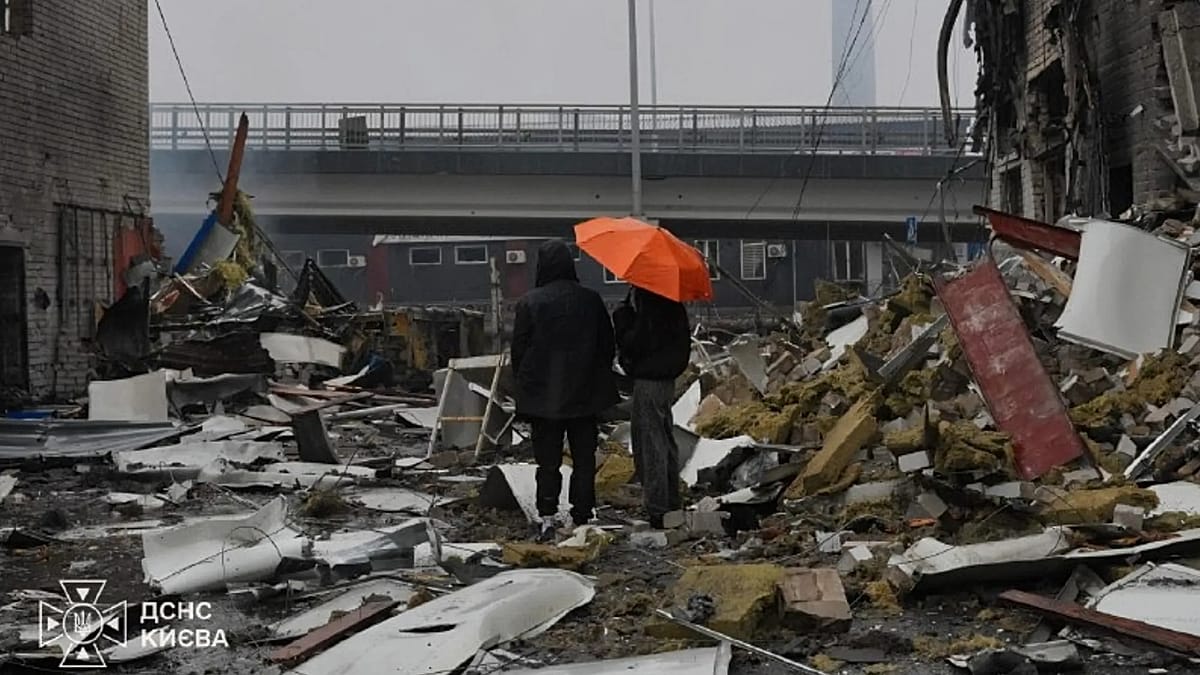
At least three people were killed and 11 others wounded in a wave of Russian strikes on Kyiv overnight, Ukrainian authorities reported on Friday. The attacks, which targeted the capital with ballistic missiles, also damaged three bridges spanning the Dnipro River, forcing the closure of key traffic routes between the city's right and left banks.
Kyiv's mayor, Vitali Klitschko, said in a Telegram post that the Podil-Voskresensky Bridge had sustained damage and that traffic from the right bank to the left bank was temporarily halted. The Darnytskyi Bridge was also hit, and the Southern Bridge came under fire, though its condition was not immediately clarified. The State Emergency Service reported fires in three districts of the city.
The overnight assault was part of a broader "massive strike" across Ukraine, according to Russia's defence ministry, which claimed to have targeted "enterprises of Ukraine's military-industrial complex, warehouses, energy facilities, transportation and port infrastructure, and naval vessels." The ministry said the attacks were carried out with "high-precision land-based, naval, and air-based weapons" as well as drones.
In the western city of Lviv, two people were killed and four wounded when a Russian strike hit the Sknyliv train station, local authorities said. The attack on the station, a civilian infrastructure site, adds to the mounting toll of recent Russian bombardments on Ukrainian cities.
Putin's warning after Kerch Bridge attack
The strikes come just days after Ukrainian forces damaged the Kerch Bridge, a key link between Russia and the annexed Crimean peninsula. Russian President Vladimir Putin had vowed a "painful" response to the attack, and on Friday he ruled out any negotiations on a partial ceasefire, saying there would be "no talks" until Ukraine's military posture changes.
New footage of the Kerch Bridge, which was partially destroyed in the strike, has emerged, showing the extent of the damage. The bridge is a symbol of Russia's annexation of Crimea and a vital supply route for its forces in southern Ukraine.
The escalation has reignited debate among Ukraine's Western allies about the use of long-range weapons. While Washington has expressed reservations about Ukraine's deep strikes into Russian territory, European allies have pushed back, arguing that Kyiv should be free to defend itself. The transatlantic rift over long-range strikes is growing as the war enters a critical phase.
In Kyiv, residents have grown accustomed to nightly air raid sirens, but the scale of Friday's attack was notable. The city's metro system, which has often served as a refuge during bombardments, was again pressed into service as an overnight shelter. The metro's role as a sanctuary has become a grim routine for many Ukrainians.
The damage to the Dnipro bridges is a logistical headache for the capital, complicating commutes and the movement of goods. Engineers are assessing the structural integrity of the Podil-Voskresensky Bridge, which was still under construction before the war. The Darnytskyi Bridge, a major rail and road link, is also crucial for the city's supply lines.
Meanwhile, the human cost continues to mount. In Odesa, a separate Russian strike killed four people and wounded 13 in the historic centre, according to local officials. The attacks on civilian infrastructure have drawn widespread condemnation from European leaders, who have reiterated their support for Ukraine's air defences.
As the war grinds on, the European Union is grappling with the broader implications of the conflict, from energy security to cyber threats. The EU Commission's own systems were recently hit by a cyberattack, highlighting the digital front lines of this war. But for now, the immediate focus remains on the ground, where Ukrainian cities are bracing for further strikes.
Klitschko urged residents to stay in shelters and heed air raid warnings. "The enemy is trying to break our spirit, but we will not give in," he said. The overnight attacks, while deadly, have not halted life in the capital. By morning, many Kyivites were back on the streets, assessing the damage and preparing for what may come next.