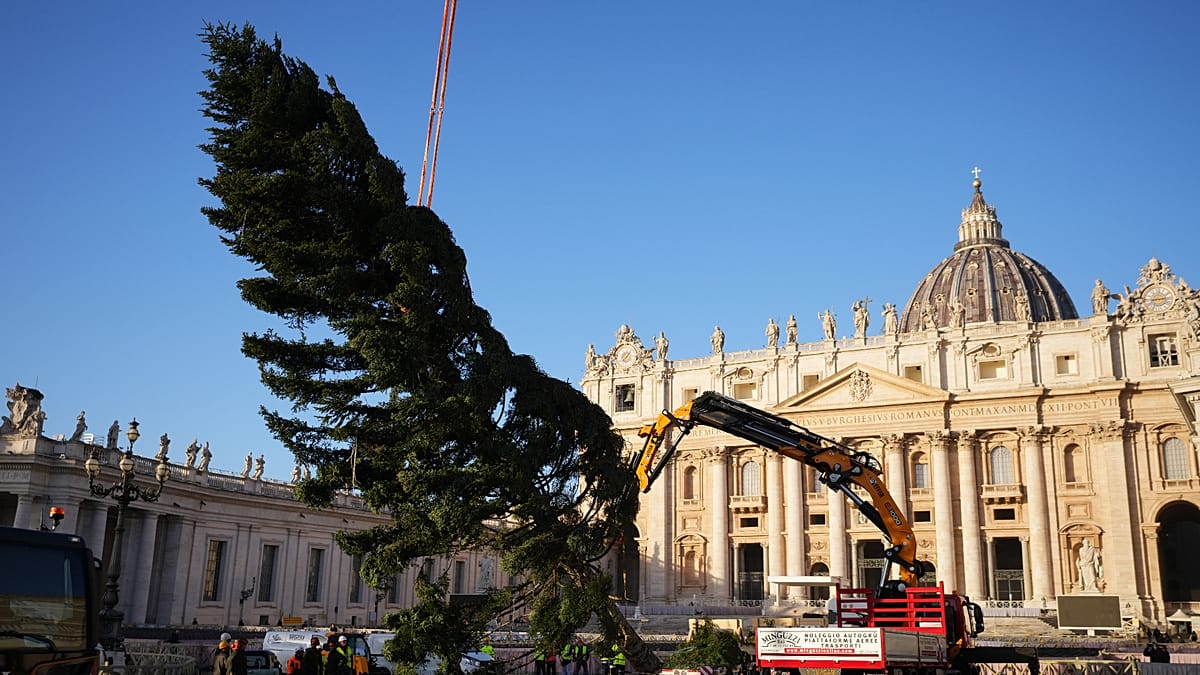
Workers in Vatican City hoisted a 25-metre silver fir into an upright position in St Peter's Square on Friday 20 November, marking the start of the annual Christmas setup at the heart of the Catholic Church. The tree, which arrived on a low-loader truck, was carefully lifted by crane and secured beside the basilica's imposing facade, drawing a small crowd of onlookers and pilgrims.
The towering specimen was donated by a community in southern Italy, a tradition that has seen different regions of the country supply the Vatican's Christmas centrepiece in recent years. The tree will remain covered until its official unveiling on 7 December, when it will be illuminated alongside the nativity scene, a moment that typically attracts thousands of visitors to Rome.
A tradition with deep roots
The Vatican's Christmas tree has been a fixture of the square since 1982, when Pope John Paul II initiated the custom. Each year, a different European region or country provides the tree, often as a gesture of goodwill and faith. This year's donation from southern Italy continues that pattern, with local officials describing it as a symbol of unity and hope.
The tree, a silver fir known for its dense, dark-green needles, was selected from a forest in the Calabrian Apennines. Local foresters oversaw its felling and transport, a journey of more than 800 kilometres to the Vatican. The community that donated it has expressed pride in seeing a piece of their homeland become part of the global Christmas celebration.
Preparations for the festive season extend beyond the square. The Vatican's nativity scene, which this year features life-size figures, is being assembled by a team of artisans and volunteers. The scene, along with the tree, will be formally inaugurated during a ceremony on 7 December, the eve of the Feast of the Immaculate Conception.
For many Europeans, the Vatican's Christmas display is a highlight of the holiday season, drawing visitors from across the continent and beyond. Rome's hotels and restaurants typically see a surge in bookings around the unveiling, as tourists combine a visit to the square with the city's other seasonal attractions.
The tree's placement comes as Europe's Christmas markets begin to open, with Strasbourg's renowned market topping accessibility rankings this year. While the Vatican's display is more about religious symbolism than commerce, it contributes to the broader festive atmosphere that sweeps through the continent each December.
Security in St Peter's Square has been heightened in recent years, and the tree installation was carried out under the watch of Vatican gendarmes. The square remains open to the public throughout the setup, though some areas are cordoned off during the lifting operation.
The Vatican has not disclosed the cost of this year's tree, but such donations typically cover the expenses of transport and installation. The tree will remain in place until mid-January, when it is removed after the Epiphany.
For those unable to travel to Rome, the Vatican's Christmas Eve Mass and the Pope's Urbi et Orbi blessing on Christmas Day are broadcast worldwide. The tree, once lit, will serve as a backdrop for these ceremonies, a familiar image for millions of viewers.
As the sun set over the square on Friday, the tree stood silhouetted against the basilica, a quiet herald of the season. For the community in southern Italy that donated it, the sight is a reminder of their connection to the wider Church and to Europe's shared cultural heritage.