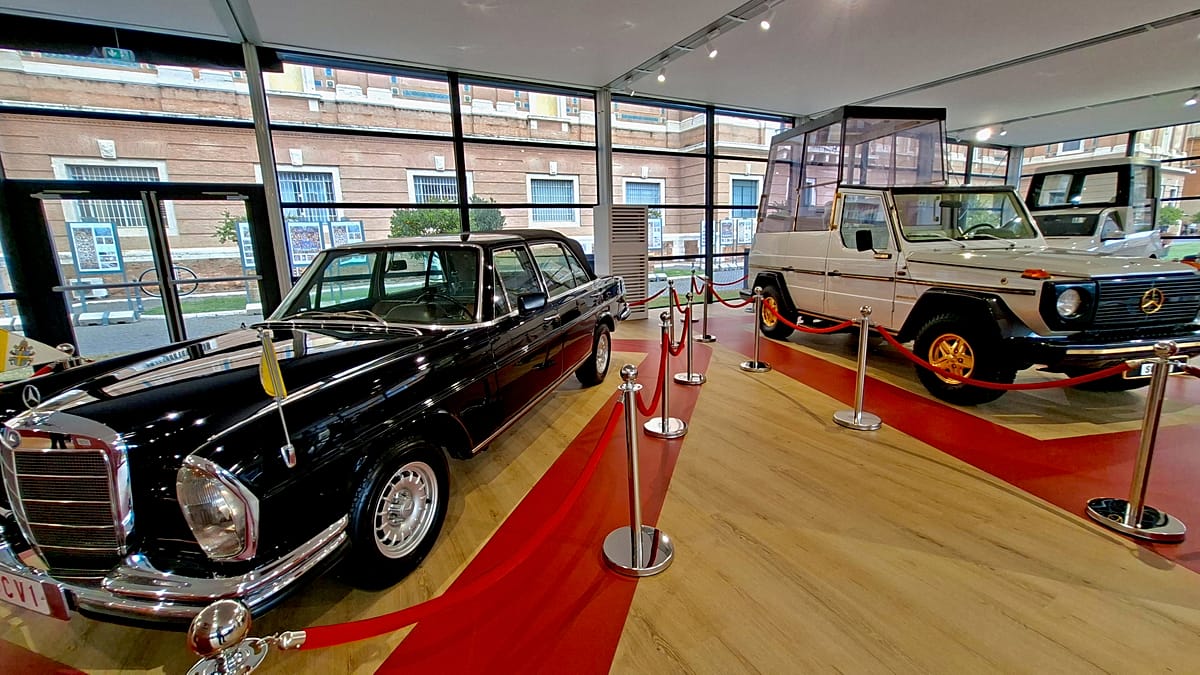
For much of the twentieth century, the pope's car was more than a means of transport: it was a mobile throne, a stage, and eventually a protective bubble. A new exhibition at the Vatican Museums, A Century of Popemobiles, brings together eight historic Mercedes-Benz vehicles to show how papal mobility has evolved since 1930, alongside a replica of the 1886 Benz Patent-Motorwagen and a current S-Class.
Curator Sandro Barbagallo, who oversees the Vatican's historical collections, stresses that the cars were never merely about moving the pontiff within Vatican City. "The message is very simple: papal mobility exists so that the pope can draw close to everyone, all over the world," he told reporters. The exhibition, he adds, reveals how each pope left his mark on the vehicle that carried him into the crowds.
From Pius XI's travelling salon to John XXIII's open windows
The story begins in 1930, when Mercedes-Benz donated a Nürburg 460 limousine to Pius XI. Achille Ratti, a former mountaineer and scholar, embraced the car as a way to leave the Vatican after decades of papal isolation following the end of the Papal States in 1870. The interior was fitted with a single silk-brocade seat, fine woods, and a decorated ceiling—a travelling sitting room designed to project prestige. It even included a panel of buttons labelled "Forward", "Slow", "Right", and "Return to the Vatican", letting the pope direct his chauffeur without a word.
John XXIII, the "good Pope" known for his informal warmth, opened the church to the world during the Second Vatican Council. In 1960, he received a Mercedes 300 d Landaulet with rear windows that could be completely removed, allowing him to greet crowds directly. The car also featured an electrically adjustable central seat, climate controls, and automatic steps—practical touches that made public appearances easier.
Paul VI and the birth of the modern Popemobile
Paul VI was the first pope to travel by plane, making apostolic journeys to the Holy Land, India, and beyond. His 1965 Mercedes 600 Pullman Landaulet had a rear roof that opened so he could stand and bless pilgrims. But the true precursor to today's Popemobile came in 1967, when a Mercedes 300 SEL Pullman was adapted for use in St. Peter's Square. As Barbagallo explains, until then popes had entered the Paul VI Audience Hall on the sedia gestatoria, a portable throne. The new vehicle allowed the pope to cross the square and be seen by all—a decisive shift toward direct contact.
The exhibition also highlights the safety imperative that reshaped papal cars after the 1981 assassination attempt on John Paul II. His Popemobile featured a bulletproof glass enclosure, yet he often asked to be driven in an open vehicle to stay close to the faithful. A barber's chair was even adapted as his seat, allowing him to turn and greet people on all sides.
Mercedes-Benz's long partnership with the Vatican is part of a broader industrial story. The company, which has frozen investment in German plants and weighed closures, remains a symbol of German engineering. The exhibition, which runs until early 2026, is a reminder of how a European manufacturer shaped the public image of the papacy.
For visitors, the show offers a rare glimpse of vehicles that have witnessed history—from Pius XI's silk-lined limousine to the armoured cars of the modern era. It also underscores a paradox: the more the popes sought to be seen, the more they needed protection. As Barbagallo puts it, "The way they have developed has constantly highlighted, on the one hand, the desire for closeness, and on the other, the need for security."
The exhibition is part of a broader cultural moment for the Vatican, which has recently hosted Bob Dylan's audience with Pope Leo XIV and seen the pontiff cast a mail-in ballot in the US midterms. It also coincides with a strong year for European museums, which continue to draw global audiences.