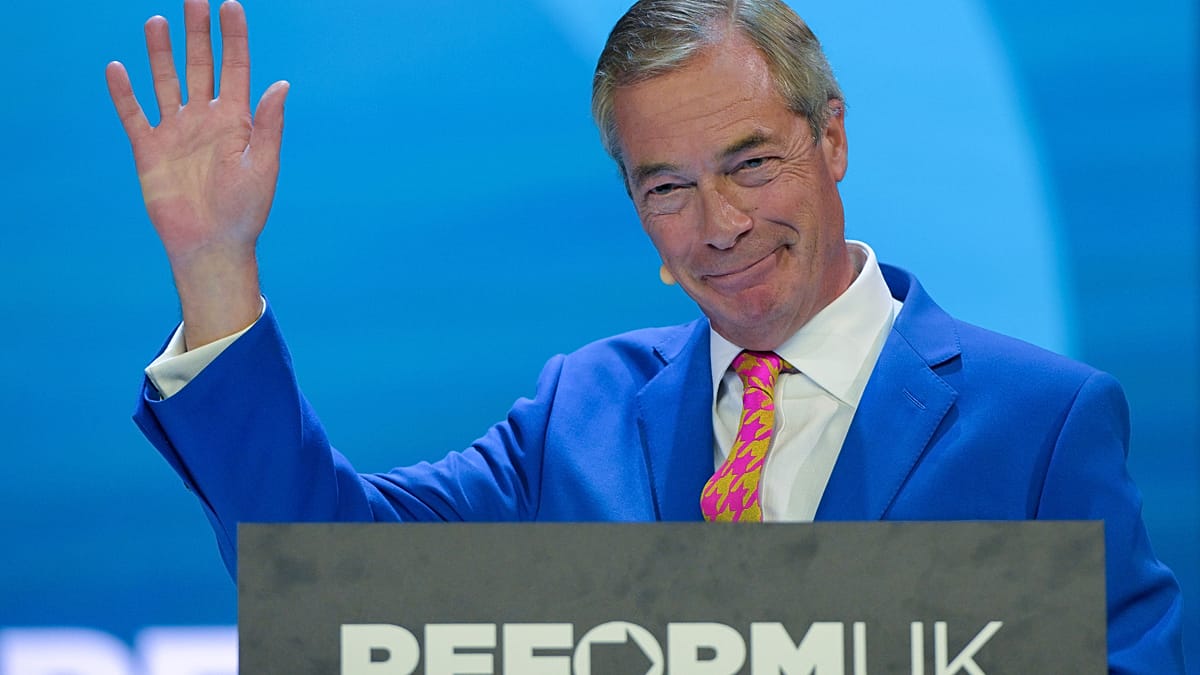
As British Prime Minister Andy Burnham arrived in Brussels for his first EU summit since taking office in July, the familiar sound of Nigel Farage's ire filled the air. The Reform UK leader, who campaigned for Brexit for decades, told Euronews' Europe Today that he was "pretty angry" at having to fight the Brexit battle all over again.
"What is happening this morning in Brussels is Andy Burnham is bringing us back into the single market in the areas of foodstuffs and farming," Farage said. He argued that Britain would have to accept EU regulations without having a vote on them, describing the move as a betrayal of Labour's promise not to rejoin the single market.
Burnham's government has sought to rebuild ties with the EU after years of strained relations under Conservative rule. Friday's summit is expected to seal agreements on trade, security, and regulatory cooperation, marking a significant step in the so-called "reset" of EU-UK relations.
Farage's defence of Brexit falters
Farage struggled to offer a convincing rebuttal to Burnham's argument that Brexit had damaged Britain's economy and international standing. He claimed Britain's global influence had actually increased since leaving the EU, citing its support for Ukraine and the AUKUS nuclear submarine agreement with Australia. "There's no question we stand taller," he insisted.
On the economic damage, however, Farage argued that the Covid pandemic made it difficult to assess Brexit's impact. He claimed Britain had prospered in sectors such as artificial intelligence and financial services, while dismissing the EU single market as a "failing, backward model".
Farage was more candid about immigration, acknowledging that Brexit had failed to deliver one of its central promises. "It was the biggest," he said when asked whether the failure to control immigration was Brexit's greatest disappointment. He blamed successive Conservative governments for allowing record immigration despite regaining control of Britain's borders.
Farage also acknowledged that many Britons felt Brexit had failed to deliver, but insisted this did not mean they wanted to reverse it. He warned that reopening the question of EU membership would divide the country and demanded another referendum if Burnham sought to rejoin. "If Labour, if Burnham, fights the next election on a ticket of rejoining the EU, he'd have to have a referendum," Farage said.
EU welcomes Britain's return
German Socialist MEP Tobias Cremer offered a sharply different assessment, telling Europe Today that Brexit had imposed enormous economic costs on Britain and that a majority of voters now favoured rejoining. "£260 billion a year, £10,000 per household," he said. "And immigration as well. Yes, EU immigration went down by 100,000 or 150,000, but overall non-EU immigration has gone up by three million since then."
Cremer said the geopolitical landscape had transformed since 2016, citing Russia's war in Ukraine, China's growing assertiveness and an increasingly unpredictable United States. "It's in both the British and European interest to stick together," he said, arguing that closer cooperation on security, defence and trade would benefit both sides.
The summit comes at a time when EU-UK relations are seeking a reset, with both sides eager to move beyond the acrimony of the Brexit years. For Burnham, the challenge is to deliver tangible benefits for British voters while navigating the political minefield that Brexit remains. For Farage, the fight is far from over.