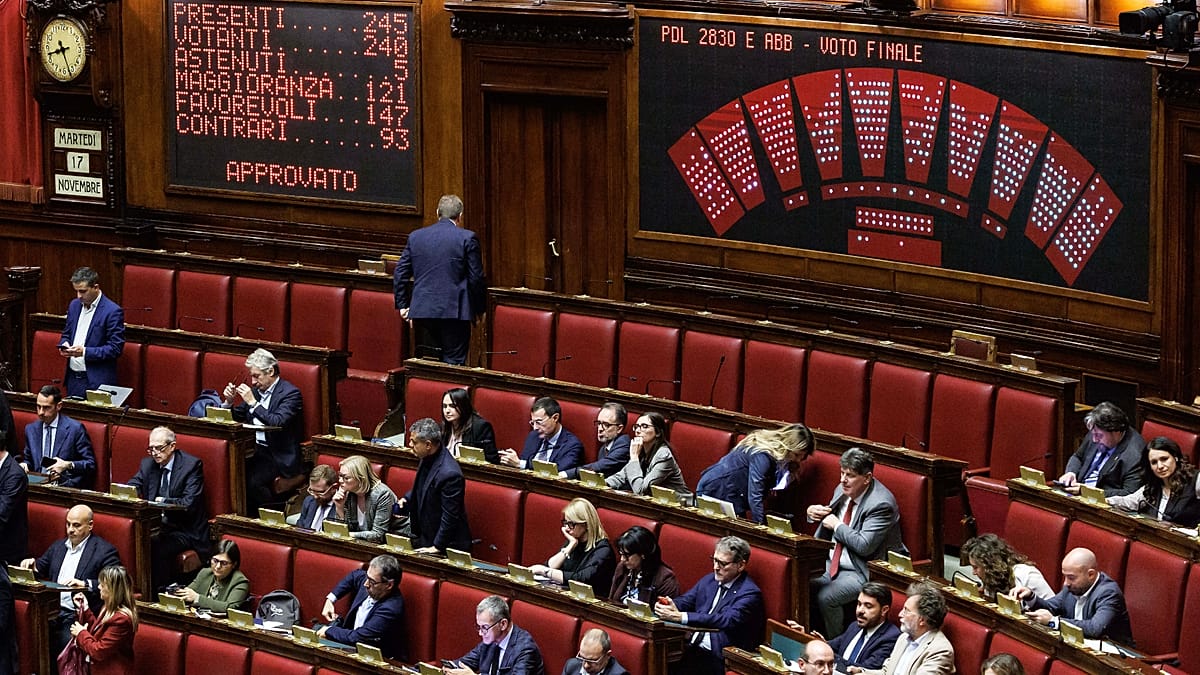
Italy's lower house has given final approval to a sweeping education decree that introduces a ban on face coverings in schools and limits the share of foreign-born students in first-year classes to 30%. The vote, held on Thursday, saw 142 lawmakers in favour, 112 against and four abstentions, following the Senate's green light on 20 November.
The measure, known as Decreto Scuola, was passed as a decree-law under the government's confidence procedure, a mechanism that allows the executive to fast-track legislation. It is part of a broader package aimed at ensuring a smooth start to the 2026/2027 school year and implementing reforms tied to Italy's post-pandemic recovery fund.
The 30% cap will not apply to students who already demonstrate adequate proficiency in Italian, a provision that critics argue creates a two-tier system. The face-covering ban effectively prevents Muslim girls from wearing burqas or niqabs in classrooms, a move that has drawn sharp rebukes from opposition parties and civil liberties groups.
Opposition decries discrimination
During the final vote, opposition MPs held up signs reading “At school nobody is a foreigner” — a slogan that captured the mood of the debate. Antonio Caso, a deputy from the Five Star Movement (M5S), accused the government of missing the real problems facing Italian schools. “The problem is not how many foreign children there are in a class, but how many teachers and what tools we provide to guarantee everyone the right to learn. Everything else is discrimination and racism,” he said.
Caso also invoked the memory of Alessandro Ingusci, a student who died while advocating for the right to study and housing. “This should be the real urgency for a government that issues decrees to address emergencies in schools. Yet this decree does not tackle any of the real urgent issues: not the safety of school buildings, not the low salaries of teachers, not the right to study,” he added.
Irene Manzi, the Democratic Party's national head for schools, condemned the measures as dehumanising. “A decree that divides girls and boys within classes and moves them from one school to another if the 30 per cent limit is exceeded, ignoring their stories, the contexts in which they live, the environment in which they grow up. It treats them like parcels,” she said. She also criticised provisions that impose sanctions on parents and require educational institutions to report families, saying this “breaks that climate of trust on which the educational community should be based.”
“What has been approved is a decree without vision,” Manzi concluded.
The governing majority, however, expressed satisfaction. Education Minister Giuseppe Valditara said the vote demonstrated “a significant show of unity of the majority around our government and its reforming action.”
Digital textbooks split the coalition
While the foreign-pupil cap dominated headlines, the most contentious issue within the ruling coalition was a provision on digital textbooks. The decree requires publishers of school and university textbooks to offer digital versions at 50% of the price of the printed edition, a measure intended to ease the financial burden on families.
The Italian Publishers Association (AIE) strongly opposed the move. President Innocenzo Cipolletta argued that it “does not bring real economic benefits to families and students” but instead shifts the cost of public policy onto publishers. He warned that the measure “interferes with copyright, opens the door to piracy, alters the economic value of the work, puts at risk the sustainability and jobs of companies and ultimately undermines the cultural value of books in the educational path.”
Within the centre-right coalition, Forza Italia opposed the e-book provision, while Brothers of Italy (Fratelli d'Italia) supported it. The majority eventually closed ranks for the final vote. Rosaria Tassinari, Forza Italia's group leader on the Culture Committee, welcomed the outcome, saying the debate had led to “a point of balance between the different sensitivities that emerged.”
The decree also introduces changes to teacher recruitment, including permanent appointments, and modifies specialisation pathways for support teachers. These elements were less controversial but are part of the government's broader effort to reform the education system.
The law now takes effect, but its implementation is likely to face legal challenges and continued political opposition. Critics argue that the measures will stigmatise foreign students and undermine the inclusive ethos of Italian schools, while supporters insist they are necessary to ensure integration and security.



