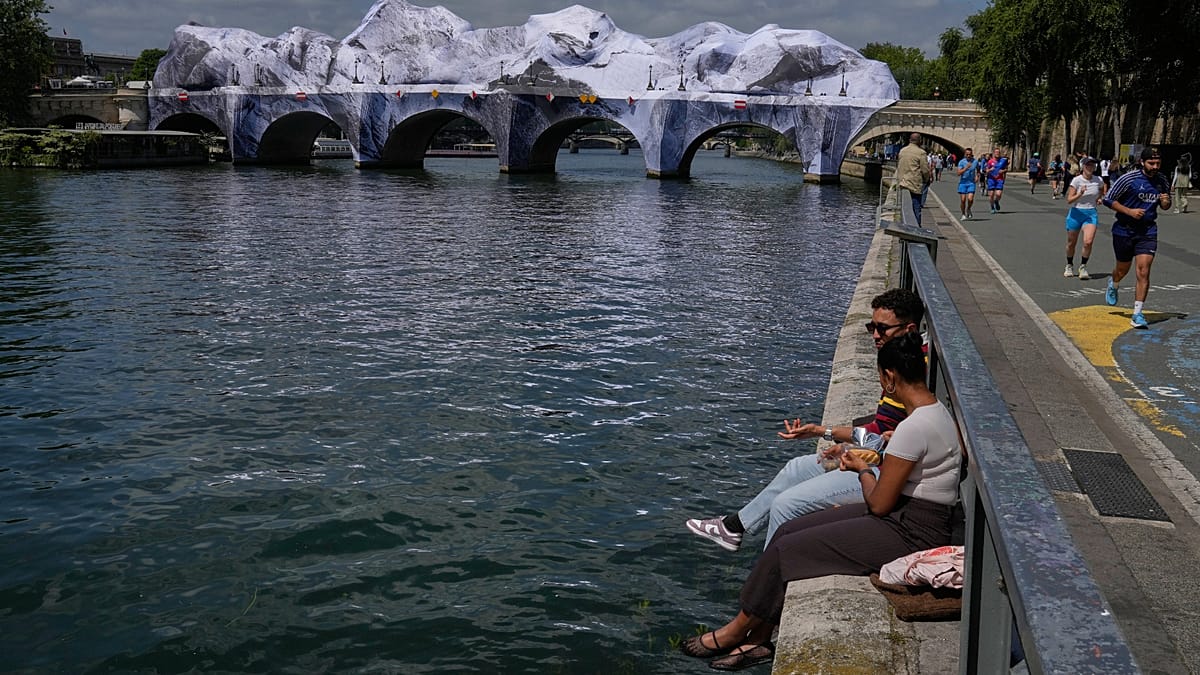
Paris's oldest bridge, the Pont Neuf, has been transformed into a giant cave by French artist JR, drawing thousands of visitors daily. The immersive installation, which opened in late September, is accessible around the clock, allowing crowds to explore the surreal space at any hour.
The project, titled "The Cave of the Pont Neuf," uses large-scale photographic prints and sculptural elements to create the illusion of a natural cavern beneath the bridge's arches. Visitors walk through a labyrinthine passage that evokes the textures and shadows of a real cave, complete with stalactite-like forms and dim lighting. The installation is JR's most ambitious public artwork to date, covering the entire span of the bridge, which connects the Île de la Cité to both banks of the Seine.
A New Chapter in Parisian Public Art
JR, known for his large-scale photographic interventions in public spaces, has previously pasted portraits on buildings in the Parisian banlieues and created a giant eye on the Louvre's pyramid. His work often challenges perceptions of scale and reality, and the Pont Neuf installation is no exception. "I wanted to create a space where people could feel like they were entering another world, right in the middle of the city," JR said in a statement. "The Pont Neuf is a symbol of Paris, but I wanted to make it feel ancient and mysterious."
The installation has become a major attraction, with queues snaking along the riverbanks. Visitors have praised the experience for its immersive quality and the way it recontextualizes a familiar landmark. "It's like walking into a dream," said Marie Dupont, a Parisian who visited on opening day. "You forget you're on a bridge. It feels like you're underground."
The project is part of a broader trend of large-scale public art installations in European cities, from Olafur Eliasson's interventions in Copenhagen to Ai Weiwei's works in Berlin. Paris, in particular, has seen a surge in such projects, with the city's mayor, Anne Hidalgo, promoting art as a tool for urban renewal and tourism. The Pont Neuf installation is expected to draw over a million visitors before it closes in early November.
However, the installation has also sparked debate about the commercialization of public space. Some critics argue that such projects, often funded by luxury brands or corporate sponsors, risk turning public landmarks into advertising platforms. JR's project is supported by the luxury goods conglomerate LVMH, which has funded similar installations in Paris, including a floating bookshop beneath Notre-Dame. That project, which opened earlier this year, combined DJ sets with a no-return policy, drawing both praise and criticism.
Despite the controversy, the installation has been widely celebrated for its artistic ambition and accessibility. Unlike many museum exhibitions, it is free to enter and open 24 hours a day, making it available to a broad audience. "Art should be for everyone, not just those who can afford a ticket to a gallery," JR said. "The Pont Neuf belongs to the people of Paris, and I wanted to give it back to them in a new way."
The installation also highlights the role of public art in shaping urban identity. As European cities compete for tourism and cultural capital, projects like JR's offer a way to stand out. Paris, already a global cultural hub, has used such installations to reinforce its image as a city of innovation and creativity. The Pont Neuf cave is the latest in a series of high-profile art projects in the city, following the VivaTech conference and the opening of the Canal Saint-Martin for swimming.
For now, the queues continue, and the cave remains a temporary wonder. Visitors are advised to come early or late to avoid the longest waits. The installation will be dismantled in November, after which the Pont Neuf will return to its original state. But for a few weeks, Paris's oldest bridge has become a portal to another world.