Jiaozi, shuijiao, bao, wonton, mantou, manty, manta, chuchvara, pelmeni, düşbərə, gürzə, khinkali. The names are as varied as the fillings, but they all share a common ancestor: the humble dumpling. This simple concept—dough wrapped around a savoury filling—travelled the ancient trade routes from China to the Iberian Peninsula, adapting to local tastes and techniques along the way.
Parallel to the Silk Road story runs what might be called the “Dumpling Belt”, a culinary corridor where these parcels changed shape, name, and cooking method as they moved westwards. From the steaming baskets of Xi'an to the bustling kitchens of Baku and the hearty tables of Tashkent, the dumpling became a canvas for regional identity.
A Chinese legend with a medical twist
According to Chinese tradition, the dumpling's origin story begins with the legendary physician Zhang Zhongjing. During a bitter winter nearly two millennia ago, he folded dough around mutton, herbs, and warming spices to treat villagers suffering from frostbitten ears, shaping the parcels to resemble the ears themselves. Archaeological finds in Xinjiang's Turfan region—dumplings preserved for over a thousand years—and early writings such as the 3rd-century poem by scholar Shu Xi describing mantou suggest that these bundles have long been part medicine, part sustenance, and wholly enduring companions of travellers across Eurasia.
The shapeshifter: from China to the Caucasus
As dumplings travelled west with merchants, nomads, and caravans, they adapted to new landscapes and tastes. In Central Asia, they became larger and heartier, such as manty and manti, filled generously with lamb and onion and cooked over clouds of steam. In Uzbekistan, delicate chuchvara and robust manti emerged; in Kazakhstan, manti settled as a staple; and in the South Caucasus, the finely crafted Azerbaijani düşbərə and gürzə were born.
Each variation reflected the ingredients, techniques, and traditions of its home. The dumpling proved to be a culinary traveller, reshaped by every culture it encountered along the Dumpling Belt.
Azerbaijan: precision in miniature
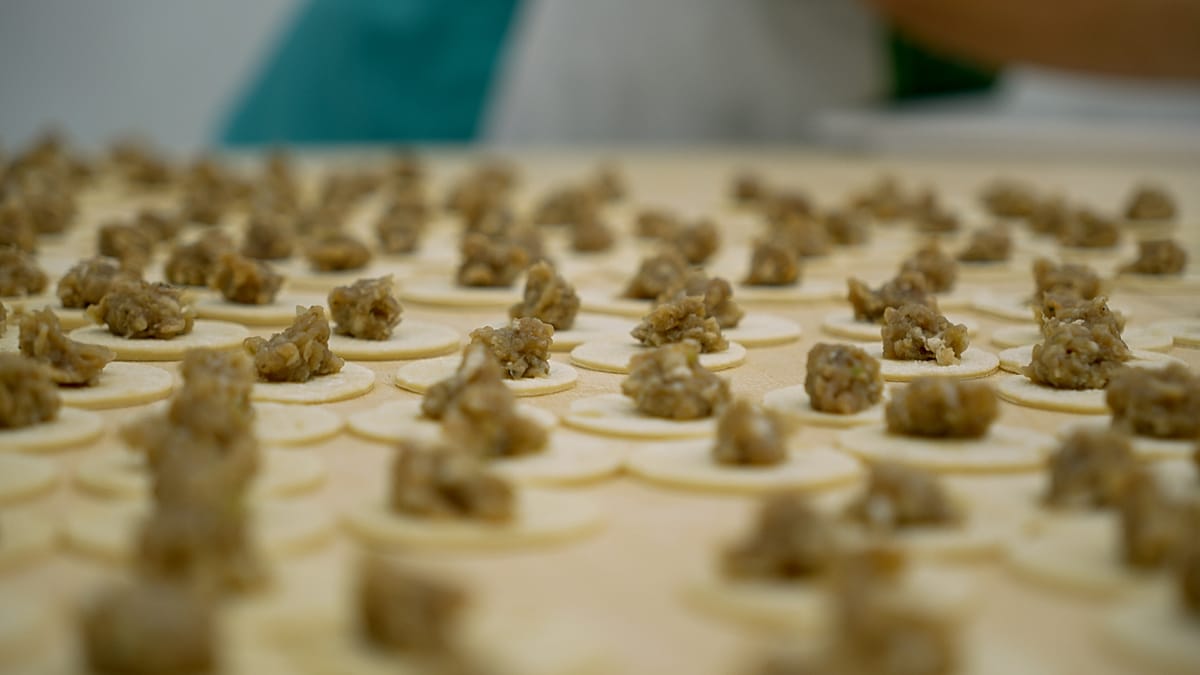
In Azerbaijan, dumplings take on two particularly distinctive forms: düşbərə and gürzə. At first glance they may seem modest, but both are celebrated for the precision and care they demand. Düşbərə are famously tiny—delicate parcels of dough filled with minced lamb and served in a fragrant broth—so small that tradition says dozens should fit onto a single spoon. Gürzə, by contrast, is slightly larger and hand-pinched along the top in a braided fold said to resemble a snake, their name echoing the local word for a viper.
Both dishes rely on simple ingredients—fine dough, seasoned meat, herbs, and broth—but their true character lies in the technique and patience required to shape them, skills often passed from generation to generation in Azerbaijani kitchens. Today, chefs continue to honour these traditions while adding their own interpretations, keeping these beloved dumplings at the heart of the country’s culinary identity.
Chef Ilkin Akbarzadeh, President of the Baku Culinary Association and a social media influencer with over 60,000 followers on Instagram, explains why dumplings are an intrinsic part of Azerbaijani heritage. “Dumpling, this is part of our traditional cuisine, the heritage cuisine in Azerbaijan.” He adds, “I think probably, many of these dumplings are coming from Asia, from China, and after some kind of transformers for every culture, every people, and all regions.”
Akbarzadeh notes that all types are made with flour: “I mean the dushbarar, kingels and the gurza, and different types of this type of food was cooked from the dough and stuffed with meat.” He says consumption peaks in colder months: “Usually in our culture, people eat it in winter time. For energy, for the health, for cold weather, you're heating the whole body, and that usually representing this food in the winter, in our culture.”
There are many versions of meat or vegetables wrapped in dough in Azerbaijan, including dushbara, kutabs, and gurza. The renowned chef says that the way to eat dushbara, which is served in a broth, is “in the one spoon, 13 on the 15 pieces of the small dushbaras.” Gurza dumplings, he says, are traditionally served with a sprinkling of sumac and/or a yogurt-mint-garlic sauce.
Uzbekistan: the home of manti
Across Central Asia, dumplings take on heartier forms shaped by nomadic traditions and the region’s love of communal cooking. In Uzbekistan, one of the most iconic is manti—large, steamed dumplings whose recipes are carefully passed down through generations. They are often filled with a mixture of lamb, beef, and finely chopped onion, with the balance of ingredients being absolutely key.
Local resident Yulduz Rakhmonova explains: “I learned how to make manti from my grandmother, who patiently taught us, her grandchildren, the craft of Uzbek cuisine. For the filling, we would mix lamb with beef and use an equal amount of onion to the meat, which would form a broth that gives manti its distinctive flavour.” She adds that the choice of meat is crucial, insisting that only fresh, high-quality ingredients should be used.
For many families, the techniques of preparing manti are inherited alongside the recipe itself. Ezoza Irmatova recalls learning from her mother-in-law: “The dough for manti must be very thin, yet strong. For this, you should use premium-quality wheat and room-temperature water. If you do everything correctly, even elderly people will enjoy the dish.” The careful folding of each dumpling is considered an art, with cooks striving for uniform shapes that are as aesthetically pleasing to the eye as they are to the palate.
Manti is commonly prepared in large quantities, reflecting the region’s tradition of hospitality and communal feasting. Whether served with a dollop of sour cream or a drizzle of vinegar, these dumplings are a testament to the enduring appeal of a simple idea that travelled thousands of kilometres and found a home in every culture it touched.